Hospital Management Software in the UAE (2026): DHA, DoH and MOHAP Requirements
Published
A hospital group opens its second facility, a day-surgery centre forty minutes down the road from its hospital in Dubai. The software is the same, the surgeons rotate between both sites, and many of the patients are the same people. The paperwork is not. The Dubai hospital sends its clinical records to NABIDH and its claims through eClaimLink. The new centre, across the emirate line in Abu Dhabi, answers to a different regulator, a different health information exchange and a different claims platform. The system that was sold as "UAE-ready" turns out to have been Dubai-ready.
That is the first thing to understand about hospital management software in the UAE: there is no single UAE requirement. Federal law applies everywhere, and then the emirate decides most of what the software actually has to do. This guide is for owners, CEOs, medical directors and finance heads of private hospitals, day-surgery centres and polyclinic groups comparing systems in 2026.
Who regulates hospitals and their software in the UAE?
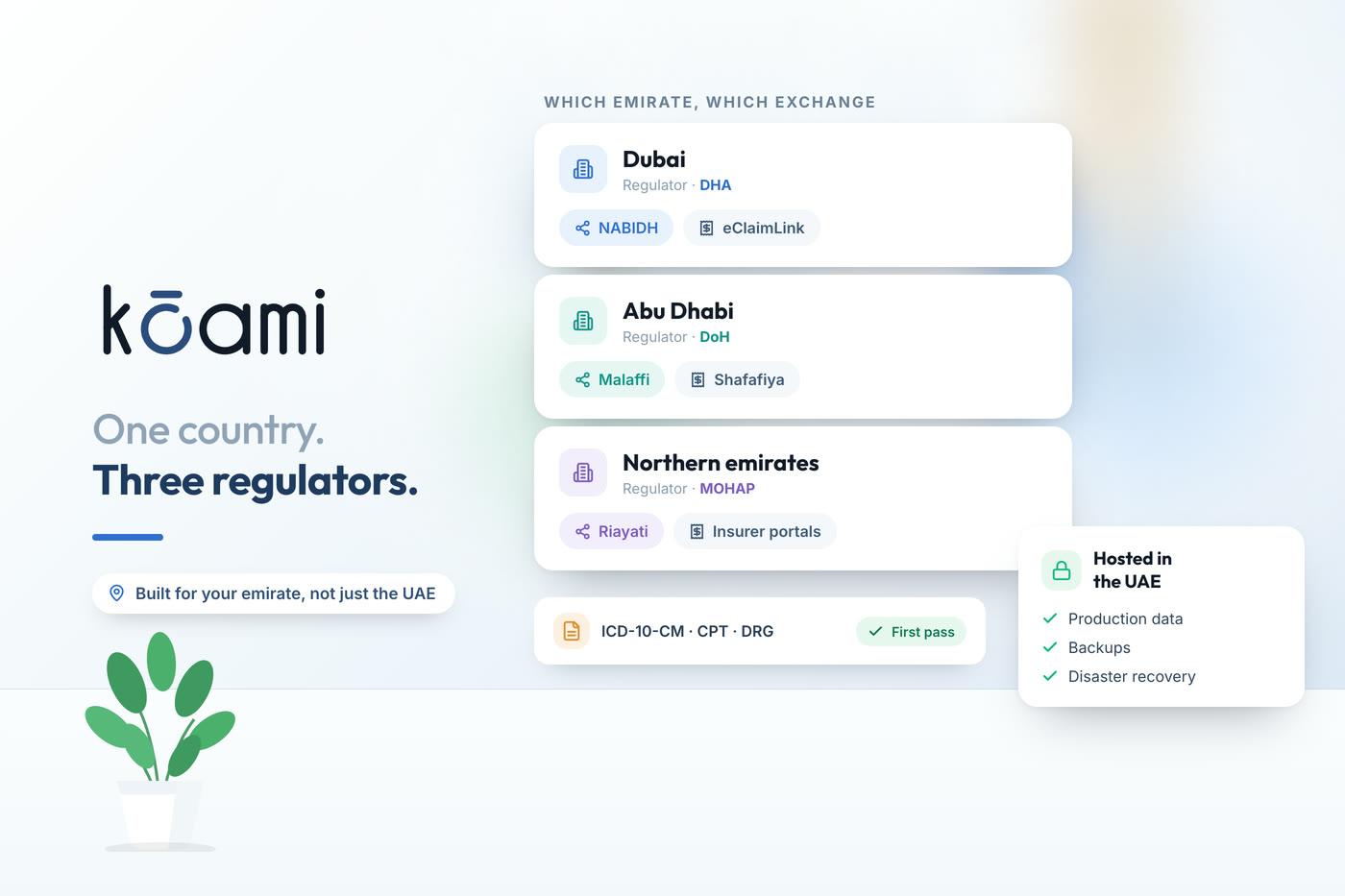
Three health authorities, depending on the emirate: the Dubai Health Authority (DHA) in Dubai, the Department of Health (DoH) in Abu Dhabi, and the Ministry of Health and Prevention (MOHAP) for private facilities in the northern emirates. Federal law sits above all three.
Each authority sets its own facility licensing standards, its own rules for connecting to a health information exchange and its own claims process. A vendor that has gone live in one emirate has not necessarily gone live in the others. So the first question in any UAE evaluation is not "do you work in the UAE?" It is "which emirate, which exchange, which claims platform — and which live facility can I call?"
What are NABIDH, Malaffi and Riayati?
They are the UAE's health information exchanges, the platforms that let a patient's record follow them between providers. NABIDH serves Dubai, Malaffi serves Abu Dhabi, and Riayati is the national unified medical record used across MOHAP and Emirates Health Services facilities.
For a licensed private facility, the exchange is not background infrastructure. Facilities are expected to connect and to send a defined set of clinical events — registrations, encounters, diagnoses, results, prescriptions, discharge summaries — in the HL7-based formats each exchange specifies. That has two consequences for the software you buy:
- The record has to be structured. An exchange can only accept a diagnosis it can read. A clinical note typed into a free-text box is a document, not data, and it cannot be sent as a coded diagnosis however good the interface is.
- Every exchange is its own project. NABIDH and Malaffi have separate onboarding, testing and conformance steps. Ask which exchanges the vendor has taken to production, at which facilities, and how long each took — not which ones are on a roadmap.
If the difference between a structured record and a text box is new to you, our guide to hospital EMR software sets out what to test.
How do insurance claims work for UAE hospitals?
Electronically, through the emirate's claims platform: eClaimLink in Dubai and Shafafiya in Abu Dhabi. Eligibility checks, prior authorisation, claim submission and remittance all run through these platforms rather than by email or courier.
Health insurance is compulsory for residents in Dubai and Abu Dhabi, and from 1 January 2025 basic cover became mandatory for private-sector employees and domestic workers in the other emirates too. In practice that means almost every patient is an insured patient, and the claims module is the revenue module. It has to:
- Check eligibility at registration, against the payer, the plan and the network the patient belongs to.
- Raise prior authorisation requests with the clinical justification the payer expects, and track each response to the encounter it belongs to.
- Code correctly the first time. UAE claims use ICD-10-CM for diagnoses and CPT for procedures, with DRG grouping for inpatient episodes where the payer settles on DRG.
- Apply each payer's price list, including network tiers, co-payments and deductibles, without a clerk working them out.
- Submit in the platform's format, then reconcile remittance advice line by line against what was billed.
- Manage rejections and resubmissions with reason codes, so the denial rate is a number somebody owns rather than a surprise at month end.
In an insured market a coding error is not a typo. It is a rejected claim, a resubmission window and a cash-flow gap the finance team then has to explain.
The structure of the work is the same one Indian hospitals know from TPA billing, which is why our guides to pre-authorisation and first-pass claim rates translate well. The codes, platforms and deadlines differ; the discipline does not.
Does patient data have to stay in the UAE?
Generally, yes. Federal Law No. 2 of 2019 on the use of information and communication technology in health fields provides that health data relating to services delivered in the UAE may not be stored, processed or transferred outside the country, except in cases approved by the health authorities in coordination with the Ministry.
Ministerial Resolution No. 51 of 2021 sets out the exceptions — certain cases involving treatment abroad, insurance, research and telemedicine among them — and each still needs to fit the resolution and be documented. The same law sets long retention periods for health records, measured in decades rather than years. For a software purchase that translates into four practical requirements:
- Hosting in the country. Production data, backups and disaster-recovery copies on UAE soil, whether in an in-country cloud region or on premises.
- Controlled support access. A vendor's support team logging in from abroad is access to the data. Agree in the contract how support is delivered and from where.
- Retention without decay. Records kept, readable and retrievable for the full period, including after you change systems — which is why data migration belongs in the evaluation, not after it.
- Emirate security standards. Abu Dhabi facilities also work to ADHICS, DoH's healthcare information and cyber security standard, which reaches access control, logging and incident response.
Our articles on where patient data lives and cloud versus on-premise cover the hosting decision in more depth. This section is a summary for buyers, not legal advice; confirm the position for your facility with your health authority and your counsel.
Does hospital software in the UAE need to work in Arabic?
For patient-facing documents, expect to need it. Many UAE patients, and some authorities' templates, expect Arabic alongside English on consent forms, invoices, discharge summaries, prescriptions and patient messages.
Bilingual output is harder than it looks. Arabic runs right to left, names have to be held in both scripts without one overwriting the other, and a discharge summary that mixes the two must still print cleanly. Test it with your own documents in the demo: print an invoice and a consent form in both languages, and search for a patient by their Arabic name.
What do VAT and e-invoicing mean for hospital billing in the UAE?
VAT is charged at 5%, with preventive and basic healthcare services generally zero-rated and other services, such as cosmetic procedures, standard-rated. The billing engine therefore has to apply the right treatment to each service line, not one rate to the whole invoice.
E-invoicing adds a second obligation. The UAE's electronic invoicing system entered its pilot on 1 July 2026. Businesses with annual revenue of AED 50 million or more must appoint an accredited service provider by 30 October 2026 and issue e-invoices from 1 January 2027; other businesses follow with an appointment deadline of 31 March 2027 and go-live on 1 July 2027. Hospital groups and pharmaceutical distributors are commonly above the first threshold.
Two points are easy to miss. A claim submitted through eClaimLink or Shafafiya is not a tax invoice, so being compliant on claims does not make a hospital compliant on e-invoicing. And smaller facilities feel the change early regardless of their own deadline, because their larger suppliers start sending them e-invoices in January 2027. Confirm the tax treatment of your services with your tax adviser.
Which modules does a UAE hospital need?
The same core as any hospital, plus the pieces the UAE's regulators and payers make non-negotiable.
- Registration with Emirates ID capture, insurance card details and an eligibility check before the consultation, not after it.
- OPD and EMR with coded diagnoses, structured orders and e-prescriptions, because the exchange and the payer both read the record.
- Inpatient care, beds and the operation theatre, with charges captured as care happens — see capturing charges as care happens.
- Pharmacy with batch and expiry control and a register for controlled medicines.
- Laboratory and radiology, with results flowing back to the chart and out to the exchange.
- Insurance, claims and billing on one tariff engine, with VAT applied per line.
- Health information exchange connectivity for your emirate.
- Workforce and credentialing, because every doctor, nurse and allied professional holds a health-authority licence with an expiry date — the problem our article on credential expiry describes.
- Inventory and purchasing across stores and, for groups, across emirates.
Our complete module list explains what each module does and which ones a smaller facility can phase in later.
How much does hospital management software cost in the UAE?
It depends far more on how the price is built than on the headline figure. Most vendors quote a subscription per bed, per user, per module or per facility, then add implementation, interfaces and support.
In the UAE, three lines matter more than they do elsewhere and are the ones most often left out of a quotation:
- Exchange and claims-platform interfaces, priced per emirate and sometimes per facility, plus the testing effort each requires.
- In-country hosting, including backups and disaster recovery in the UAE, which rules out the cheapest offshore hosting some vendors build their price on.
- Arabic configuration of documents, templates and patient messages.
Add up five years of everything, at your current size and at the size you plan to be, before comparing two quotes. The worksheet in our guide to affordable hospital management software was written for India but the method transfers line for line.
What is the cheapest hospital management software in the UAE?
The cheapest system to buy is usually a clinic-grade product or a generic ERP with healthcare screens, and for a single small clinic that can be enough. The cheapest system to run is a different one: the system that gets claims paid the first time, keeps you connected to the exchange without a custom project every year, and does not need a second product for the pharmacy or the laboratory.
In an insured market the arithmetic is unforgiving. A few points of avoidable claim rejection on a mid-size hospital's revenue outweigh the difference between a cheap licence and a complete suite within the first year. So ask "what will this cost over five years with every module and interface we need, and what will it do to our rejection rate?" — not "what is the monthly fee?"
What should you ask a hospital software vendor in a UAE demo?
Ten questions, in writing, before the demo rather than after it.
- Which emirates are you live in, and with which exchange: NABIDH, Malaffi or Riayati?
- Which claims platforms do you submit to in production today, and at which facilities?
- Can we speak to a live customer in our emirate?
- Where exactly will our production data, backups and disaster-recovery copies be hosted?
- From which country will your support team access our system?
- Which coding sets do you hold, and how are they kept current?
- Show an eligibility check, a prior authorisation, a submitted claim and a remittance reconciliation, end to end.
- Print an invoice, a consent form and a discharge summary in Arabic and English.
- How will you support our e-invoicing obligation, and through which accredited provider?
- What does it cost to export all our data, in what format, when we leave?
A vendor who answers all ten plainly is usually a vendor whose implementation will go the way the proposal said it would. If you are moving from an existing system, our guide to switching hospital software covers running both systems through the cutover.
Where Kōami fits
Kōami is built to give hospitals a premium, complete hospital suite at an affordable price, and that structure is the same in the UAE as anywhere else. Kōami Hospital puts registration, OPD and EMR, inpatient care, the operation theatre, pharmacy, laboratory, radiology and billing on one patient record, with ICD-coded diagnoses, structured orders, medication reconciliation, a tariff and package engine for insurers and corporates, role-based access and an audit log of every view and edit. Kōami Workforce tracks licences and rosters for round-the-clock staff, and Inventory runs stores across sites.
The affordability is structural. You pay only for the modules you switch on; hospital deployments are typically priced per bed with unlimited users, so every clinician has their own login and the audit trail stays real; and onboarding, data migration support and training are included in hospital plans. Enterprise plans support cloud, hybrid and on-premise deployment, which is what lets a UAE hospital keep its records inside the country.
Emirate-specific work — the connection to NABIDH, Malaffi or Riayati, submission to eClaimLink or Shafafiya, and Arabic patient documents — is scoped for your facility during evaluation, and we will confirm in writing what is in place for your emirate before you sign. That is the same standard this guide asks you to hold every vendor to. See how Kōami pricing is structured, then book a demo and bring your emirate, your payer mix and your current quotation. Groups operating across the Gulf may also want our guides for Saudi Arabia and Kuwait.
Follow Kōami on LinkedIn
Get the next guide on hospital operations, software and compliance in your feed, as soon as it is published.