Where Your Patient Data Lives, and Why It Matters
Published
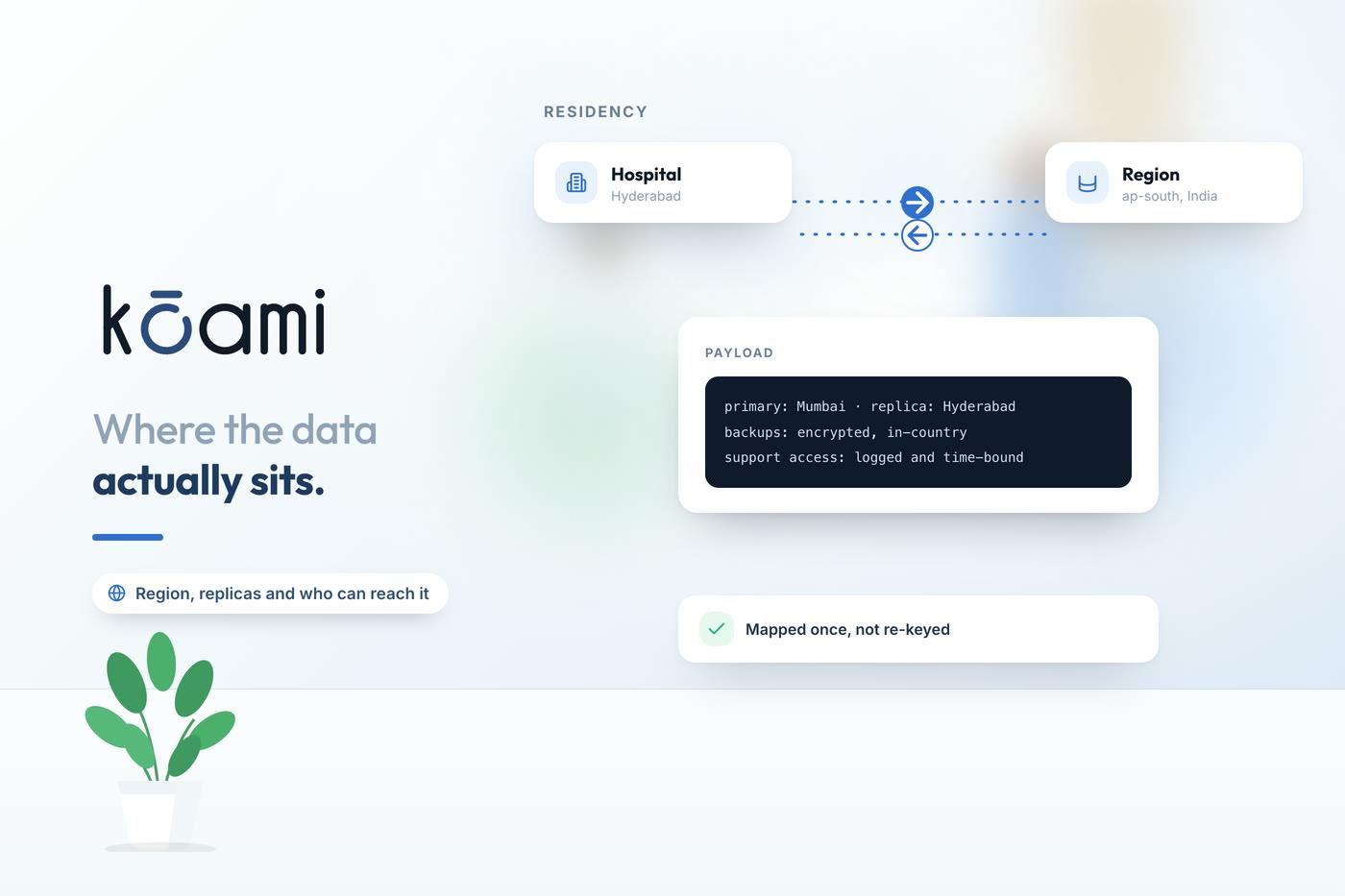
When a patient hands over their name, their UMR, a scan of an old discharge summary and a photo of a rash, they are not thinking about which server rack that data lands on. That is your job. Where patient data physically lives, who can reach it, and under whose laws it sits are not abstract concerns for a compliance binder. They shape what happens when a regulator asks a question, when a cloud region has an outage, or when a hospital in Pune wants to be certain its records are not sitting in a data centre three continents away.
What "residency" actually means
Data residency is the answer to a deceptively simple question: in which country do the bytes rest when nobody is looking at them? It is easy to confuse with two neighbours. Data sovereignty is the legal reality that whichever jurisdiction hosts the data can, in principle, compel access to it. Data localisation is a rule that says certain records must not leave a defined boundary at all. A hospital can be perfectly happy with residency in Mumbai while still being exposed if the management console, the backups, or the support team quietly sit elsewhere.
The honest version of the story includes the parts that are easy to forget:
- Primary storage: the OPD note, the IPD chart, the lab result.
- Backups and snapshots, which often replicate to a second region for durability.
- Search indexes and caches, which hold copies of the same clinical text.
- Logs and telemetry, which can leak identifiers into a monitoring system abroad.
- The imaging tier, where a single CT study is hundreds of DICOM instances that have to live somewhere too.
If you only reason about the first line, you have described a fraction of where the data really is.
Why Indian hospitals feel this sharply
For a hospital operating in India, residency is not a philosophical preference. The Digital Personal Data Protection framework treats health information as sensitive and sets expectations about how it is handled and where it can be processed. Empanelling bodies, insurers and large corporate clients increasingly ask pointed questions in their onboarding forms. "Where is our data stored?" is now a line item, not a courtesy.
The safest answer to a residency question is one you can prove with an architecture diagram, not one you assert in a sales call.
There is also the practical matter of latency and continuity. A radiologist scrubbing through a study over DICOMweb does not want frames arriving from a far region. A registration desk booking an OPD slot at 9 a.m. rush does not want a round trip across an ocean for every keystroke. Keeping the hot path close to the users is both a compliance posture and a performance one.
How Kōami thinks about it
Across the Kōami ecosystem - the HMIS, the HRMS, the inventory and imaging modules - the design principle is that a hospital should be able to name its region and trust that the whole footprint honours it. That means the transactional database, the object storage holding scanned documents, the PACS tier holding DICOM, and the daily backups all resolve to the same declared boundary rather than drifting to wherever a default happened to point.
A few capabilities make that real rather than aspirational:
- Region pinning at the tenant level, so a hospital's records are provisioned into a chosen geography from day one.
- Encryption of data at rest and in transit, so that residency is paired with confidentiality rather than standing alone.
- Segregation of tenants, so one hospital's data is never commingled with another's in a way that makes residency claims meaningless.
- Access logging that records who read what, which turns "we keep it safe" into something you can actually audit.
None of this is a certification claim. Kōami is young, and it would be dishonest to wave a badge we have not earned. What we can do is describe the controls plainly and let a hospital's own security team verify them.
The questions to ask any vendor
If you take one thing from this piece, let it be a short interrogation to run on every clinical software vendor, including us:
- Where does primary storage sit, by region and provider?
- Do backups and disaster-recovery copies stay in that same region, or cross a border for durability?
- Who, on the vendor side, can technically access production data, and is that access logged?
- When you delete a record, how long do copies persist in snapshots and logs?
- If you had to exit the contract, in what format and from which region do you get your data back?
The answers separate vendors who have thought about this from vendors who will improvise when the regulator calls. A vague or shifting answer to the backup question in particular is a reliable tell.
Residency is a promise, not a setting
It is tempting to treat residency as a checkbox flipped once during setup. In practice it is a promise that has to survive every future decision: the new analytics feature that ships logs somewhere convenient, the support engineer who pulls a copy to debug, the cost optimisation that moves cold storage to a cheaper region. A residency guarantee is only as strong as the discipline behind the least glamorous parts of the system.
For a hospital, the goal is not to become an infrastructure expert. It is to ask the right five questions and to work with software that answers them the same way twice. Patient trust is built quietly, in places patients never see. Knowing where their data lives, and being able to say so with confidence, is one of those quiet foundations worth getting right.
Follow Kōami on LinkedIn
Get the next guide on hospital operations, software and compliance in your feed, as soon as it is published.