Hospital management software in Nepal. Built around the way your hospital works.
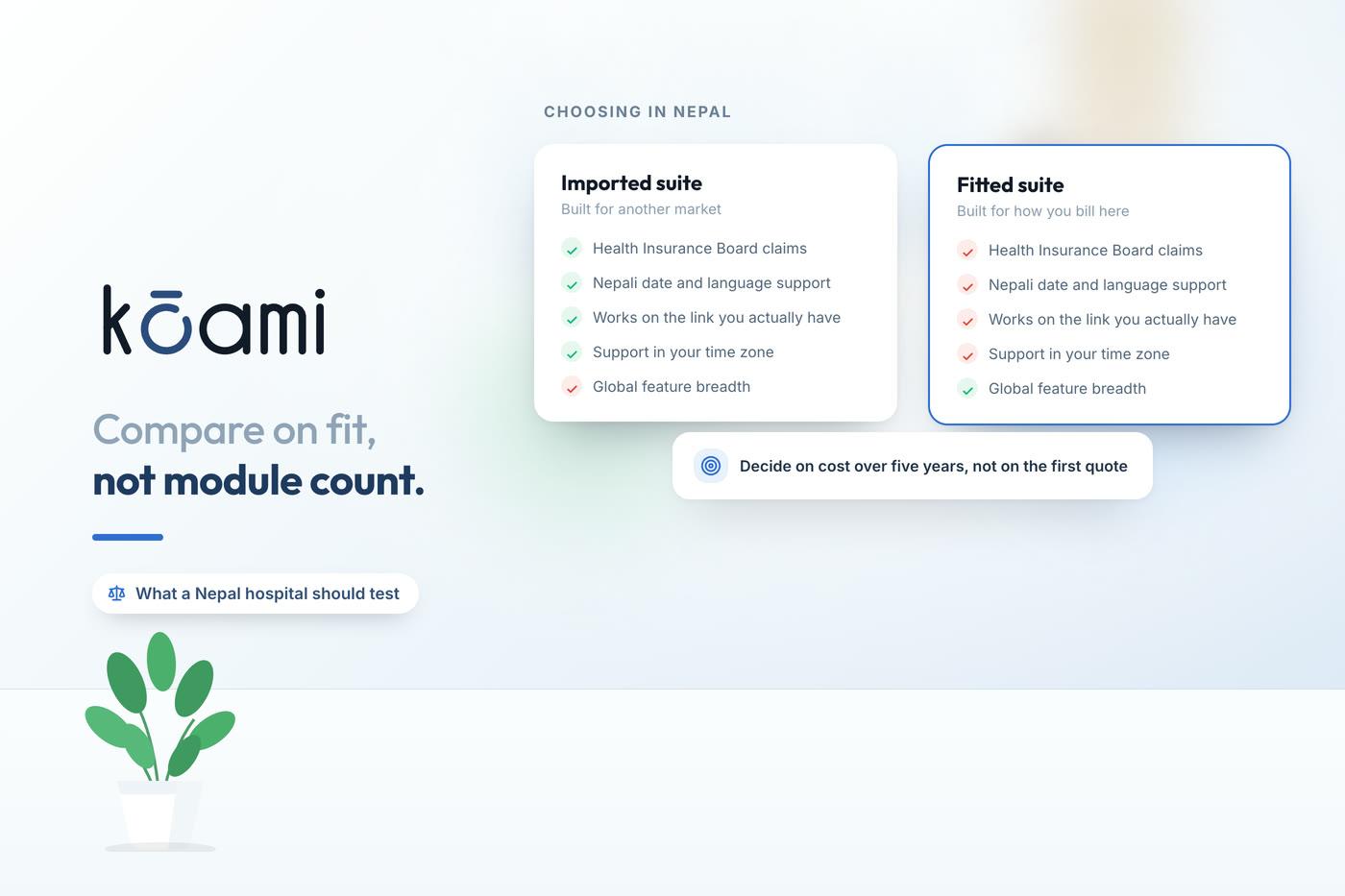
A hospital in Nepal does not need an Indian system with the currency symbol changed. It needs patient registration, OPD and IPD, billing, pharmacy, laboratory and management reporting to work as one flow, while local configuration — Nepalese rupees, fiscal calendars, invoice formats, Health Insurance Board workflows and government reporting — is tested against the hospital’s actual obligations.
Kōami provides the connected clinical and operational platform underneath that work. Nepal-specific statutory, reporting and payer requirements are scoped during discovery and verified before go-live; they are not hidden behind a vague claim that the product is “fully localised”.
What should hospital management software in Nepal include?
Hospital management software for Nepal should connect registration, appointments, OPD, IPD and beds, EMR, orders and results, pharmacy, inventory, billing, insurance worklists and management reporting on one patient identity. It should also support Nepalese rupees, local invoice and fiscal-period configuration, reliable operation on the hospital’s real connectivity, exportable data, and an agreed path for HMIS and Health Insurance Board workflows.
What the system has to do
One patient identity
Registration, consultations, admissions, laboratory, imaging, pharmacy and billing use one MRN, so staff do not reconcile duplicate patients between counters.
OPD, IPD and bed flow
Appointments, token queues, admission, transfer, discharge and housekeeping status stay visible from the front desk to the ward.
EMR, lab and imaging
Structured clinical notes, orders and results, analyser interfaces, DICOM workflows and secure report delivery without re-keying the same order.
NPR billing and payer configuration
Tariffs, packages, sponsor splits and approval limits configured in Nepalese rupees, with local invoice and Health Insurance Board requirements validated during implementation.
Pharmacy and supply chain
Batch, expiry, FEFO, purchase, store and ward stock on the same ledger that dispensing and patient billing read from.
Open integration and reporting
APIs, webhooks and exportable structured data, with HMIS, interoperability and local reporting interfaces scoped against current Ministry requirements.
What a Nepalese hospital should test in a live demo
Use one real patient journey and your own local forms. A generic feature tour will not expose localisation gaps.
- Register a patient, run an OPD consultation, order a lab test, dispense medicine and produce the final NPR bill.
- Show the exact invoice, tax and fiscal-period configuration your finance team requires, including Bikram Sambat dates where your workflow uses them.
- Run a Health Insurance Board case from eligibility and service capture through claim evidence, query and settlement reconciliation.
- Produce the routine facility reports your medical-records team sends today and identify what remains manual.
- Disconnect the primary internet link and show the documented continuity procedure for registration, pharmacy and billing.
- Interface one of your actual analysers and show how a rejected or corrected result is audited.
- Move stock between a central store, pharmacy and ward while preserving batch and expiry history.
- Export patients, encounters, bills, results and stock in usable formats, then explain the exit clause and cost.
How it connects
Kōami Hospital
Registration, OPD/IPD, EMR, billing, pharmacy, laboratory, wards and reporting on one patient record.
Read moreKōami Inventory
Procurement, stores, batch and expiry, FEFO and multi-location stock behind pharmacy and ward consumption.
Read moreKōami PACS
Browser-first DICOM viewing and reporting for hospitals and diagnostic centres, with secure external sharing.
Read moreKōami Workforce
Healthcare rostering, attendance and credentials; Nepal payroll and statutory rules must be scoped during implementation.
Read moreBook a Nepal discovery call
Bring your current forms, reports, payer process and connectivity constraints so localisation can be assessed before a proposal.
Read moreGo deeper
Frequently asked questions
Bring the forms you use in Nepal
A useful discovery call starts with your real invoice, insurance case, HMIS report, pharmacy ledger and one complete patient journey. We will separate what is ready, what is configurable and what requires localisation.
Book a demo