
Best hospital management software in India. How to compare them properly.
Search for the best hospital management software in India and you get a dozen ranked lists, most written by vendors who placed themselves at number one. They tell you who is marketing actively. They tell you very little about which system will still be serving your hospital in year six.
There is no single best HMS. There is a best fit for a particular hospital — its size, its specialities, its compliance load and its appetite for change. This page is the comparison method rather than the ranking, because the method is what survives contact with your own shortlist. Kōami is on that shortlist too, and the section at the end says plainly where it fits and where it does not.
What is the best hospital management software for an Indian hospital?
The best hospital management software is the system that matches your hospital’s size, speciality mix and compliance obligations, and that your staff are still using correctly two years after go-live. Depth of billing, structured clinical data, multi-branch behaviour and ABDM certification separate serious systems; module counts on a brochure do not.
What the system has to do
Billing depth
Package against open billing, mid-stay tariff changes, insurance and cash split on one bill, credit notes, partial refunds, and corporate rate cards applied without manual intervention.
A structured clinical record
Coded diagnoses, structured orders and results as values. A rich-text editor demos beautifully and can be reported on by nobody.
Multi-branch behaviour
One patient identity across sites, consolidated financials, per-site tariffs and stock visible across stores.
Statutory registers
NDPS, blood bank, birth and death, biomedical waste — generated from live data rather than kept as a parallel book.
Concurrency and print speed
What happens at nine in the morning with forty terminals billing at once, and whether the pharmacy label prints in under two seconds.
Downtime behaviour
What the hospital does when the link drops. A vendor without a real answer has not run a hospital through an outage.
The four kinds of vendor you will meet
None of these categories is wrong. They fail in different ways, which is the useful part.
Enterprise international suites
Suits: Large corporate chains needing deep clinical functionality and global standards maturity.
Watch for: Cost, configuration time, and Indian statutory and PM-JAY localisation — verify rather than assume it.
Established Indian HIS vendors
Suits: Hospitals that want deep localisation of Indian billing and regulatory reality from a vendor with fifteen years in the market.
Watch for: Ageing user interfaces, on-premise origins, and limited API access for anything you want to build alongside.
Cloud-native Indian platforms
Suits: Hospitals and groups wanting modern interfaces, subscription pricing and ABDM awareness built in from the start.
Watch for: Depth varies enormously — some are full HIS platforms, some are clinic software with a hospital label. Test the corners: blood bank, NDPS, complex package billing.
Custom builds and integrators
Suits: Organisations whose workflow is genuinely unusual and who have the budget to specify it precisely.
Watch for: Continuity. It fits exactly until you need it changed and the two engineers who understood it have left.
Ten questions that expose a weak system in a demo
A scripted demo avoids the awkward cases, so ask for them by name. Bring your own tariff sheet.
- Admit a patient, change the tariff mid-stay, add a package on day two, then discharge and produce the bill.
- Show a partially rejected PM-JAY claim and what the team does next.
- Create an ABHA number at registration and link a care context, live.
- Show the audit trail for a record that was viewed but not edited.
- Cancel a dispensed medicine, reverse the stock, and show the ledger.
- Take the network away — what does the front office do for two hours?
- Generate the NDPS register from today’s transactions.
- Show consolidated revenue across two branches with different tariffs.
- Produce a patient’s complete data for a DPDP request.
- Export our data. Show us the format, the timeline and the cost.
How it connects
Kōami Hospital (HMS/HIS/HIMS)
Registration and UMR, OPD, IPD and ADT, EMR, pharmacy, lab, radiology, theatre, nursing and the full revenue cycle on one record.
Read moreKōami Workforce (HRMS)
Rotational rostering, geofenced attendance and Indian statutory payroll, so consultant payouts read clinical activity directly.
Read moreKōami Inventory
Multi-store stock with batch, expiry and FEFO, reorder automation and procure-to-pay behind the pharmacy and the wards.
Read moreKōami PACS
Browser-first DICOM viewing and structured reporting, so imaging is not an island with its own patient identity.
Read moreAll six products
How Hospital, Workforce, Inventory, PACS, Fertility and Field Service share one identity and one data model.
Read morePricing
How Kōami is quoted, and what drives the number for a hospital of your size.
Read moreGo deeper
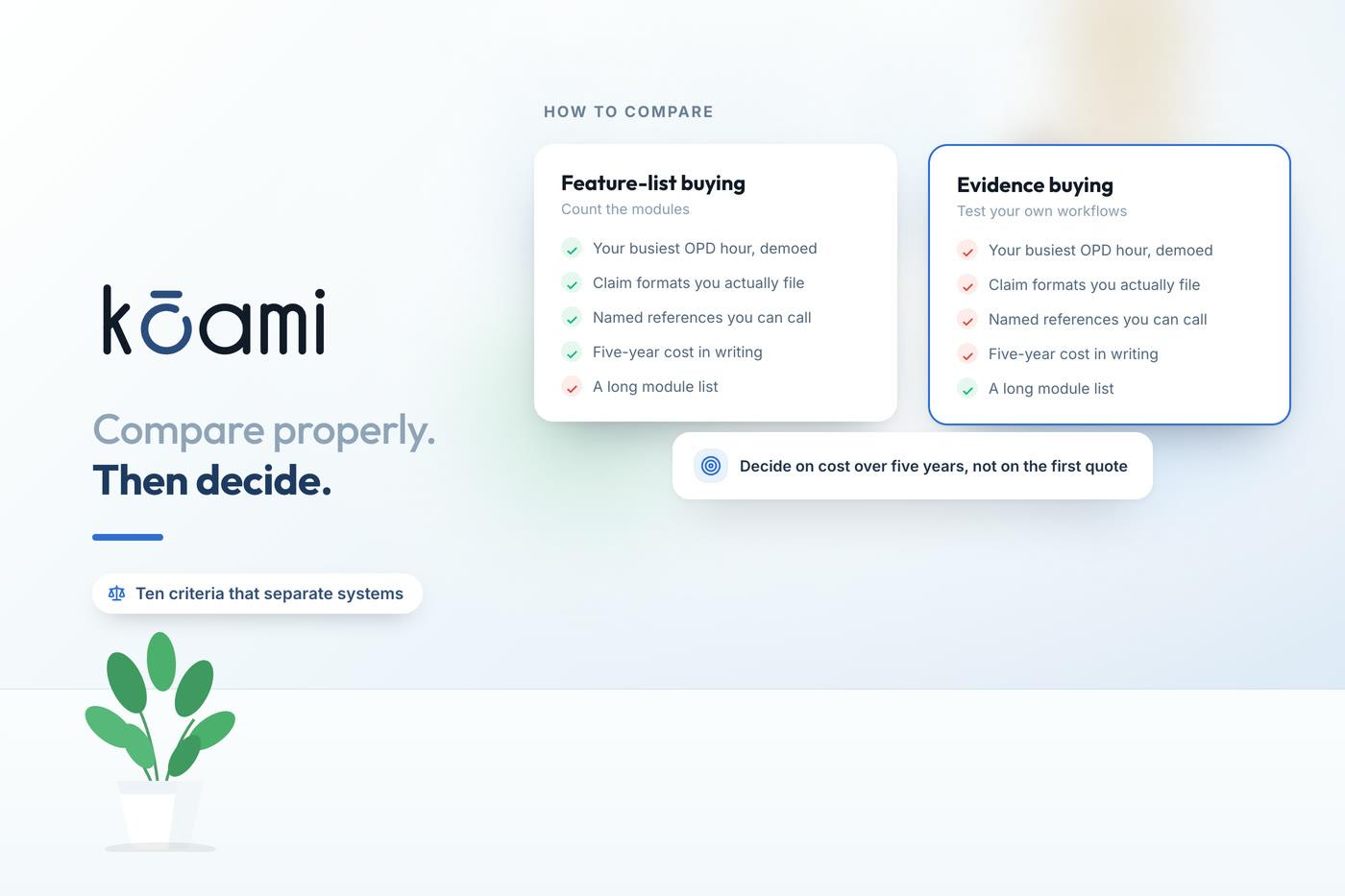 Best hospital management software in India: the long read
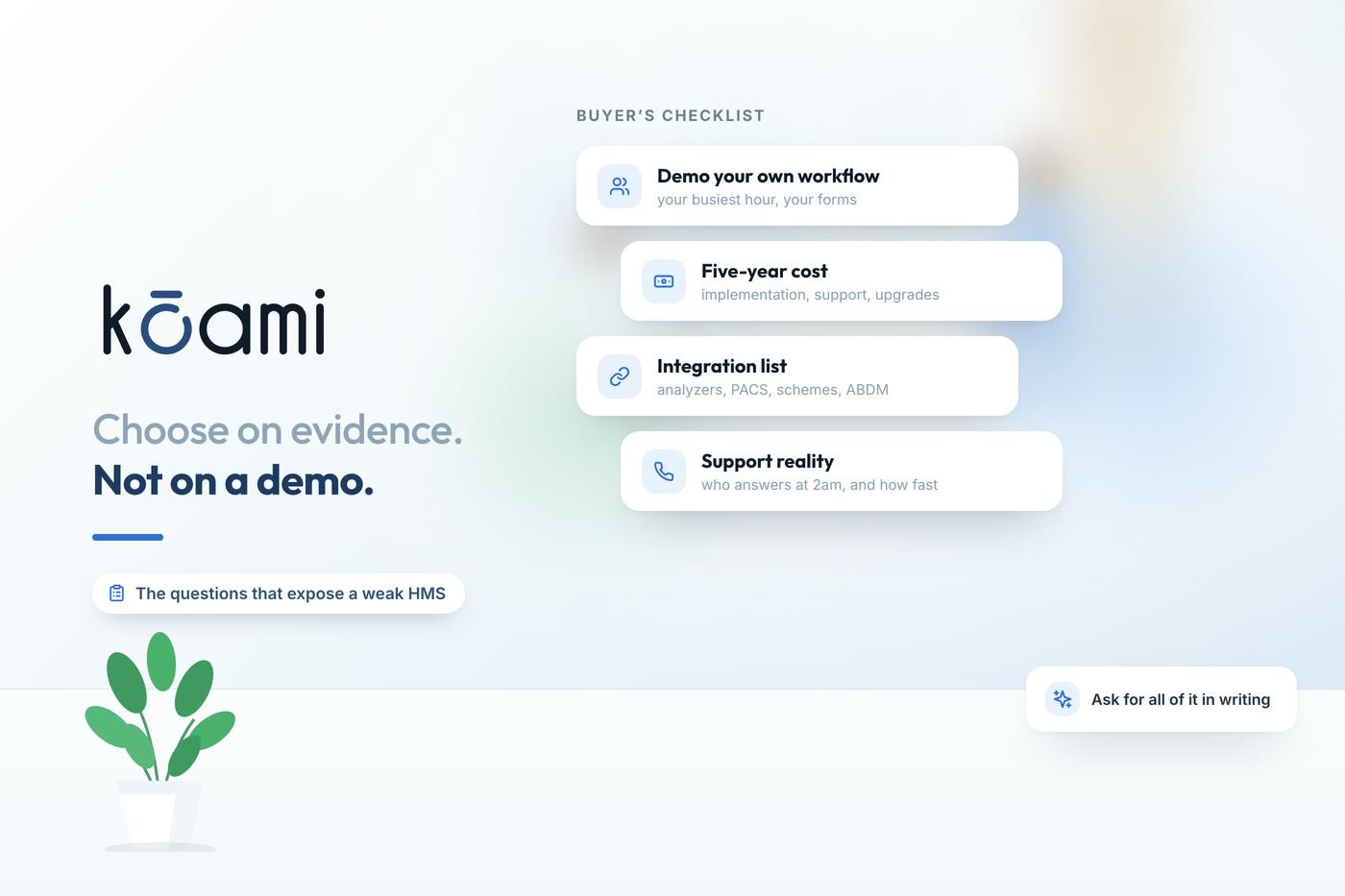 How to choose the right HMS in 2026
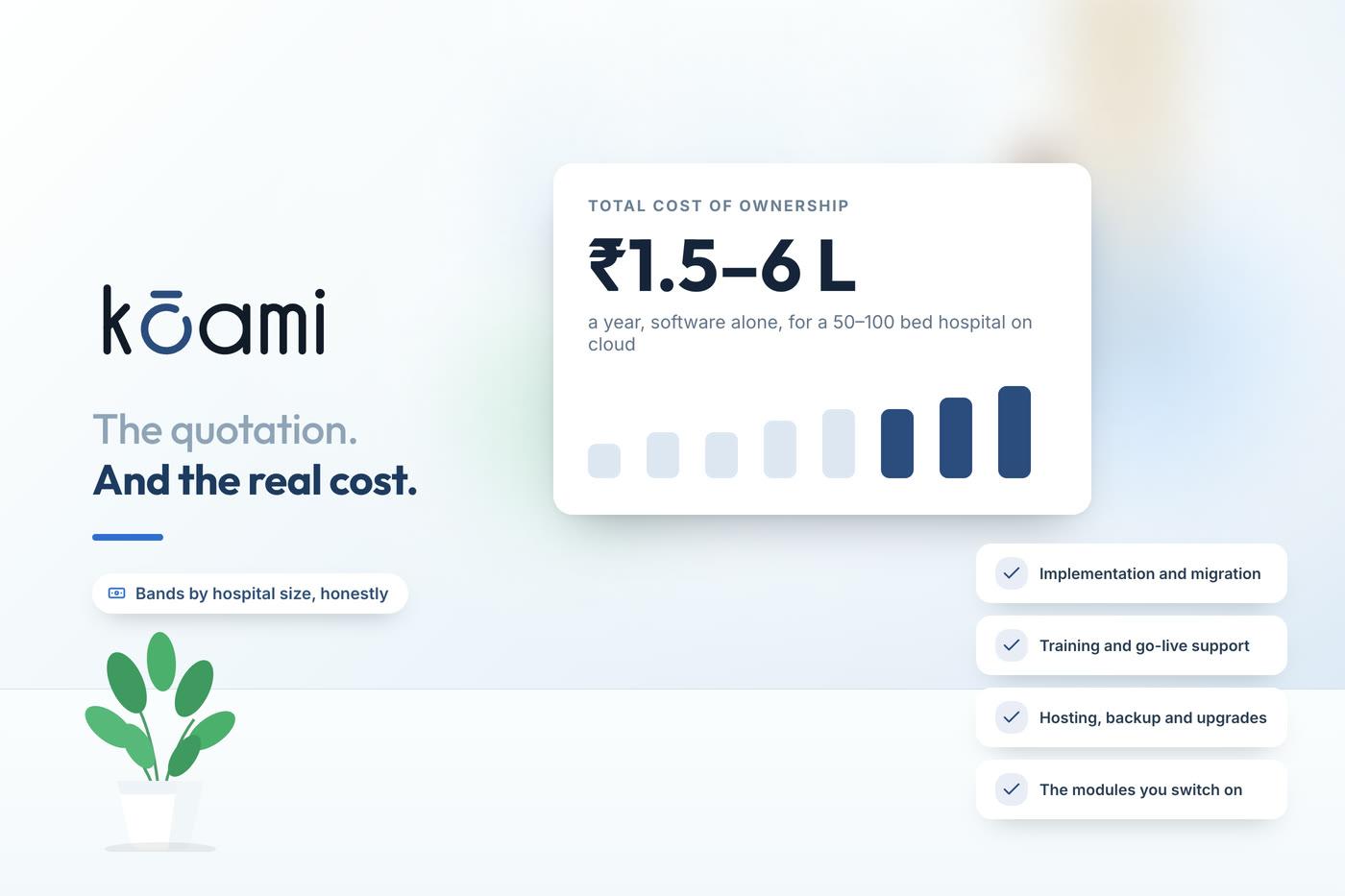 What hospital management software actually costs in India
- Affordable hospital management software: a premium suite without the enterprise price
- HMS, HIS, HIMS, EMR, EHR: the acronyms settled
- The complete HMS module list
- One platform or best-of-breed?
- Switching hospital management software
- Free and open-source HMS: what it actually costs
- Hospital management software in the UAE: DHA, DoH and MOHAP
- Hospital management software in Saudi Arabia: NPHIES, ZATCA and PDPL
- Hospital management software in Kuwait: a buyer’s guide
Frequently asked questions
Bring your own tariff sheet
The fastest way to compare any HMS, including this one, is a demo run on your workflows rather than the vendor’s sample data. Bring a real admission, a real package and a rejected claim.
Book a demo