
Multi-speciality hospital software. One record across every department.
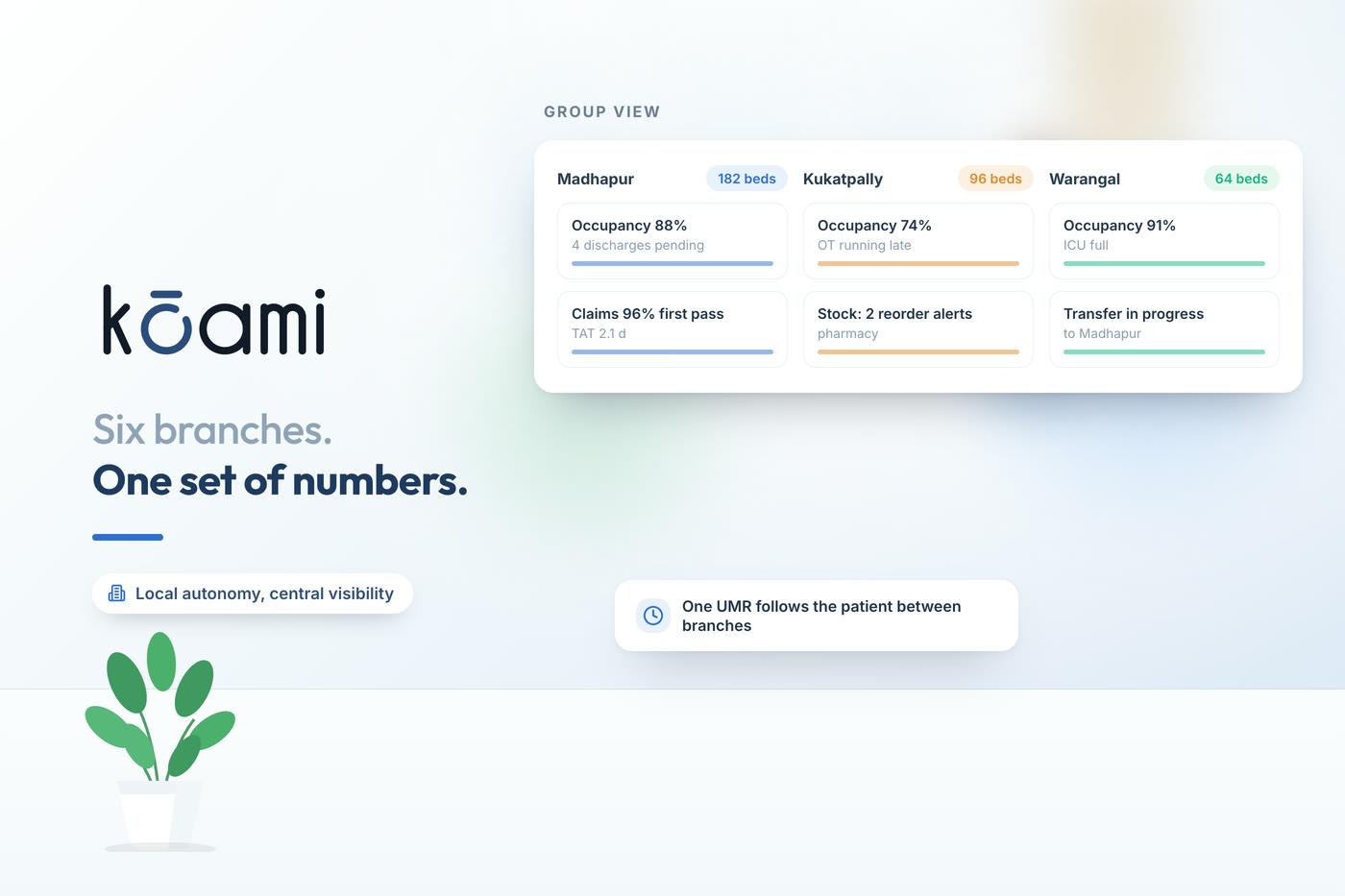
A multi-speciality hospital is not a bigger version of a small one. It is a set of departments with genuinely different workflows sharing one patient, one set of resources and one bill — and it is usually several sites that a board wants to see as one organisation.
The failures at this scale are never about a missing feature. They are about a patient who exists twice, a tariff that differs between branches for no recorded reason, and a consolidated report that three people spend the last week of every month producing.
What does a multi-speciality hospital need from its software?
One patient identity shared across every department and every branch, workflows deep enough for each speciality without forcing them all into one pathway, per-site tariffs and configuration under a common master, cross-consultation inside the same record, stock visible and transferable across the group, and consolidated clinical and financial reporting that reconciles by design rather than by monthly export.
What the system has to do
One UMR across sites
A patient registered at the satellite unit in March and the main hospital in September is one person with one history, not two records to be merged later.
Departmental depth
Theatre, laboratory, radiology, nursing, pharmacy and the emergency department each with their own workflow, on one chart rather than in one generic pathway.
Cross-consultation
A referral to another speciality that lands inside the same record, so the opinion is part of the chart rather than a note that has to be found.
Per-branch tariffs and configuration
Different rate cards, packages and department structures per site under a common master, so local reality is accommodated without fragmenting the data.
Group stock
Every store, ward and theatre in every branch as a stock point, with transfers between them, so a shortage at one site is met from another rather than by emergency purchase.
Consolidated reporting
Clinical and financial reporting across sites from one data model, so the board pack is generated rather than assembled.
What to test at multi-site scale
Concurrency and consolidation are where systems that demo well at one site come apart.
- Register a patient at one branch and recognise them at another.
- Apply two different tariffs to the same procedure at two sites, under one master.
- Refer a patient between specialities and show the opinion in the same chart.
- Produce consolidated revenue and occupancy across all branches.
- Transfer stock between branches and show both ledgers.
- Run peak-hour OP billing on forty terminals and time the print.
- Move a staff member between sites and show their access follow them.
- Show what happens at one branch when the network link there drops.
How it connects
Kōami Hospital
Multi-branch by design: shared master data, per-site tariffs and consolidated reporting.
Read moreHospital ERP software
Where clinical joins procurement, workforce and finance across the group.
Read moreConnected ecosystem
How six products share one identity and one data model across sites.
Read moreGo deeper
Frequently asked questions
Test it at your scale
Bring two branches’ tariffs, a shared patient and a month of consolidated numbers. Single-site demos prove nothing about group behaviour.
Book a demo