
Hospital ERP software. Clinical and back office, one ledger.
Buyers reach for the word ERP when what they mean is that the clinical system and the back office should stop being separate. It is a fair instinct. The monthly ritual of exporting attendance to payroll, consumption to accounts and procedures to consultant payouts is a real cost, and it is paid every month forever.
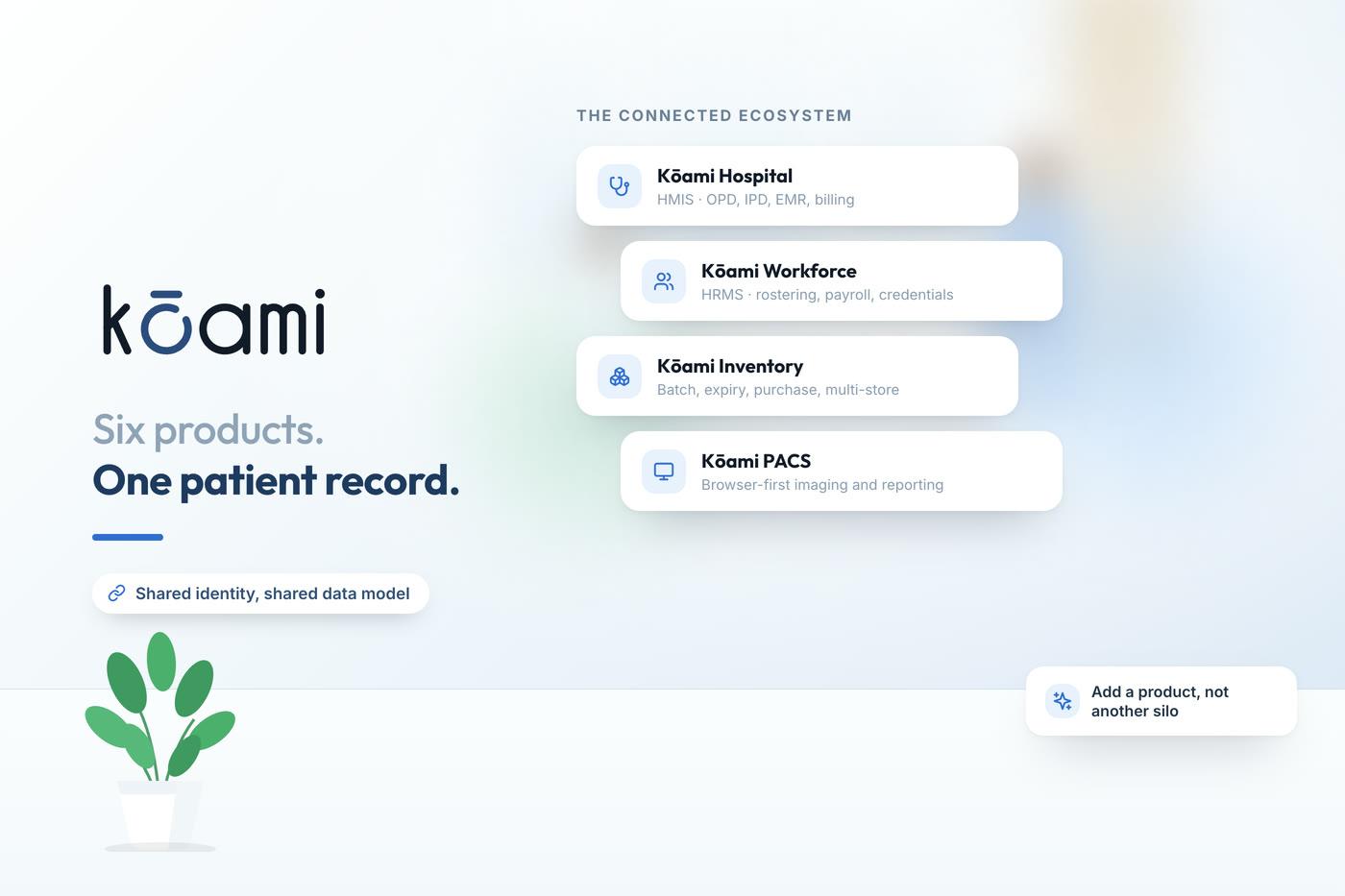
Kōami is built as one connected system rather than a hospital product with satellite tools attached, which is the practical meaning of ERP in a healthcare setting: one identity, one data model, and numbers that reconcile because they were never separated.
What is hospital ERP software?
Hospital ERP software runs a hospital’s clinical and administrative operations on one integrated platform — patient care, billing and revenue cycle, procurement and inventory, workforce and payroll, equipment maintenance and management reporting — so that data entered once is available everywhere. In practice most Indian buyers use "hospital ERP" and "HMS" interchangeably; the ERP framing signals that finance, supply chain and HR are in scope rather than clinical alone.
What the system has to do
One patient identity, everywhere
A single UMR across outpatient, inpatient, theatre, diagnostics and every branch, so there is no reconciliation between two versions of the same person.
Revenue cycle end to end
Tariff and package engine, charges captured at the point of care, TPA and scheme claims, and audit-ready invoices from the same engine that priced the service.
Procure to pay
Requisition, approval, purchase order, goods receipt with batch capture, three-way invoice match and vendor payment, connected to the stock the wards actually consume.
Workforce and payroll
Rostering, geofenced attendance and Indian statutory payroll on the chain that feeds it, with consultant payouts calculated from recorded clinical activity rather than a monthly export.
Assets and maintenance
An asset register with AMC linkage and depreciation alongside preventive maintenance, SLA tracking and downtime reporting.
Multi-branch consolidation
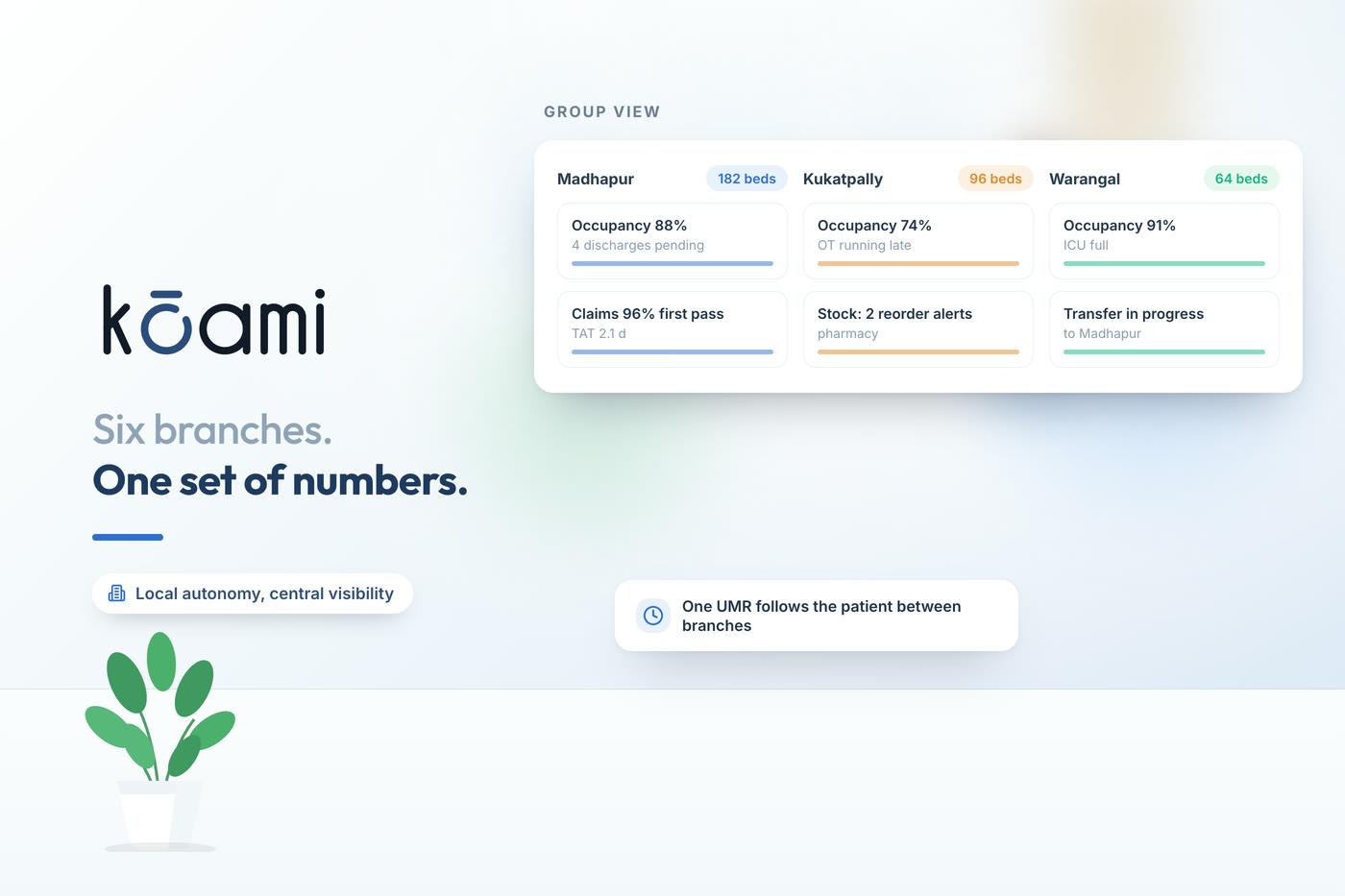
Per-site tariffs and configuration with consolidated financial and operational reporting, and stock visible across the group.
What an ERP evaluation should establish
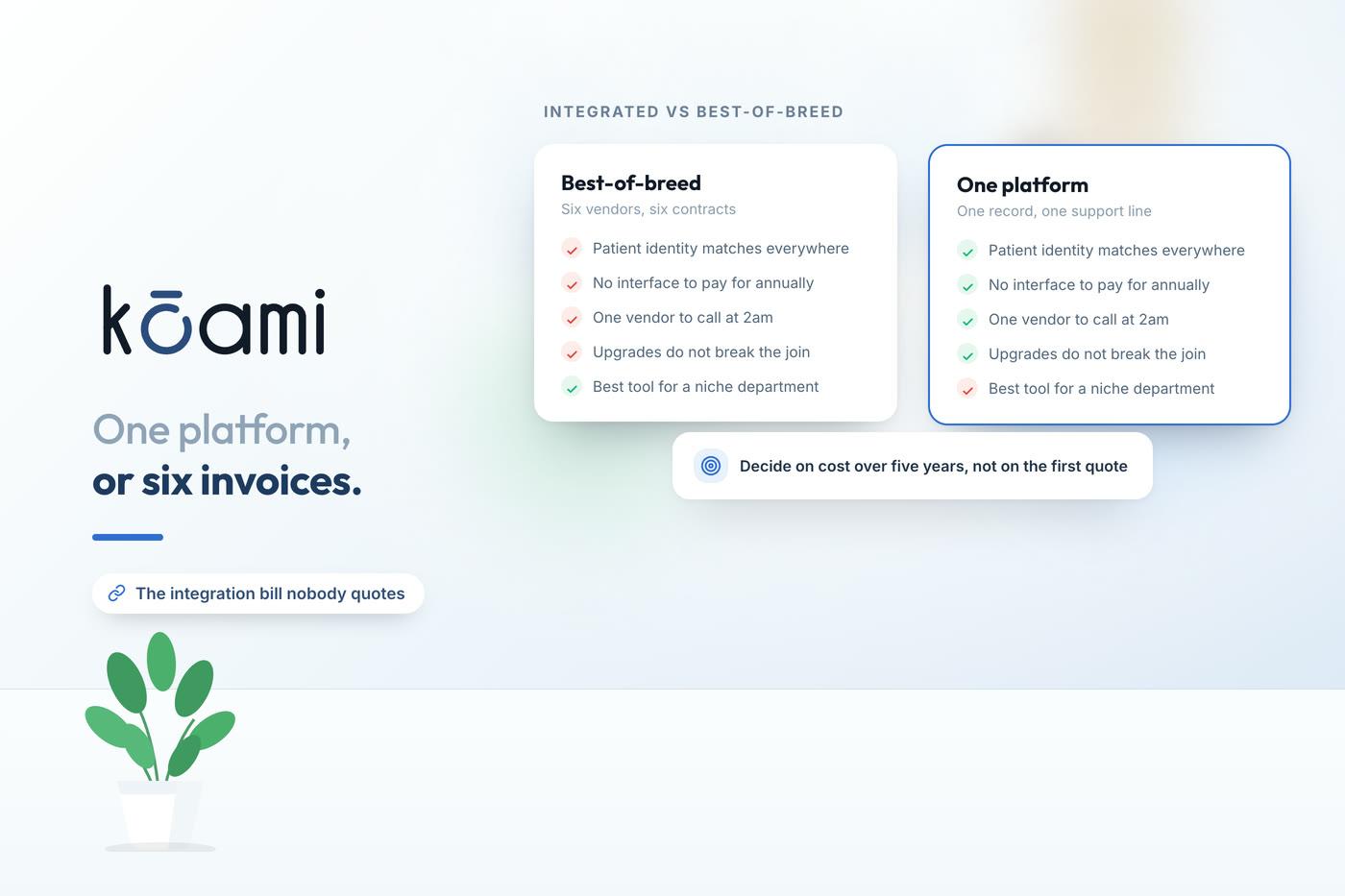
The question is never feature count. It is which boundaries remain, and who reconciles across them.
- List every place a number is exported from one system and imported into another today.
- Show a consumable used in theatre reaching the patient bill and the stock ledger together.
- Calculate a consultant payout from procedures recorded in the clinical system.
- Produce consolidated revenue across two branches with different tariffs.
- Run statutory payroll from attendance without a manual adjustment sheet.
- Show the chart-of-accounts mapping to your existing accounting package.
- Ask what stays outside the platform, and who owns the interface.
- Ask for the five-year total including implementation, migration and integrations.
How it connects
All six products
Hospital, Workforce, Inventory, PACS, Fertility and Field Service on one identity and one data model.
Read moreConnected ecosystem
How the products share data, and what that removes from a normal Tuesday.
Read moreBest hospital management software guide
The criteria to score any platform against, ERP framing or not.
Read moreGo deeper
Frequently asked questions
List your exports
Write down every place a number leaves one system and enters another today. That list is the business case, and we will price against it.
Book a demo