Hospital Staff Productivity: The Hours Lost Before Anyone Touches a Patient
Published
Productivity is an uncomfortable word in a hospital, because it sounds like a demand that people work harder. In most hospitals the staff are already working extremely hard. The hours being lost are not lost to slowness. They are lost to coordination: finding things, chasing people, re-entering data that already exists somewhere, and covering for a roster that did not match the day.
That distinction changes what you do about it. You cannot fix coordination loss by asking for more effort.
Where do nursing hours actually go?
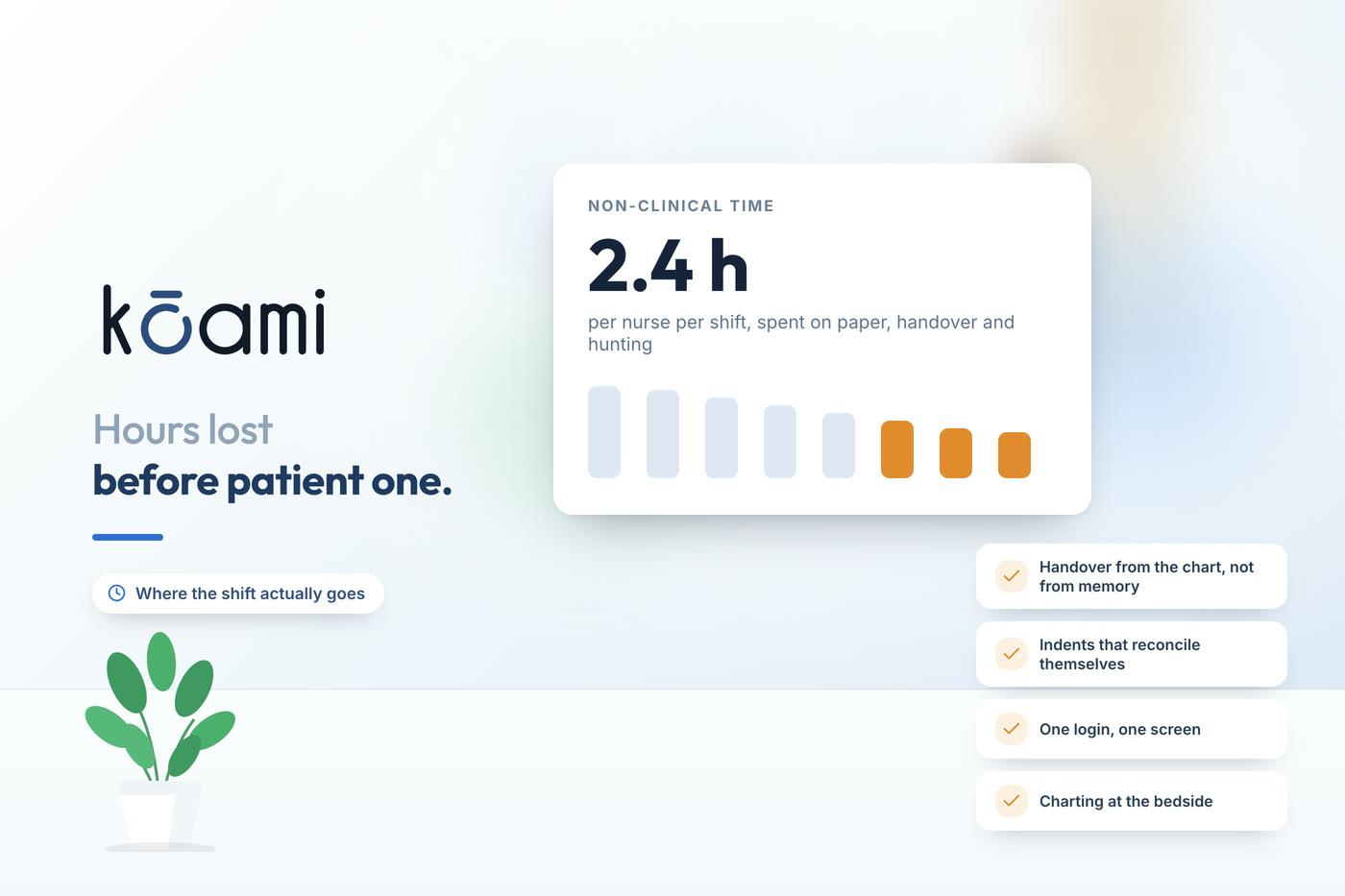
A substantial share goes to documentation, hunting for supplies and equipment, and communication that exists only because two systems do not talk to each other.
Studies of nursing time across health systems consistently find that direct patient care is a minority of the shift. The remainder is documentation, medication administration logistics, handover, coordination calls, and searching. The proportions vary; the shape does not.
The searching is the part hospitals underestimate. A nurse who cannot see ward stock on a screen walks to the store. A nurse who does not know whether the pharmacy has dispensed walks to the pharmacy. A nurse who needs the consultant's decision waits for the round because there is no other channel. None of these is visible in any report, and together they are a large number.
Which of those hours are actually recoverable?
Three categories, and they are recoverable by design rather than by discipline.
- Duplicate entry. The same observation, order or consumption recorded in a register and again in a system, or in two systems. Every duplicate is pure loss.
- Physical search. Walking to find stock, equipment, a chart, a person or a result that could have been on a screen.
- Waiting on a handoff. Time spent unable to proceed because another department has not done something and there is no way to see whether they have.
What is not recoverable, and should not be targeted, is time spent with patients, time spent thinking, and the handover conversation. Hospitals that squeeze those create a different and worse problem.
If a ward keeps a paper register alongside the system, the register is telling you something the system failed to do. Find out what, before you ban the register.
How does the roster itself destroy productivity?
By staffing to headcount rather than to workload, and by being fragile enough that every absence becomes a scramble.
A roster built on the assumption of a fixed number of nurses per ward ignores that thirty beds holding stable post-operative patients and thirty beds holding high-dependency cases are entirely different amounts of work. When the mismatch happens, the ward absorbs it, and absorbing it is what burnout is made of.
The fragility is the second half. When someone calls in sick at half past five in the morning, the typical hospital response is a series of phone calls made by whoever is on duty, which consumes the first hour of a senior nurse's shift and frequently ends with an unfilled gap or an inappropriate fill. The mechanics of doing this properly are in overcoming nursing shortages with dynamic shift allocation and letting nurses swap shifts without chaos.
Where do administrative hours go?
Into reconciliation between systems, and into month-end.
The reconciliation is continuous and invisible: attendance against roster, dispensing against stock, charges against care, claims against documents, consultant activity against payouts. Each of these is somebody's recurring task, and each exists only because two records of the same fact are kept in two places.
Month-end concentrates it. Payroll month-end in a hospital with attendance in one system and the roster in a spreadsheet is a week of work that could be a day. The chain that removes it is described in getting PF, ESI, PT and TDS right.
Consultant payouts deserve their own mention, because they are the clearest case of a calculation that requires data from two systems. A share on procedures performed needs the procedure data. If the clinical system and the payroll system are separate, somebody exports, somebody reconciles, and somebody queries the result every month.
What should a hospital measure?
Six numbers, and the first is the one that changes the conversation.
- Proportion of nursing time in direct patient care, sampled rather than surveyed
- Overtime hours, by ward and by cause
- Unfilled shifts and time to fill a gap
- Roster changes made after publication
- Number of duplicate registers maintained alongside the system, counted honestly
- Month-end payroll cycle time
Sampling the first is worth doing properly. An observer following a nurse for a shift and timing categories will tell you more about your hospital than any survey, and it will tell you which of the three recoverable categories dominates in your building.
How Kōami gives the hours back
The recoverable losses above are all consequences of separate systems, so the mechanism is a shared record rather than any single feature.
Kōami Workforce addresses the roster and the administrative chain:
- Rotational rostering with skill and ratio rules, edited on an employee-by-day grid, so a roster reflects who is qualified for what rather than only how many bodies are on the floor.
- Shift-swap and on-call handled as approvals inside the system rather than as phone calls, so a gap is filled from a pool of eligible, rested staff.
- Geofenced, face-verified mobile check-in, biometric and kiosk options, with regularisation and overtime as workflows rather than as exception forms.
- Statutory payroll running from that attendance directly, with PF, ESI, PT and TDS, shift differentials and LOP handled, so month-end is a review rather than a reconstruction.
- Credential compliance tracked against the roster, so a lapsed registration is caught when the shift is built rather than at an audit.
- Workforce analytics on headcount, overtime, attrition and cost, so the numbers above are produced rather than assembled.
Kōami Hospital addresses the ward-level losses:
- Nursing charting at the bedside with vitals, intake and output, clinical scores and shift handover in the record, so the observation is written once.
- Orders placed from the chart reach pharmacy, the lab and the imaging worklist directly, and status comes back, so a nurse can see whether something has happened rather than walking to find out.
- Ward stock and indents run on the same backbone as Kōami Inventory, so what the ward holds is on a screen and consumption recorded at administration is also the charge and the stock movement.
- Consultant activity recorded in the clinical record is the same data the payout calculation reads, which removes the monthly export entirely.
Productivity work in hospitals goes wrong when it starts with people and ends with targets. It goes right when it starts by counting duplicate entry, physical search and blocked handoffs, and then removes them. If you want to see what that would look like in your wards, bring a shift observation to a demo.
Follow Kōami on LinkedIn
Get the next guide on hospital operations, software and compliance in your feed, as soon as it is published.