Best HRMS for Hospitals in India (2026): Why Generic HR Software Breaks on a Rotational Roster
Published
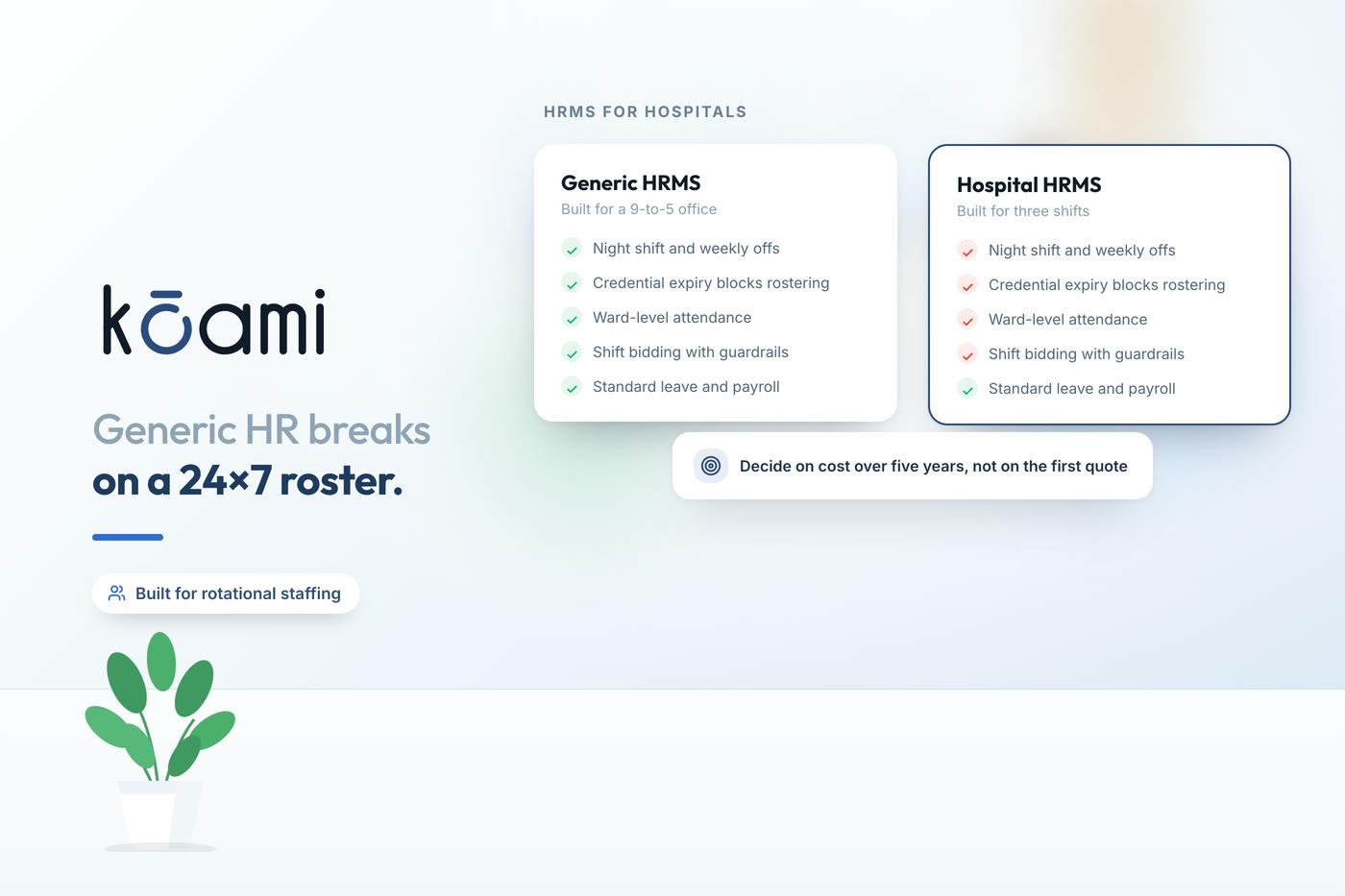
Hospitals usually buy their HR software the way every other business does. Somebody compares three well-known Indian HRMS platforms, picks the one with the cleanest payroll and the nicest app, and rolls it out. Six months later the HR team is running the nursing roster in a spreadsheet again, because the system that handles a nine-to-six office cannot handle a ward.
Nothing about that failure is unusual. Generic HRMS platforms are good products built for a work pattern hospitals do not have.
Why does generic HR software fail in a hospital?
Because it assumes a fixed shift, a fixed location and a fixed skill, and a hospital has none of those.
Consider a single week in a 200-bed hospital. Nurses rotate across morning, evening and night in patterns that must respect rest rules. Someone calls in sick at half past five in the morning and a replacement has to be found who is credentialed for high dependency. A consultant is on call rather than on shift, and on-call is paid differently. Housekeeping is outsourced but must still be tracked on site. Attendance is captured at three gates and two ward stations. Overtime is generated by clinical events, not by schedules.
Generic HRMS handles the payroll end of that reasonably well. It handles the front end, which is rostering against skill and acuity, either badly or not at all. So the roster leaves the system, and once the roster is outside the system the attendance and overtime data feeding payroll is reconstructed rather than recorded.
What does a hospital actually need that generic HRMS lacks?
Six capabilities, and the first three are where most deployments fail.
- Rotational rostering with rules. Shift patterns, weekly-off entitlements, minimum rest between shifts, night-shift limits, and the ability to publish a roster and then modify it without republishing everything.
- Skill and credential awareness in the roster itself. The system should refuse, or at least warn, when a shift is filled by someone whose licence expired last week or who is not credentialed for that unit.
- Shift swap and open-shift filling. Staff-initiated swaps with supervisor approval, and open shifts offered to eligible staff on their phones rather than through a WhatsApp group.
- Attendance that survives a hospital campus. Multiple capture points, geofencing for field and home-care staff, biometric where it exists, and a sane exception workflow for the inevitable failures.
- Indian statutory payroll, done properly. PF, ESI, professional tax, TDS, gratuity, bonus, and the returns that go with them, with hospital-specific earnings like night allowance, on-call and shift differential handled as first-class components rather than manual adjustments.
- Credential and compliance tracking. Registration renewals, immunisation status, background verification, mandatory training. NABH will ask for this and the answer needs to be a report, not a cupboard.
The test for a hospital HRMS is simple: can the charge nurse fill tomorrow morning's sick-leave gap inside the system, on a phone, in under two minutes? If not, the roster will leave the system, and the payroll data will follow it.
How should attendance and payroll actually connect?
Attendance should generate payroll inputs automatically, with exceptions raised rather than corrections applied.
The common failure is a monthly reconciliation ritual: HR exports attendance, compares it against the roster, chases departments for approvals, adjusts for the exceptions, and then runs payroll under time pressure with a spreadsheet of manual entries. Every step in that chain is a place where a night allowance goes missing and a nurse loses trust in the system.
What good looks like is a chain that holds end to end. The roster defines the expected shift. Attendance records the actual. The difference is an exception with a defined owner and a deadline. Approved exceptions become payroll components with an audit trail. By the time payroll runs, there is nothing to reconstruct.
Ask any vendor to walk that chain with a real example, including a nurse who worked a double, swapped a shift, and had a biometric failure on one of the days.
What about doctors, who are not employees in the usual sense?
Consultants need a different model, and a hospital HRMS that only understands salaried staff will push them into a spreadsheet too.
Visiting and consulting arrangements in Indian hospitals include revenue share on OPD and procedures, fixed retainers plus share, per-session payments, on-call allowances, and combinations of all of these that vary by department. The calculation depends on clinical activity captured in the HMS, not on attendance.
This is the strongest argument for keeping workforce and hospital systems on one data model. A consultant payout that depends on procedures performed requires the procedure data. When the two systems are separate, someone exports, someone reconciles, and the payout is late.
What should a hospital ask in an HRMS demo?
Bring your own roster. A demo on the vendor's sample data will show you a roster that has never had a bad week.
- Build next week's roster for a 30-bed ward with three shifts, using our actual shift patterns and rest rules.
- Now a nurse calls in sick for tomorrow morning. Fill the gap, on a phone, with someone credentialed and rested.
- Show me what happens when I try to roster a nurse whose registration expires on Thursday.
- Run a swap between two staff, with approval, and show the effect on both payslips.
- Process payroll for a month containing a double shift, a night allowance, an unapproved absence and a biometric failure.
- Generate the PF and ESI returns for that month.
- Show me every staff member with a credential expiring in the next sixty days.
- Calculate a consultant payout that depends on procedures done in the hospital system.
The last one is the question that separates a hospital HRMS from an HRMS being sold to a hospital.
How do you evaluate the vendors on the market?
There are three groups, and they fail predictably.
Large Indian HRMS platforms are excellent at payroll and compliance, with mature statutory handling and good employee self-service. Rostering is usually shift-based rather than skill-based, and credential compliance is a custom field. Suitable for a hospital's administrative staff; usually supplemented for nursing.
Global workforce management suites do have real acuity-based scheduling, and they are built for exactly this problem in large health systems. Cost and Indian statutory localisation are the questions to press hard on.
Healthcare-specific Indian platforms sit between the two. Rostering and credentialing are built in, statutory payroll is local. Depth of the payroll engine varies, so test it against your most complicated month rather than a clean one.
Where Kōami Workforce fits
Kōami Workforce is the healthcare-specific option, and it exists because the alternative in most hospitals is a spreadsheet sitting between two good systems.
It covers rotational rostering with rest and skill rules, geofenced and multi-point attendance, shift bidding and swaps, Indian statutory payroll, and credential expiry tracking. Because it sits on the same platform as the hospital system, consultant payouts that depend on clinical activity are calculated from that activity rather than from an export, and a credential that lapses is visible to the person building the roster.
If your hospital's HR pain is purely payroll, a mainstream Indian HRMS will serve you well and cost less. If it is the roster, and the reconciliation the roster causes, that is a different problem and it needs a different tool.
Follow Kōami on LinkedIn
Get the next guide on hospital operations, software and compliance in your feed, as soon as it is published.