Training Staff Who Have Used Paper for Twenty Years
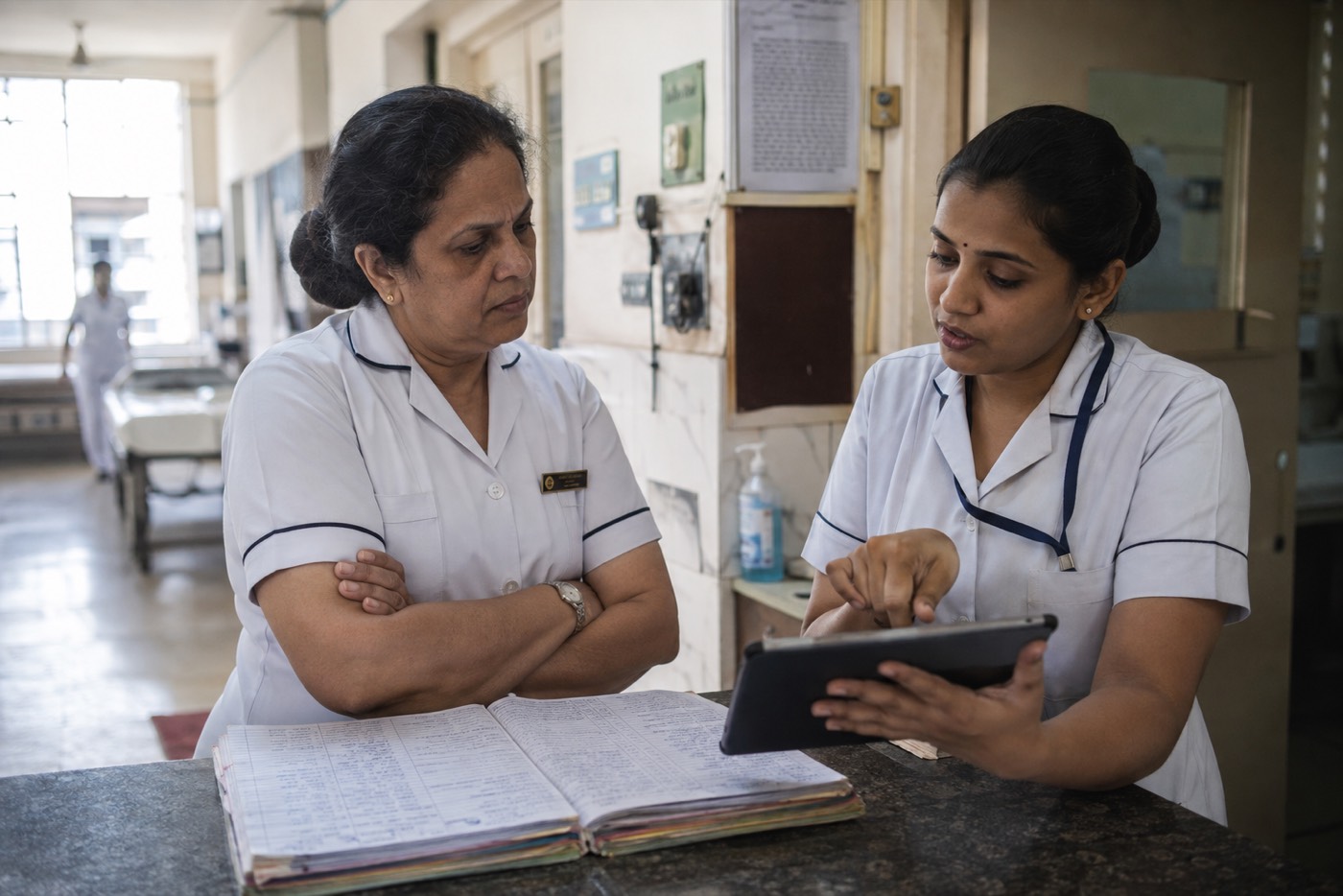
The ward sister has a register. Hardbound, cracked spine, kept on the second shelf under the nursing station counter, and she has run a thirty-bed female medical ward out of it for nineteen years. She knows which page the handover sits on. She has her own shorthand for a patient who needs watching. She can tell you without turning a page who is due for a dressing change and who the consultant wants reviewed before evening rounds. Then a project team arrives with laptops and a go-live date, and tells her that from the fifteenth, everything goes into the system.
She is not impressed by the demo. She is also not being difficult.
Resistance is usually a rational risk assessment
Hospitals talk about resistance to change as though it were a personality defect. It rarely is. Ask any nurse who has sat through two abandoned software rollouts and she will explain the arithmetic quite calmly. The register has never crashed. The register works during a power cut. The register does not log her out after four minutes of inactivity while she is holding a syringe. Against that, she is being offered something a vendor says will be better, delivered by a project team that will be gone in six weeks.
There is a second, quieter calculation running underneath. She is the most competent person on that floor and everybody knows it. Juniors ask her; she does not ask them. The moment she has to hunt for the discharge screen while a first-year nurse watches, that order wobbles. Twenty years of earned authority, traded against the risk of looking slow in front of the people she trains.
Nobody resists a better system. They resist becoming a beginner in public.
Once you see it that way, most of the standard playbook looks wrong. A classroom session at 3pm with a projector asks her to be a student in a room full of her own juniors. A single induction covering registration, OPD billing, IPD orders and TPA workflow teaches her mostly things she will never touch.
Train in the ward, not in the classroom
The training that works happens standing at the nursing station, with live patients on the screen. Not dummy data. Her ward, her beds, her patients, her consultant's orders. The moment the training set is fictional, the exercise turns abstract and nothing sticks.
In practice:
- Sessions of twenty to thirty minutes, not two hours. Attention on a working ward comes in short windows.
- Timed to the shift, not to the trainer. Catch the night shift at 6am when the ward is quiet rather than asking eleven nurses to come in on an off day.
- Scoped to the role. A staff nurse needs vitals, medication administration, nursing notes and handover. She does not need the tariff master.
- Repeated. One pass teaches nobody. Three short passes across a fortnight, with real work in between, teaches everybody.
Hospitals resist this because it is expensive in trainer hours. It is far cheaper than a rollout that quietly reverts to paper.
Super-users carry the rollout, not the trainers
External trainers leave. That is the structural flaw in the classroom model — the knowledge walks out of the building on the last day of go-live. What survives is whatever the ward can teach itself.
The super-user model addresses this by picking two or three people per ward, per shift, and training them properly and early, a fortnight ahead of everyone else, with time to break things in a test environment without an audience. They are not necessarily the fastest typists. Choose them for standing: whoever the floor already goes to when something goes wrong.
A few things separate a real super-user programme from a list of names on a slide:
- Protected time. An hour a shift during go-live weeks, formally covered.
- A direct line to the implementation team, not the general helpdesk queue.
- Authority over small decisions. Which screen the ward defaults to, how the handover note is structured. Ownership converts people faster than instruction.
- Public credit. In a hospital, being the person who knows is a currency.
By the second month she is answering most of the questions the helpdesk would otherwise receive, and answering them better.
The laminated card beats the training manual
Somebody will produce a sixty-page user manual. It will be a PDF, it will live on a shared drive, and precisely nobody will open it at 2am in casualty.
What gets used is a single laminated A5 card taped inside the nursing station cupboard door or hanging on a string beside the terminal. Admission in six steps. How to record a dose given late, and where the reason goes. How to raise an incident. Who to call when the printer will not release the discharge summary. It is written in the ward's own language, shorthand included, and reprinted whenever the workflow changes.
The same logic applies to the software. If a nurse has to remember an eight-step path, the design is at fault, not the nurse. Systems like Kōami earn their place on a ward by keeping the common actions — record vitals, administer a drug, hand over the shift — a couple of taps away, and by not throwing her out of the screen when the patient in bed 12 needs both her hands for ten minutes.
The loudest sceptic makes the best champion
There is a strong temptation to route around the difficult senior: train the enthusiastic young nurses, build momentum, let the holdout come along later. This nearly always backfires, because the ward takes its cue from her, not from the project plan. If she is visibly unconvinced, the floor runs the system as a data-entry chore alongside the register — double documentation, which is worse than either system alone.
Bring her in before go-live, not after. Ask her what the system gets wrong. She will tell you precisely, and she will usually be right: the handover screen does miss the thing she tracks, the medication chart does not show the allergy clearly enough. Fix two of the things she raises and tell her which two. That is the conversion moment, and it has very little to do with training. She is not being asked to accept the system. She is being asked to shape it.
When she does turn, she turns hard, because she has spent twenty years being right in public and has no intention of stopping. A sceptic who has openly signed off is worth a dozen willing juniors.
Adoption shows up in the third month
Go-live week tells you almost nothing. Everyone is being watched and compliance looks excellent. The honest test comes in the third month, on a Sunday night, when the ward is two nurses short and nobody is observing. If the register has come back out of the cupboard, the rollout failed, whatever the dashboard says.
The wards where it holds are the ones where the senior sister decided the system was hers. That decision is never made in a training room. It gets made the day somebody senior enough to matter asked her what was wrong with it, and then changed it.