Hospital Website Design in India (2026): What It Must Do, and What It Costs
Almost every hospital website in India was built to satisfy a committee. It opens with a photograph of the building, a message from the chairman, a rotating banner of accreditation logos, and a menu with nineteen items. Somewhere behind all that is the thing a patient came for: a phone number, a department, a doctor's timing, and a way to book.
A hospital website has one job — turn somebody who is already looking for care into an appointment, a call or a walk-in — and a second job that nobody assigns it: being the page Google can rank for the treatments you perform. This guide covers what the site must contain, how fast it has to be, what it costs in India in 2026, and the questions to ask before you sign with anybody, us included.
What makes a hospital website good in 2026?
It books appointments on a phone in under thirty seconds, it loads in under three, and every page a patient could search for exists as its own page. That is most of it.
The rest is credibility. A patient choosing a hospital is making a decision with real consequences and very little information, so the site has to supply the things that reduce risk: which doctors actually work there and what they are qualified in, what a procedure involves and what it costs, which insurers are accepted, what the emergency number is, and what other patients say. Stock photography of smiling models in lab coats does the opposite — it tells a reader the site is a brochure rather than a record.
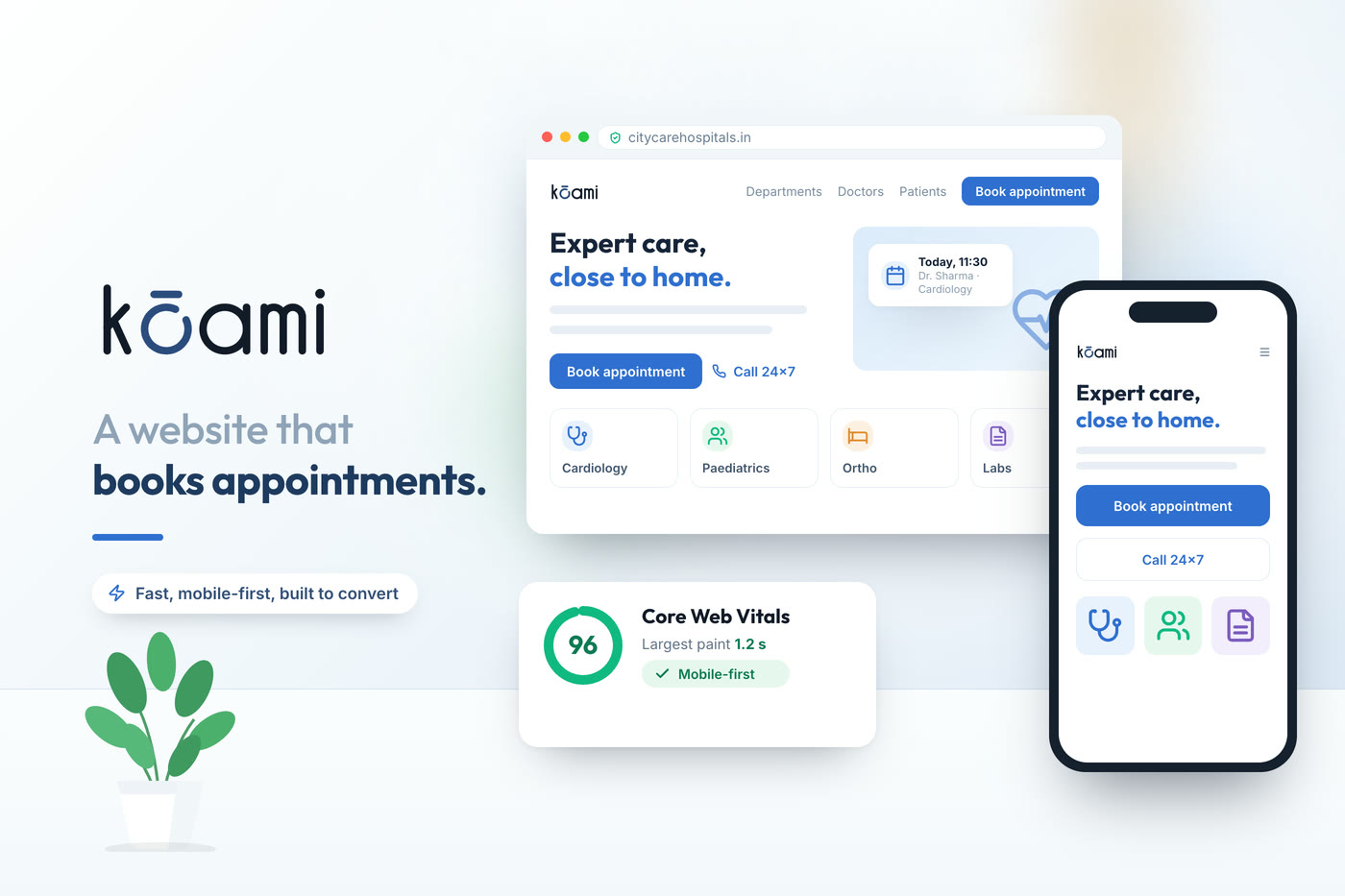
A useful test: open your site on a mid-range Android phone, on mobile data, and try to book an appointment with a cardiologist for tomorrow. Count the taps and the seconds. That number is your website strategy.
What pages does a hospital website actually need?
One page per thing a person searches for. Concretely:
- A page per department or speciality — cardiology, orthopaedics, nephrology — each describing conditions treated, the team, and what to expect.
- A page per doctor, with qualifications, registration, languages spoken, OPD timings and a direct booking link. These are among the most-visited pages on any hospital site, because people search doctors by name.
- A page per major treatment or procedure, written for a patient rather than a peer: what it is, who needs it, how long recovery takes, what it costs.
- A page per location if you run more than one, each with its own address, phone number, map, timings and photographs — and genuinely different content, not the same paragraph with the city swapped.
- Insurance, TPA and scheme pages listing the insurers and government schemes you are empanelled with. People search these terms directly.
- An international patients page if you want medical-tourism enquiries, covering estimates, visa letters, airport pickup and language support.
- Emergency, ambulance, health checks and packages, each addressable on its own.
- Careers, news and a blog — the parts that keep the site from being frozen.
- Privacy, terms and a grievance contact, which the DPDP Act makes non-optional for a site collecting patient enquiries.
The structural rule underneath: if a patient could reasonably type it into Google, it deserves a URL. A department buried as a tab inside a single "Services" page cannot rank, because it does not exist as a page.
How much does a hospital website cost in India?
Published ranges from Indian studios put a clinic site at roughly ₹90,000 to ₹2.5 lakh and a multi-department hospital site at roughly ₹1.6 lakh to ₹6.5 lakh, with complex multi-location builds quoted in the ₹3–12 lakh band. Those are advertised prices rather than a market survey, so treat them as the shape of the thing.
What actually drives the number is not page count:
- Integrations. A site that writes into your HMS appointment slots, or pulls doctor availability from it, is a different project from a site with a contact form.
- Locations and languages. Each branch is its own page set; each language is a parallel site that has to be maintained, not a translation plugin.
- Content. Somebody has to write eighty department, doctor and procedure pages and have a clinician check them. This is usually the largest hidden cost and the first thing cut.
- Compliance and consent. Cookie and consent handling, data-retention rules and a privacy notice that matches what the forms actually do.
Against that, the recurring costs are small and predictable: hosting, domain, SSL, backups and maintenance. If a quotation bundles "SEO" into a website price as a lump with no deliverables listed, ask what is actually being delivered in month three.
How fast does a hospital website need to be?
Fast enough to pass Core Web Vitals, which Google defines with three thresholds: Largest Contentful Paint at or under 2.5 seconds, Interaction to Next Paint at or under 200 milliseconds, and Cumulative Layout Shift at or under 0.1. INP replaced First Input Delay in March 2024, so an agency still reporting FID is reporting a metric that no longer exists.
Speed is not a vanity metric here. A hospital site is opened by people in a hurry, frequently in an emergency, often on a bad connection. The common causes of a slow Indian hospital site are unremarkable and fixable: uncompressed hero images straight from a camera, four font families, a chat widget and three tracking scripts loaded before the content, and a rotating banner nobody reads.
Should you build on WordPress or custom?
WordPress is the right default for most hospitals, and it is fine for almost everything except heavy integration. Your team can edit it, developers are available everywhere in India, and the plugin ecosystem covers appointments, multilingual content and forms. The risks are equally well known: plugin bloat slows it down, and an unmaintained installation is a security liability holding patient enquiries.
A custom build earns its cost when the site is genuinely an application — live slot availability from the HMS, patient portal logins, complex package configurators, or a multi-country structure with separate content per market. Whichever you choose, the ownership question matters more than the stack: the domain, the hosting, the code and the CMS must be in your name.
Should the website connect to your hospital system?
Yes for appointments, carefully for anything else. The appointment is the one place where an unconnected website costs real money every day: a form that lands in an inbox is re-keyed by hand into the HMS, which means double entry, slot conflicts and a patient who turns up to find no booking.
Connecting the site to the system removes that, and it adds something more useful: the source of the booking travels with it. When the enquiry becomes an appointment and the appointment becomes a UMR, marketing stops being an act of faith. That chain is the subject of following a patient from ad click to admission.
What should stay off the public site: anything that exposes clinical data without authentication. Reports and records belong behind a login in the patient portal, not in a link that anyone with the URL can open.
What should you demand from whoever builds it?
- Ownership of the domain, hosting, code, CMS and analytics, in your name, from day one.
- A staging site and a handover session with your team, plus documentation of how to add a doctor.
- Core Web Vitals passing on mobile at launch, evidenced.
- Schema markup for the organisation, the doctors and the FAQs, so search engines can read the site properly.
- Search Console and analytics configured, with call and WhatsApp tracking.
- A written content plan naming who writes the department pages and which clinician approves them.
- A privacy notice and consent flow that match what the forms actually collect.
Where Kōami fits
We build these sites for hospitals, clinics, diagnostic centres and fertility centres as part of Kōami Studio — mobile-first, fast, multilingual where you need it, and handed over on a CMS your own staff can run.
The part we can do that a general web studio cannot is the join to the hospital's own systems. Where the hospital runs Kōami Hospital, the website can book into real OPD slots and the booking arrives with its source attached, so the marketing can be measured against registrations rather than form fills. If you want a view of what your current site is costing you, send us the URL and we will audit its speed, structure and search visibility and tell you what we would change first.
Keep reading
Affordable Hospital Management Software in India (2026): A Premium Suite Without the Enterprise Price
Nursing Home Management Software in India (2026): Features, Price and a Buyer’s Checklist