Home Healthcare Scheduling: Nurses and Physios Across a City
Published
A home care operator in a large Indian city can have 40 nurses and 15 physiotherapists and still miss visits. The problem is rarely headcount. It is that a 30-minute dressing in Kukatpally and a 45-minute physiotherapy session in Gachibowli were given to the same nurse at 10 and 10:30, because whoever built the schedule did not look at the map.
This article is for the operations head of a home healthcare business, or the outreach manager running home visits for a hospital. It covers visit types and durations, skill-matched scheduling, geo-verified visits, clinical notes on mobile, and billing. It includes a visit-planning template you can use with or without software. All numbers are illustrative.
Start with visit types and real durations
You cannot schedule what you have not defined. List every visit type you offer and give each one a planned duration based on your own visit logs. A starting list might look like this:
- Wound dressing: 30 to 45 minutes, nurse.
- Injection, IV antibiotic or infusion: 30 to 60 minutes, nurse, with a doctor's order on file.
- Catheter or Ryle's tube care: 30 to 40 minutes, nurse.
- Post-operative physiotherapy: 45 to 60 minutes, physiotherapist.
- Elderly care attendant: 8 or 12-hour shift, attendant. This is a shift, not a visit, and should be rostered separately.
- Home sample collection: 15 minutes, phlebotomist.
- Doctor home visit or teleconsult follow-up: 20 to 30 minutes, doctor.
Two details matter. First, the first visit of an episode always takes longer, because the nurse assesses the home, the patient and the family, so give it its own code. Second, record actual durations on every visit and review the planned figure each quarter. Planned durations that are always 15 minutes short are why schedules collapse after lunch.
Skill-matched scheduling
Every visit has a minimum skill requirement and a few preferences. The scheduler's job is to meet the requirement first and the preferences second.
- Requirement: qualification (nurse, physiotherapist, attendant, phlebotomist), any specific competence (PICC line care, tracheostomy, paediatric), and a current registration where your service model needs it. Track registration and certificate expiry dates the same way a hospital does.
- Preference: the same caregiver as last time, a female caregiver if requested, a language the patient speaks, and the family's preferred time window.
Continuity is more than a courtesy. A nurse who saw the wound on Monday will notice on Wednesday that it looks worse. A different nurse each day sees only a wound.
Zoning: the cheapest capacity you will find
Travel is the largest hidden cost in home care. Work out visits per caregiver per day like this:
- Usable shift minutes ÷ (average visit minutes + average travel minutes).
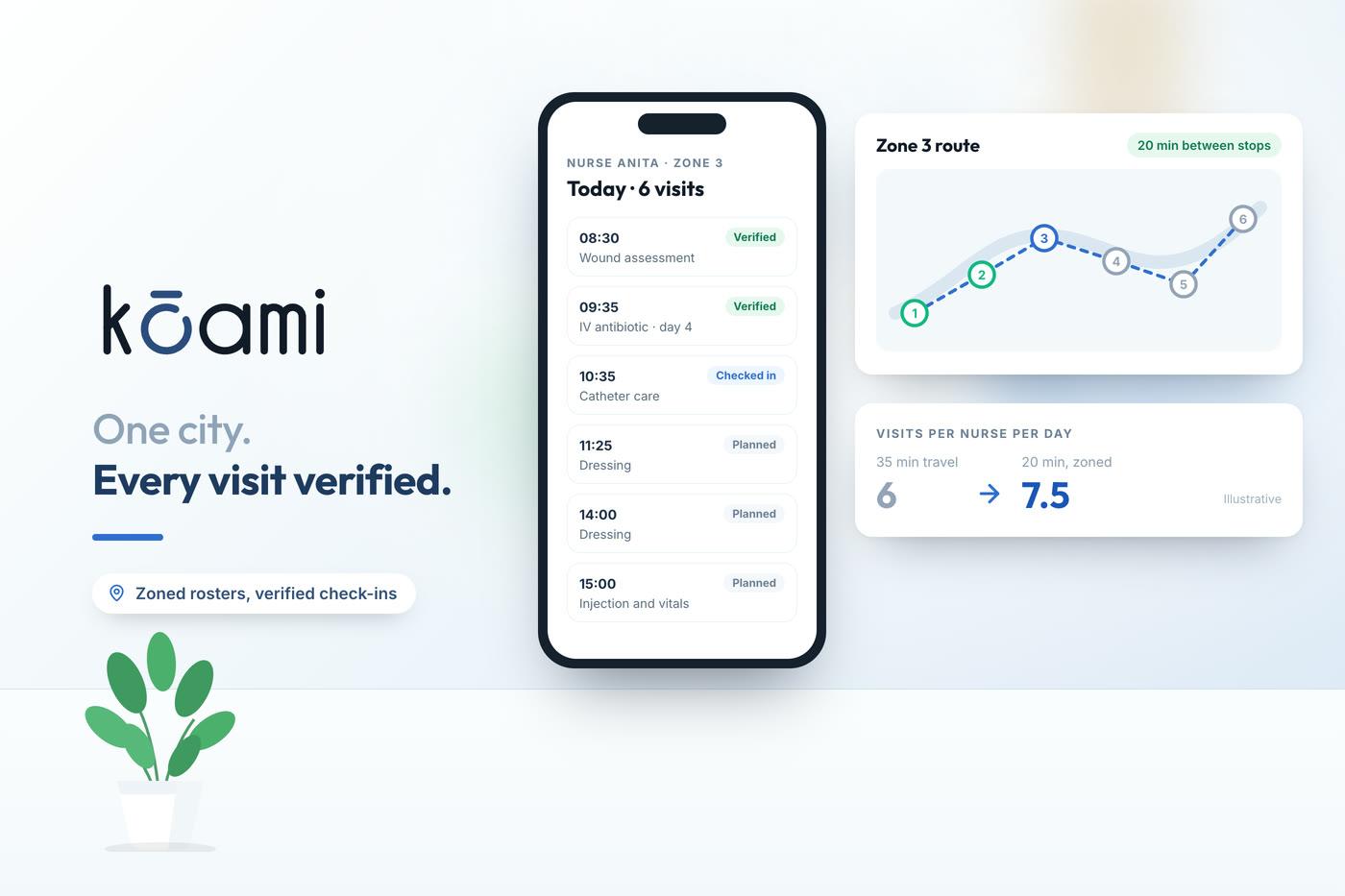
- Example: an 8-hour shift with a 30-minute break gives 450 usable minutes. With 40-minute visits and 35 minutes of travel, that is 450 ÷ 75, or 6 visits.
- If you split the city into zones and keep each caregiver mostly inside one zone, travel might fall to 20 minutes. Then it is 450 ÷ 60, or 7.5 visits.
That is about 25% more visits from the same team, without hiring anyone. Your numbers will differ; the method will not. Zones should follow traffic reality, not municipal boundaries. A river crossing or a flyover under construction can matter more than distance.
A visit-planning template
Whether you use software or a shared sheet, each planned visit needs the same fields. Use this as the template:
- Visit ID and episode ID (one episode can have many visits).
- Patient name, MRN and verified address with a map pin.
- Visit type code and planned duration.
- Required skill and preferred caregiver.
- Time window agreed with the family.
- Assigned caregiver and zone.
- Materials to carry (dressing kit, injection, consumables).
- Doctor's order reference for any medication or procedure.
- Status: planned, confirmed, checked in, completed, missed, cancelled.
- Check-in time, check-out time and actual duration.
- Billing code and package balance after the visit.
And for each caregiver, a daily plan:
- Start point and start time.
- Visits in sequence, each with its window and expected travel time from the previous stop.
- Buffer slots: keep one 45-minute slot free in each zone each day for urgent add-ons.
- End time, with any overrun flagged for the next day's planning.
A worked day for one nurse (illustrative)
Here is how one zone's plan might read for a nurse starting at 8:30 from home:
- 08:30 to 09:15: first visit of a new episode, post-surgical wound assessment (45 minutes, longer because it is the first visit).
- 09:35 to 10:15: IV antibiotic, day 4 of 7, doctor's order on file.
- 10:35 to 11:05: catheter care.
- 11:25 to 12:05: wound dressing, same patient as Monday.
- 12:05 to 12:35: break.
- 12:55 to 13:40: buffer slot, kept free for an urgent add-on from the zone.
- 14:00 to 14:40: wound dressing.
- 15:00 to 15:40: injection and vitals check.
- 16:00 to 16:30: notes completed, next-day kit collected.
That is six planned visits and one buffer slot that becomes a seventh visit on most days, with 20 minutes of travel between stops and the notes done before the shift ends rather than at night.
Confirm the next day's visits with each family by evening. A visit cancelled at the door costs a full slot plus travel.
Geo-verified visits, done fairly
Verification protects patients, families and caregivers. The family can see that the visit happened. The caregiver has proof of attendance if a dispute arises. The business can bill with confidence.
The usual method is check-in and check-out on the caregiver's phone, with location captured at those two moments and compared with the patient's map pin. Set a sensible radius, since GPS in dense apartment blocks can drift by a hundred metres or more. When a check-in falls outside the radius, ask for a reason rather than rejecting it.
Location data deserves care. The Digital Personal Data Protection Act, 2023 treats a caregiver's location and a patient's address and health details as personal data. Good practice, whether or not a given obligation is in force yet:
- Tell caregivers what is captured, when and why, and limit capture to check-in, check-out or working hours.
- Do not use visit location data for unrelated purposes.
- Collect only what the visit and the bill need from patients, and give them a clear notice at enrolment.
- Restrict who can see addresses and clinical notes, and keep access logs.
The DPDP Rules, 2025 were notified on 13 November 2025, and most of their obligations, including the security safeguards in Rule 6 (encryption or masking, access control, logs kept for a year, backups), come into force eighteen months after notification. Building them in now is cheaper than retrofitting later.
Clinical notes on mobile
The note is the visit. A caregiver should be able to complete it in a few minutes, on a phone, with patchy network. What the note should hold:
- Vitals, with the normal range for this patient shown alongside.
- What was done, against the care plan, and the materials used.
- Wound photographs, taken in the app with the patient's consent and stored in the record, not in the phone's gallery.
- Red flags with a clear escalation path: who to call, and within how long.
- The next planned visit, so the schedule updates itself.
If a doctor reviews the patient remotely, that consultation falls under the Telemedicine Practice Guidelines of March 2020, which set out how registered medical practitioners consult, document and prescribe remotely. The nurse at the bedside can be the doctor's eyes and hands, but the doctor's own record of the teleconsult still needs to be made.
Waste from home visits
Used needles and soiled dressings do not stop being bio-medical waste because they were generated in a living room. The Bio-Medical Waste Management Rules, 2016 apply to all persons who generate, collect or handle bio-medical waste in any form. Give caregivers puncture-proof sharps containers, bring sharps back into your facility's waste stream, and record it. Confirm your arrangement with your State Pollution Control Board.
Billing visits
Bill from the completed visit, not from the schedule. Each verified visit already carries the visit type, the caregiver, the duration and the materials, so the invoice can be generated from it. This removes the end-of-month argument about whether the Tuesday visit really happened.
Three billing models are common, and many operators run all three:
- Per visit: simple, but families feel every charge.
- Package: for example, 10 physiotherapy sessions or 14 days of post-surgical nursing. Draw the package down visit by visit and show the family the balance.
- Shift: for attendants and long-hours nursing, billed by the shift with attendance as the basis.
If you work with a hospital, agree up front whether visits are billed by the hospital as part of a discharge package or by you directly. Get it in writing, with the visit codes both sides will use.
The weekly review
Each Monday, look at five numbers for the previous week:
- Visits planned, completed, missed and cancelled at the door.
- Average travel time per visit, by zone.
- On-time arrival rate against the agreed window.
- Continuity: the share of visits done by the patient's usual caregiver.
- Notes completed within two hours of check-out.
These tell you whether the problem is the plan, the map or the team.
Where software fits
The work is the same whether a hospital outreach team or a standalone operator runs it: one roster, one visit record, one bill. Kōami's workforce tools already cover rosters, geofenced attendance and credential tracking for hospital teams, and in a demo we can walk through how a home visit service would sit alongside them. Our articles on geofenced attendance and credential expiry go deeper on the workforce side, and the nurse scheduling software page shows the roster.
This article is general information, not legal advice. Check your data protection approach and waste arrangements with your advisers.
If you would like to see a city-wide home visit roster, verified visits and package billing on synthetic data, we can walk you through it. Book a demo: koami.in/book-demo
Frequently asked questions
- How many home visits can a nurse do in a day?
- Divide the usable shift minutes by the average visit time plus average travel time. With a 450-minute usable shift, 40-minute visits and 35 minutes of travel, that is about six visits. Cutting travel to 20 minutes through zoning lifts it to about seven and a half. The figures are illustrative; use your own visit logs.
- What is visit verification in home healthcare?
- It is evidence that a visit happened at the patient's home, at a recorded time, for a recorded duration, by the assigned caregiver. Usually that means a check-in and check-out on a mobile app, with location captured at those two moments and a short clinical note.
- Is it legal to track home care staff location in India?
- Location is personal data under the DPDP Act, 2023, so it needs a lawful basis, a clear notice and limits on use. Capture location at check-in and check-out or during working hours only, explain why, and do not use it for anything unrelated to visits. Take legal advice for your specific setup.
- How should home visits be billed?
- Bill from the completed visit record, not from the schedule. Each verified visit carries its service code, duration and caregiver, so the invoice reflects what was done. Packages such as 10 physiotherapy sessions should be drawn down visit by visit, with the balance visible to the family.
- What should a home care visit note contain?
- Vitals, the procedure done, materials used, the patient's condition against the care plan, anything escalated to the doctor, and the next planned visit. Wound photographs need the patient's consent and should stay inside the clinical record, not in the caregiver's phone gallery.
Sources
Follow Kōami on LinkedIn
Get the next guide on hospital operations, software and compliance in your feed, as soon as it is published.