Never Staff an Expired Licence Again
Published
There is a particular kind of quiet risk in a hospital that never shows up until an auditor or a lawyer goes looking for it: the staff member on duty whose licence, registration or mandatory training lapsed weeks ago, and whom the roster kept assigning because nobody was watching the dates. Nothing looks wrong on the day. The nurse is competent, the shift is covered, the ward runs. The problem is entirely on paper - until the paper is what matters, in an accreditation review, an insurance query, or an adverse event investigation. Credential expiry is one of the most preventable risks in healthcare operations, and one of the most commonly ignored.
The credentials that actually lapse
"Credential" is a broad word, and the things that expire are more numerous than most rosters track. In a typical hospital the list runs long:
- Nursing council registration and its periodic renewal.
- Medical registration for clinicians.
- BLS, ACLS and other life-support certifications with fixed validity windows.
- Radiation safety badges and training for staff working near imaging.
- Fire safety, infection control and other mandatory annual trainings.
- Role-specific competencies that a unit requires before it will accept a nurse onto its rota.
Each of these has an issue date and an expiry date, and each one is somebody's responsibility to renew. In practice that responsibility is scattered across the individual, the HR file, and a supervisor's memory, which is to say it is nobody's reliable job.
Why the spreadsheet always loses
The default tool for tracking credentials is a spreadsheet with a column of expiry dates, and it fails in the same way every time. Somebody has to remember to open it, sort it, and act on it before a date passes. That person goes on leave, gets busy during an NABH cycle, or simply trusts that the last update is still current. The spreadsheet does not raise its hand. It waits to be asked, and by the time someone asks, the expiry has already happened and staff have already worked shifts they were not, on paper, cleared to work.
A credential register that does not warn you is just a record of when you found out too late.
The failure is structural, not personal. Any control that depends on a human remembering to check a static list will eventually fail on the day that human is distracted. The fix is to make the credential data active rather than passive.
Make the credential block the assignment
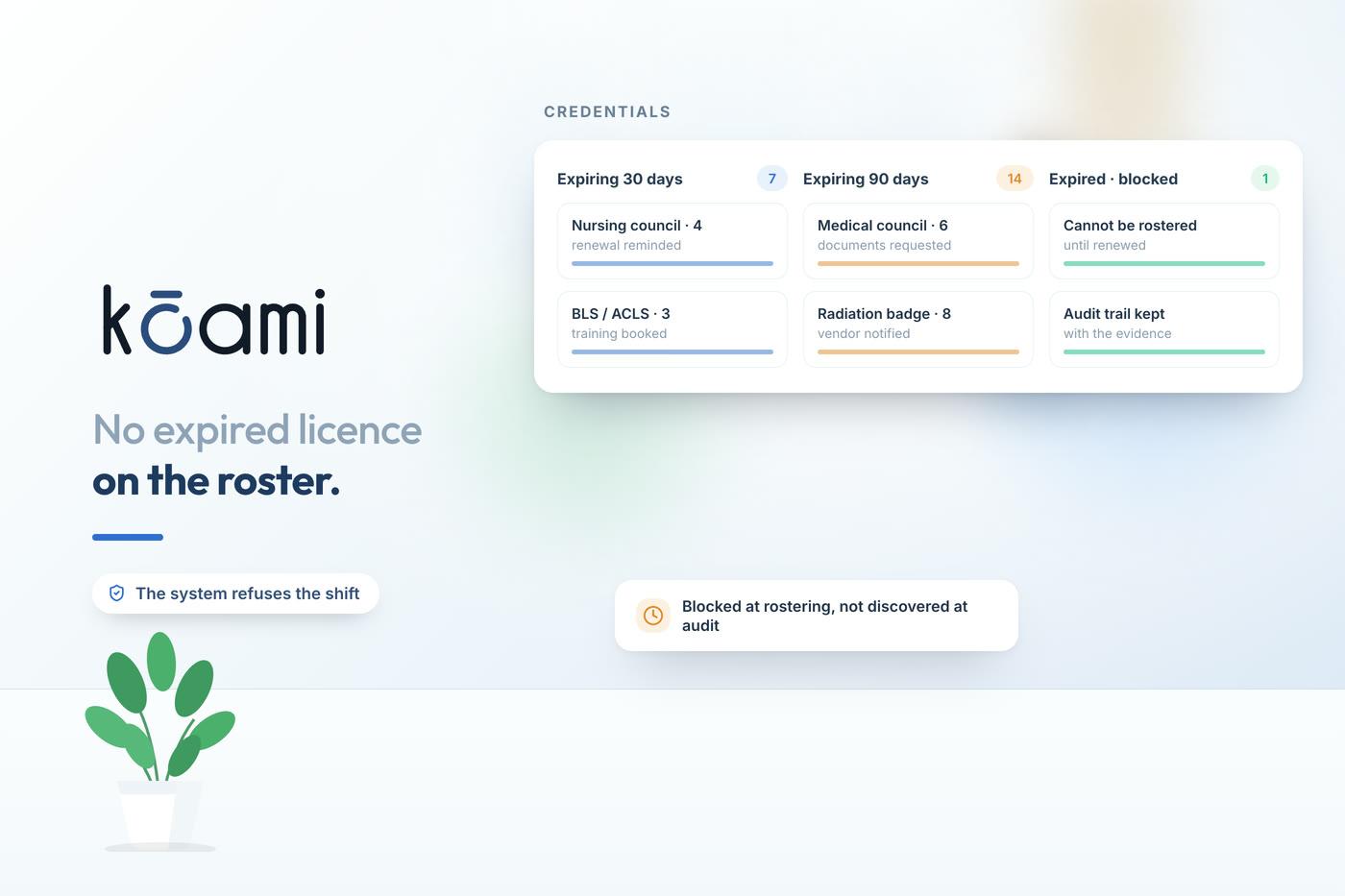
The decisive move is to connect the credential record to the roster itself, so that expiry is not merely reported but enforced. In the Kōami HRMS, each staff member's credentials are held as structured records with expiry dates, and those dates participate in scheduling decisions. That changes the question from "did anyone notice?" to "can this person even be assigned?"
Concretely, the system can:
- Warn well ahead of expiry - 60, 30 and 7 days out - to the individual, their supervisor and HR, so renewal happens before the deadline, not after.
- Flag a scheduled shift where the credential will lapse before the shift is worked.
- Prevent, by policy, the assignment of a nurse to a unit whose required competency she does not currently hold.
- Surface a live dashboard of who is expiring when, by department, so managers see the wave coming.
The graduated warnings matter. A single alert on the expiry date is useless; a renewal often takes weeks to arrange. Nudging at 60 days gives people time to actually do something, and enforcing the block at the roster level means that even if every reminder is ignored, an expired credential still cannot quietly end up on a duty list.
It is worth stressing how different this is from the reporting model most hospitals rely on. A report tells you, after the fact, that something went wrong. An enforced rule stops the wrong thing from happening in the first place. The credential register moves from being an archive you consult during an audit to being an active guardrail that shapes today's roster.
Design the reminders so people act
An alert that everyone ignores is worse than no alert, because it trains people to dismiss the system. Credential reminders earn attention when they are specific, escalating and owned:
- Specific: name the credential, the person, the exact expiry date and what renewal requires.
- Escalating: if the 60-day nudge is ignored, the 30-day and 7-day reminders widen to include the supervisor and then HR.
- Owned: every credential has a clear responsible person, so a reminder lands somewhere accountable rather than in a shared inbox nobody reads.
Get this right and renewals stop being fire drills. The unit knows in advance that three nurses need ACLS refreshers next quarter and can schedule the training without pulling the ward apart at the last minute.
From risk register to routine
The payoff is not only avoiding a bad audit finding, though that alone justifies the effort. It is that credential management stops being a periodic panic and becomes a quiet routine. When the roster itself refuses to staff an expired licence, the worst outcome is designed out rather than watched for. Accreditation reviews become a matter of exporting a clean report rather than scrambling to plug gaps in the fortnight before the assessors arrive.
No hospital sets out to staff an expired credential. It happens because the information sits in a passive list while the roster carries on regardless. Close that gap - let the expiry date reach into the scheduling decision - and the problem largely solves itself. The nurse gets renewed on time, the ward stays properly covered, and the paper tells the same true story as the practice. That alignment, boring as it sounds, is what good clinical governance actually looks like day to day.
Follow Kōami on LinkedIn
Get the next guide on hospital operations, software and compliance in your feed, as soon as it is published.