IRDAI Cashless 1-Hour Rule: A TPA Desk Checklist
Published
It is 4:40 pm on a Friday. The surgeon has written the discharge order, the patient's family has the car waiting downstairs, and the insurance desk is still building the final bill because two pharmacy returns have not been posted. When the discharge request finally goes to the TPA at 6:15, the family has already been waiting ninety minutes, and none of that time was the insurer's.
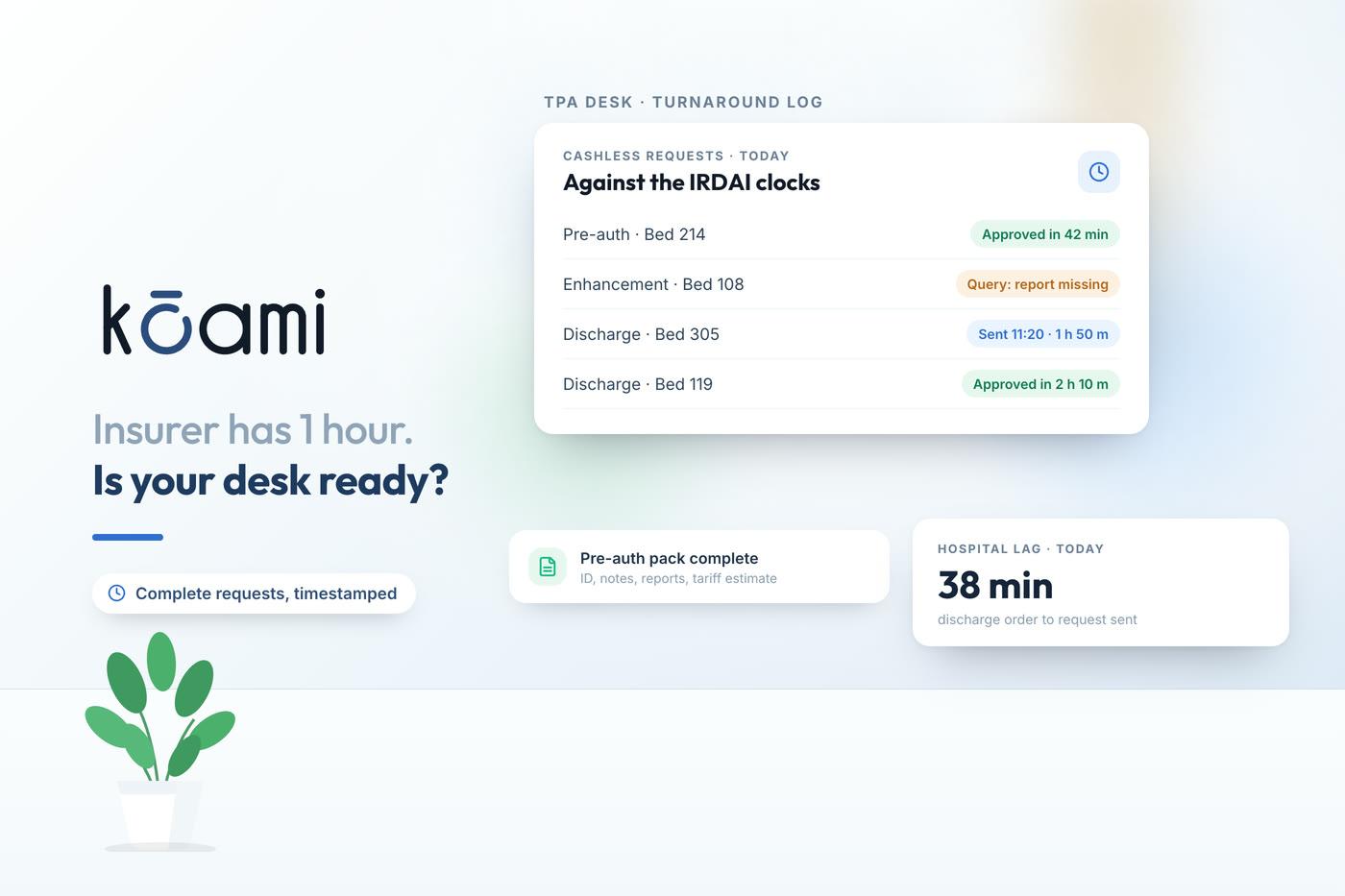
That gap is what this article is about. In May 2024 IRDAI put hard clocks on insurers for cashless decisions. Those clocks only start when the hospital's request lands. If your desk is slow or sends incomplete requests, the rule does not help your patients, your bed turnover or your cash flow. This is a working guide for the TPA desk head and the CFO who answers for both.
What does the May 2024 IRDAI master circular actually say?
The document is the Master Circular on Health Insurance Business, reference IRDAI/HLT/CIR/PRO/84/5/2024, dated 29 May 2024. It superseded 55 earlier circulars listed in its Annexure-6, including the 2022 standards and benchmarks for hospitals. The cashless clauses that matter to a hospital desk are in Chapter I, paragraphs 15 to 17. Quoted closely:
- Para 15(a): every insurer "shall strive to achieve 100% cashless claim settlement in a time bound manner", with reimbursement only in exceptional cases. Note the word "strive". It is a target, not a guarantee.
- Para 15(b): the insurer "shall decide on the request for cashless authorization immediately but not more than one hour of receipt of request". Insurers had to have systems in place by 31 July 2024.
- Para 15(c): insurers may arrange dedicated help desks in physical mode at the hospital. Optional, not mandatory.
- Para 16(a): final authorisation within three hours of receipt of the discharge authorisation request from the hospital. "In no case, the policyholder shall be made to wait to be discharged from the Hospital."
- Para 16(b): if there is a delay beyond three hours, any additional amount charged by the hospital "shall be borne by the insurer from shareholder's fund".
- Para 16(c): if the patient dies during treatment, the insurer shall immediately process the claim request and have the mortal remains released from the hospital immediately.
- Para 17(c): insurers and TPAs "shall collect the required documents from the Hospitals. Policyholder shall not be required to submit the documents."
IRDAI's Master Circular on Protection of Policyholders' Interests (5 September 2024) repeats these timelines and adds two lines worth printing for the desk: non-cashless claims are to be settled within fifteen days of submission, and "no claim shall be rejected or closed for want of documents". When we checked IRDAI's circulars list in October 2026, we found no later circular changing these cashless timelines. Check again before you train staff on it.
What the circular does not say
Three gaps cause most of the confusion at hospital desks.
- It does not bind the hospital to a clock. The one hour and three hours belong to the insurer. Nothing stops the clock running long before the request is sent. That time belongs to your hospital.
- It does not define a "complete" request. If a pre-auth arrives without the investigation report the medical team needs, a query is the predictable result. The circular doesn't say how a query affects the clock. The safe assumption is that a complete request is the only kind that reliably gets decided within the hour.
- It does not separate planned and emergency admissions. The one-hour rule applies to "the request for cashless authorization", whatever the admission type. Planned admissions give you no extra time.
Where does the clock really start?
Draw the timeline the way the insurer sees it and then the way the patient sees it. For a planned surgery:
- Patient arrives, admission advised. Hospital time.
- Desk verifies policy, collects ID and the doctor's notes, builds the estimate. Hospital time.
- Request submitted on the insurer's or TPA's portal, or through the claims exchange where that insurer is live. Insurer's one hour starts.
- Decision, query or approval. Insurer time. If there is a query, the time it takes to answer is hospital time again.
On discharge day, the pattern repeats. The doctor's discharge order, the summary, pharmacy returns, final bill and the request itself are all hospital time. Only after the request is received does the insurer's three hours begin.
The rule gave insurers a deadline. It gave hospitals a mirror: every minute before submission is now visibly yours.
Pre-auth document pack: a complete checklist
Most queries come down to a short list of missing or inconsistent items. Keep this checklist laminated at the desk and built into whatever system raises the request. It is a working list drawn from common TPA query patterns. Your insurers' own forms decide the final list.
Patient and policy
- Photo ID of the patient, matching the name on the policy or e-card exactly (spelling, initials, date of birth)
- Health card or policy number, insurer and TPA name, corporate or retail policy noted
- Policy validity checked for the admission date; any waiting-period or sub-limit flags noted
- Contact number and email of the patient or attendant for insurer communication
Clinical justification
- Treating doctor's notes: presenting complaint, duration, relevant history, examination findings
- Provisional diagnosis, with ICD code where your desk records it
- Planned line of treatment or procedure, with the reason inpatient care is needed
- Investigation reports that support the diagnosis (imaging, lab), dated, legible, with the patient's name on each page
- For accident cases: whether an MLC was registered and the MLC or FIR number where applicable
- For maternity, chronic or pre-existing conditions: first consultation date and history the policy will ask about
Cost estimate
- Room category requested and its per-day tariff, matched to the policy's room-rent eligibility
- Estimated length of stay
- Itemised estimate: procedure or package, surgeon and anaesthetist fees, OT, implants (with type), investigations, pharmacy and consumables
- Package code and rate if the insurer has an agreed tariff with your hospital
- Signature or digital confirmation from the treating doctor on the request form
Before you press submit
- Name, age and gender identical across the ID, the form and every report
- Estimate built from the same tariff that will produce the final bill
- Every attachment opens and is readable on a phone screen
- Submission time recorded
Running-bill and enhancement discipline
The second biggest source of discharge-day delay is the gap between what was approved and what has been spent. Patients stay an extra day, an implant changes, a second procedure is added, and the desk finds out at final billing.
A simple rule fixes most of it: review the running bill against the approved amount every day at a fixed time, for example after morning rounds. When the running bill crosses about 80% of the approved amount, or when the clinical plan changes, raise the enhancement then, with the updated notes, not on discharge day. The 80% trigger is our suggestion, not an IRDAI number. Pick a threshold that suits your case mix and apply it consistently.
- Daily: running bill vs approved amount for every cashless inpatient
- On change of plan: enhancement request with the doctor's note explaining why
- On room change: check the room-rent eligibility again, since proportionate deductions often start here
- Before discharge order: pharmacy returns posted, consumables reconciled, no pending charges from lab or radiology
A discharge-day sequence that fits the 3-hour window
The aim is to send a complete discharge request within a set time of the doctor's discharge order. Here is a sequence many desks can adapt. The times are illustrative targets, not rules.
- T-24 hours: ward flags expected discharges for tomorrow. Desk checks each one: approved amount, running bill, open enhancement.
- T-0 (doctor writes discharge order): discharge summary drafting starts immediately; nursing closes medication charts; pharmacy starts returns.
- T+30 min: pharmacy returns posted; lab and radiology confirm no pending charges.
- T+45 min: final bill generated from the same tariff as the estimate; summary signed.
- T+60 min: discharge authorisation request submitted with the final bill, summary, investigation reports and any implant stickers or invoices. Submission time recorded.
- Insurer's three hours start. The desk watches for queries and answers within minutes, not hours.
Worked example, illustrative: a 100-bed hospital with 12 cashless discharges a day loses about 24 bed-hours daily if each one waits two extra hours on hospital-side steps. That is roughly one bed-day every day, or about 365 bed-days a year, before counting the impact on admissions waiting for beds. You can redo the sum with your own numbers. The point is that hospital time is the part you control.
Tracking turnaround by insurer and TPA
You can't manage what you don't timestamp. Keep a log, in your system or a shared sheet, with one row per request. This is the template we suggest.
Insurer-wise turnaround log: columns
- Request ID and patient UHID
- Insurer and TPA
- Request type: initial pre-auth, enhancement, final discharge
- Admission order time (or discharge order time for final requests)
- Request submitted time
- First response time and response type: approved, query, partial, denied
- Query sent time, query answered time
- Final decision time and approved amount
- Patient left the bed time (for discharge requests)
- Reason code for any query (from a fixed list: ID mismatch, missing report, tariff mismatch, room eligibility, policy exclusion, other)
What to calculate every week
- Hospital lag: order time to submission time. This is yours.
- Insurer turnaround: submission to final decision. Compare with one hour (pre-auth) and three hours (discharge).
- Query rate by insurer and by reason code. A high rate for one reason is a desk training or template problem.
- Patient wait: discharge order to patient leaving the bed.
A sample row, illustrative: Insurer A via TPA X, final discharge, order 11:05, submitted 12:20, query 13:10 (pharmacy bill not itemised), answered 13:25, approved 14:05, bed vacated 14:30. Hospital lag 75 minutes plus 15 minutes answering the query; insurer turnaround 1 hour 45 minutes. The query was avoidable.
After a month, the log tells you which insurers decide inside their windows, which reasons drive your queries, and how much of the patient's wait was your own.
Where a connected system helps
The checklist and the log are useful on paper. They work far better when the request is built from data the hospital already has. When registration, the doctor's notes, investigation reports and the tariff live in one system, the pre-auth and the final bill come from the same source, and every timestamp in the log is captured as the work happens. Kōami builds the pre-auth and discharge request from the patient's existing clinical and billing record and keeps each request's status and timestamps on the patient's stay, so the desk works from a live list instead of an inbox. For the process side, see our guides on pre-auth without the back-and-forth and reducing claim settlement time, and how the National Health Claims Exchange changes the transport layer.
A one-page summary for the desk
- The insurer's clocks: one hour for cashless decisions, three hours for final discharge authorisation, both from receipt of your request.
- Your clock: everything before submission, and every minute spent answering a query.
- Send complete requests: identity matched, clinical justification attached, estimate built from the real tariff.
- Review running bills daily and raise enhancements when the plan changes.
- Start discharge work at the discharge order, not at the final bill.
- Timestamp every request and review the log weekly by insurer and reason.
This article is general information, not legal advice, and is based on IRDAI's circulars as published at the time of writing. Check your insurer agreements and IRDAI's site for updates.
If you want to see how a pre-auth, an enhancement and a discharge request look when they are built from one patient record, book a demo.
Frequently asked questions
- Does the IRDAI 1-hour rule apply to the hospital or to the insurer?
- To the insurer. Para 15(b) of the 29 May 2024 master circular says the insurer shall decide on a cashless authorisation request immediately and not later than one hour of receipt. The hospital's job is to send a request complete enough to be decided in that hour.
- When does the 3-hour discharge clock start?
- On the insurer's receipt of the discharge authorisation request from the hospital (para 16(a)). Time the hospital spends finishing the summary and final bill before sending that request is not covered by the insurer's three hours.
- Who pays if final discharge approval takes longer than 3 hours?
- Para 16(b) says any additional amount charged by the hospital because of a delay beyond three hours shall be borne by the insurer from the shareholders' fund. Your hospital still needs timestamps to show the request went in complete and on time.
- Can the TPA ask the patient to submit claim documents?
- The circular says insurers and TPAs shall collect required documents from the hospital and the policyholder shall not be required to submit them (para 17(c)). That shifts the paperwork to the hospital desk, which is why a complete document pack matters.
- Are insurers required to keep a help desk inside the hospital?
- No. Para 15(c) says insurers may arrange dedicated physical help desks at hospitals. It is optional. Para 15(d) separately requires insurers to offer pre-authorisation to policyholders in digital mode.
Sources
Follow Kōami on LinkedIn
Get the next guide on hospital operations, software and compliance in your feed, as soon as it is published.