Hospital Management Software in Kuwait (2026): A Buyer’s Guide for Private Hospitals
Published
The finance manager of a private hospital in Kuwait City runs the month-end revenue report and finds it 1.4 dinars short of the ledger. Not 1,400. One point four. It takes two days to find, and the cause is not fraud or a missing bill. The billing system was built for currencies with two decimal places, and the Kuwaiti dinar has three. Every line item had been rounded to the nearest ten fils, thousands of times a month, and the errors had quietly added up.
It is a small story, and it is a good summary of buying hospital software in Kuwait. Most of what a Kuwaiti private hospital needs is what any good hospital needs. The difference is in a handful of local details — the payer mix, the currency, the tax position, the language and where the data sits — that generic or imported systems get slightly wrong, and slightly wrong every day becomes expensive. This guide is for owners, CEOs, medical directors and finance heads of private hospitals, specialist centres and clinic groups in Kuwait.
What should hospital management software do for a private hospital in Kuwait?
It should run the whole hospital on one patient record — registration, outpatient and inpatient care, the operation theatre, pharmacy, laboratory, radiology and billing — and get five Kuwait-specific things right: billing across a mixed payer base, the three-decimal dinar, a tax engine that works without VAT today, Arabic and English documents, and a defensible decision on where patient data is hosted.
Kuwait's private sector is unusually concentrated in a few kinds of facility: general private hospitals, specialist centres in fields such as maternity, orthopaedics, ophthalmology, dermatology and fertility, and multi-branch polyclinic groups. Each needs the same core, and each puts the weight on a different module, which is why the demo should run your busiest real scenario rather than the vendor's.
How do insurance and payers work for private hospitals in Kuwait?
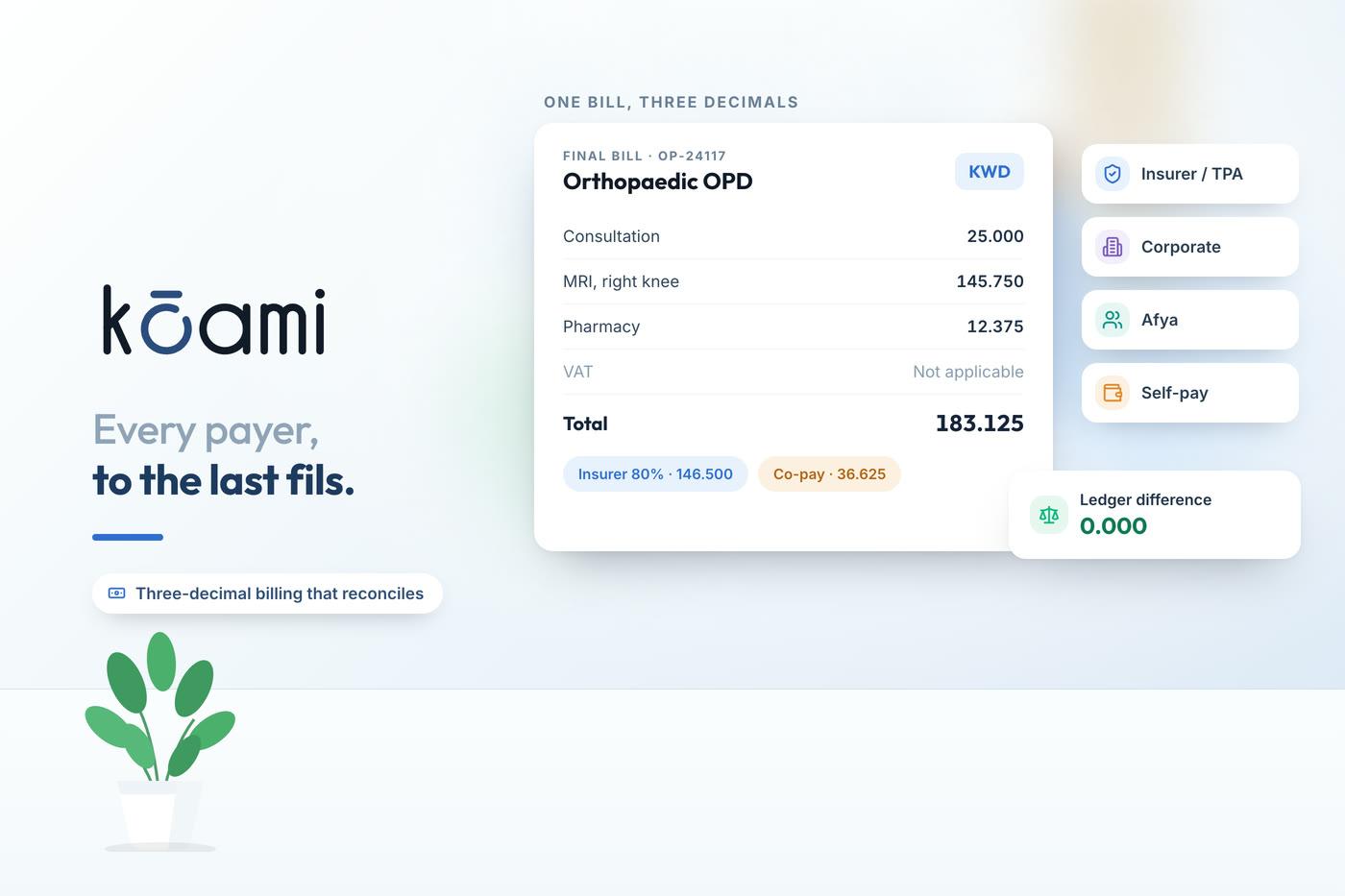
A Kuwaiti private hospital typically bills several kinds of payer at once: private insurers and their third-party administrators, corporate accounts, the Afya scheme for retired Kuwaiti citizens, and self-paying patients. Each comes with its own price list, approval rules and paperwork.
Dhaman, the Health Assurance Hospitals Company, provides the mandatory health cover that expatriate residents need, delivered largely through its own primary care centres and hospitals rather than through private hospitals. So for most private hospitals the commercial patient is a Kuwaiti citizen choosing private care, a resident with a private or employer-sponsored plan, or a self-payer — and the billing system has to handle all of them in the same afternoon.
For software, that means:
- Payer-specific price lists and packages, applied automatically from the patient's registration rather than chosen by the clerk.
- Approvals tracked against the encounter, so a procedure is not performed, billed and then discovered to have needed an approval nobody requested.
- Co-payments and deductibles calculated at the counter, not reconstructed at discharge.
- Statements and claim packs per payer in the format each insurer or TPA expects, with outstanding amounts aged by payer.
The discipline is the one Indian hospitals know from TPA and corporate billing, which is why our guides to package versus open billing and getting paid faster translate well.
Why does the Kuwaiti dinar matter to hospital billing software?
Because the Kuwaiti dinar is divided into 1,000 fils and priced to three decimal places, and software built for two-decimal currencies rounds it wrongly. A tariff of 12.375 KWD stored as 12.38 is a small error once and a reconciliation problem a thousand times a month.
Three decimals have to hold everywhere the money goes: the tariff master, every line on a bill, discounts and co-payments, refunds and deposits, pharmacy sales, the general-ledger export and every report. Test it in the demo by creating a tariff with a value in fils, applying a percentage discount and a co-payment to it, refunding part of it, and then checking the ledger export to the last fils.
Is there VAT on healthcare in Kuwait?
No. Kuwait does not levy VAT as of 2026. It has signed the common GCC VAT framework but has not passed the law that would implement it, and current government plans point to no introduction before 2028 at the earliest.
That does not mean tax can be ignored in the software. A hospital system for Kuwait should issue clean invoices without VAT today and have a tax engine that can be configured — not rewritten — if VAT or excise rules arrive, since groups expanding into the UAE or Saudi Arabia will meet VAT and e-invoicing there immediately. Hard-coded "no tax" is a decision you will pay to undo.
Does patient data have to stay in Kuwait?
Kuwait does not yet have a single comprehensive data protection law that governs every business. The main privacy instrument, CITRA's Data Privacy Protection Regulation (Resolution No. 26 of 2024), applies to service providers licensed by CITRA, the communications regulator, and CITRA's cloud computing regulatory framework governs licensed cloud providers and how data is classified and hosted.
For a hospital, that means the hosting decision rests on a combination of things: Ministry of Health licensing conditions, the expectations of insurers and corporate clients, the data-classification rules your cloud provider operates under, and plain prudence about sensitive data. Many private hospitals choose to keep production data and backups in Kuwait for exactly that reason, and a group operating across the Gulf will in any case meet strict in-country rules in the UAE and Saudi Arabia.
Whatever you decide, put three things in the contract: where production data, backups and disaster-recovery copies sit; from which country vendor support may access the system; and how you get all your data back when you leave. Our article on where patient data lives covers the trade-offs. This section is a summary for buyers, not legal advice; confirm the position for your facility with counsel.
Does hospital software in Kuwait need to work in Arabic?
For patient-facing documents, yes. Consent forms, invoices, discharge summaries, prescriptions and patient messages are commonly expected in Arabic alongside English, and a large expatriate population means many patients read neither as a first language.
Arabic runs right to left, names must be held in both scripts without one overwriting the other, and mixed-language documents must still print cleanly. Bring your own consent form and discharge summary to the demo and ask to see both produced, printed and searched in both languages.
How should a multi-branch clinic group in Kuwait set up its software?
On one patient record and one master data set across every branch, with branch-level stock, cash and reporting underneath. A patient seen in Salmiya and then in Jahra should be one patient with one history, not two registrations that a call-centre agent has to reconcile.
The details that matter for groups:
- Central masters, local operations. One tariff and drug master maintained centrally, with branch-specific prices where they genuinely differ.
- A shared appointment book so the call centre can offer the nearest free slot in any branch.
- Stock by branch, purchasing centrally, with inter-branch transfers recorded rather than carried in a car boot.
- Rosters that fit the week. Kuwait's weekend falls on Friday and Saturday, and Ramadan changes clinic hours for a month; a rostering system should handle both without a spreadsheet.
- Licence tracking for every clinician, because each one holds a Ministry of Health licence with an expiry date — the problem our article on credential expiry describes.
Our guide to running a multi-branch hospital group on one system goes into the group model in more depth.
Which modules does a Kuwaiti private hospital need?
- Registration with Civil ID capture and payer details recorded once.
- OPD and EMR with coded diagnoses, structured orders and e-prescriptions.
- Inpatient care, beds and the operation theatre, with charges captured as care happens.
- Pharmacy with batch and expiry control and a controlled-medicines register.
- Laboratory and radiology with results returning to the chart.
- Billing with multi-payer price lists, approvals, co-payments and three-decimal accuracy.
- Workforce, rostering and licensing for round-the-clock staff.
- Inventory and purchasing across stores and branches.
- Reports an owner reads: revenue by department, doctor and payer, outstanding receivables and occupancy.
Our complete module list explains what each one does and which can be phased in later.
How much does hospital management software cost in Kuwait?
Vendors quote per bed, per user, per module or per facility, then add implementation, interfaces, hosting and support. The structure of the price decides the total far more than the headline figure does.
In Kuwait, ask specifically about local hosting and its backups, Arabic configuration, payer statement formats, three-decimal currency support and the cost of adding a branch. Then put five years of all of it side by side at your current size and at the size you plan to be. The worksheet in our guide to affordable hospital management software was written for India, but every line applies.
What is the cheapest hospital management software in Kuwait?
The cheapest system to buy is usually a clinic product or an imported system sold with few changes. The cheapest system to run is the one that bills every payer correctly to the fils, does not need a second product for the pharmacy or laboratory, and lets a new branch open on the same platform rather than on a new contract.
Ask a narrower question than "what is the monthly fee?" Ask what each system will cost over five years with every module, branch and interface you need, and what it will save in reconciliation time and unbilled charges. A complete suite at a fair price routinely wins that comparison against a cheap system plus the people it takes to correct it.
What should you ask a hospital software vendor in a Kuwait demo?
- Which hospitals or clinic groups in Kuwait or the wider Gulf run your system live today?
- Show a tariff in fils through discount, co-payment, refund and ledger export, and reconcile it.
- Show three payers — an insurer, a corporate account and a self-payer — billed for the same procedure.
- How is our tax set-up configured today, and what changes if VAT arrives?
- Where will production data, backups and disaster-recovery copies be hosted?
- From which country will your support team access our system?
- Print an invoice, a consent form and a discharge summary in Arabic and English.
- Show one patient seen in two branches, with one history.
- What does a new branch cost to add, in money and in weeks?
- What does it cost to export all our data, and in what format, when we leave?
Where Kōami fits
Kōami is built to give hospitals a premium, complete suite at an affordable price. Kōami Hospital runs registration, OPD and EMR, inpatient care, the operation theatre, pharmacy, laboratory, radiology and billing on one patient record, with a tariff and package engine for insurers, sponsors and corporate accounts, role-based access and an audit log of every view and edit. It is multi-branch by design, so a second or fifth site joins the same record. Kōami Workforce handles rotational rosters and licence tracking, and Inventory runs stock across every store.
You pay only for the modules you switch on, hospital deployments are typically priced per bed with unlimited users, and onboarding, data migration support and training are included in hospital plans. Enterprise plans support cloud, hybrid and on-premise deployment, so a Kuwaiti hospital can keep its data where it decides it should be.
Kuwait-specific configuration — three-decimal dinar billing, payer statement formats and Arabic patient documents — is scoped for your facility during evaluation, and we will confirm in writing what is in place before you sign, the same standard this guide asks of every vendor. See how Kōami pricing is structured, then book a demo and bring a real month of bills. We will run them through with you, to the last fils.
Follow Kōami on LinkedIn
Get the next guide on hospital operations, software and compliance in your feed, as soon as it is published.