Digital Marketing for Hospitals in India (2026): What Actually Fills the OPD
Most hospitals in India already spend money on marketing. It goes on a hoarding near the flyover, a health camp, a brochure redesign, and a Facebook page somebody in administration updates when they remember. What almost none of them can tell you is which of those things produced the patient who walked into the OPD this morning, because nobody wrote it down in a form that survives the shift.
Meanwhile the shortlist that decides where that patient goes is being made somewhere else entirely — in a search box, on a map, and in a column of reviews, usually on a phone, usually within a few kilometres of the hospital. This guide is about that second world: what it is made of, what it costs, what Indian law lets a hospital say inside it, and how to measure the whole thing in admissions rather than in clicks.
What does digital marketing for a hospital actually involve?
Five jobs, in this order: being findable, being credible, being contactable, being present where demand is created, and being measurable. Everything an agency will sell you fits into one of those, and a programme that skips any one of them leaks.
Findable is search and maps — the hospital appearing when somebody types a treatment, a speciality or "near me". Credible is what they see when they find you: reviews, doctor profiles, real photographs, articles that answer the question they actually asked. Contactable is the website doing its job — an appointment in two taps, a phone number that connects to a desk that answers, a WhatsApp thread that does not die. Present is advertising and social, which create demand rather than wait for it. Measurable is the part that almost everybody skips, and the part that decides whether next year's budget is argued from evidence or from anecdote.
A hospital does not need all five at full strength on day one. It does need to know which one it is currently failing, because that is where the next rupee belongs.
Where does a patient's shortlist actually get made?
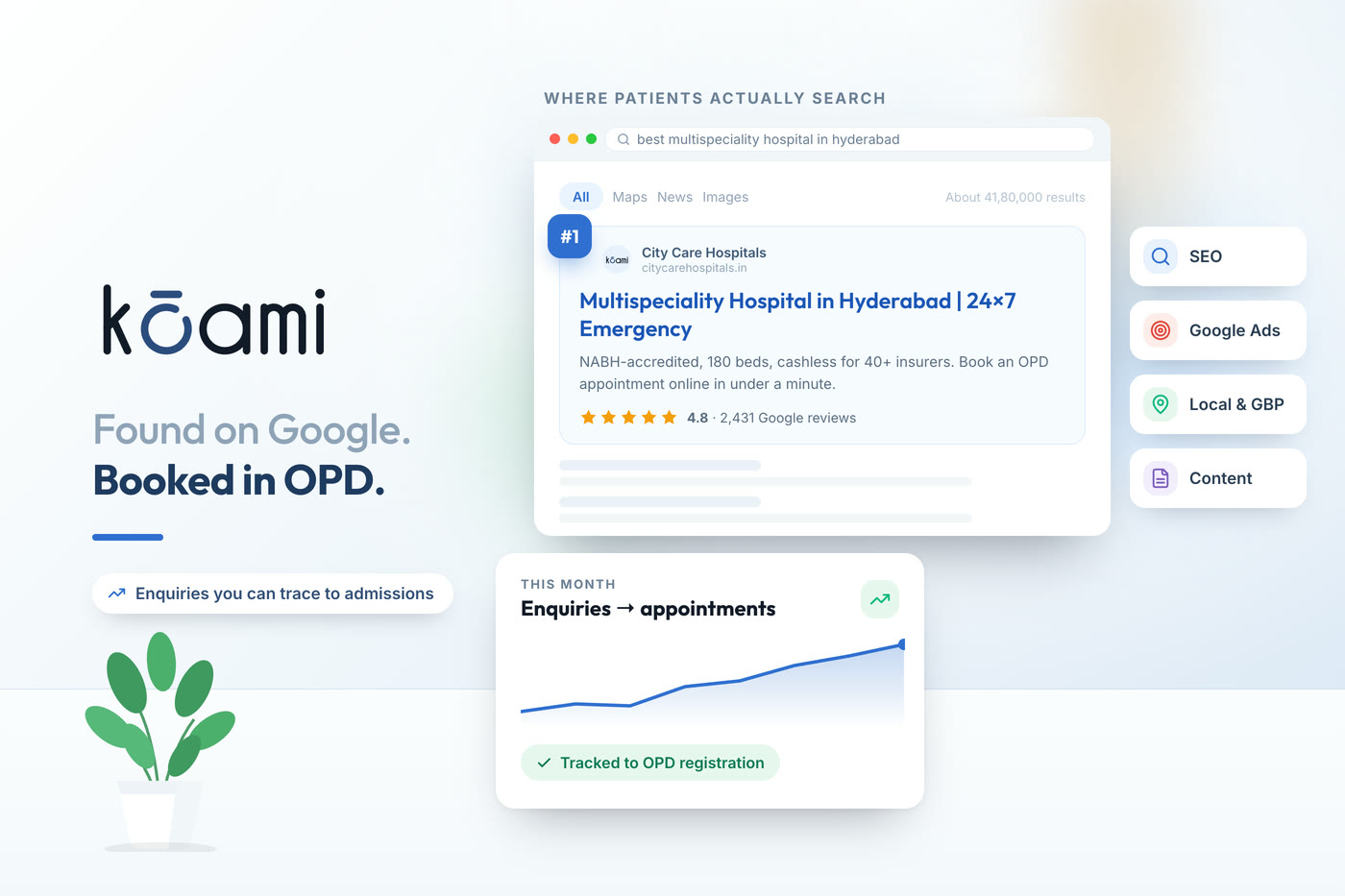
In three places, and only one of them is your website. The first is the Google results page for a query like "gastroenterologist in Kukatpally" or "best maternity hospital near me". The second is the map — the three local listings that appear above everything else, with ratings, distance and a call button. The third is the set of reviews and photographs attached to those listings.
This matters because of where the effort usually goes. A hospital will spend eight lakh on a website redesign and nothing on the Google Business Profile that decides whether anybody ever reaches the website. For local, urgent, high-intent searches — which is most of healthcare — the profile is the shop window and the website is the shop.
The second thing that matters is the device. Assume a mid-range Android phone on a patchy 4G connection in a waiting room, not a designer's laptop. A site that takes six seconds to paint on that phone has lost the patient before the hero image arrives.
Which channel brings patients into the OPD fastest?
Ranked honestly by time-to-first-patient: Google Business Profile, then paid search, then reputation, then SEO, then social.
- Google Business Profile can move in days. Claiming the listing, fixing the category, adding services, hours, photographs and a booking link is a week of work that routinely changes the number of calls a hospital gets.
- Paid search is immediate. You are buying the top of the results page for the terms you cannot yet rank for, and you can turn it off.
- Reviews compound quickly. A steady, honest flow of them — asked for at discharge, never bought — moves both the map pack and the conversion rate of everybody who sees it.
- SEO is the slowest and the cheapest per patient in the long run. Treatment pages, department pages and genuinely useful articles take months to rank and then keep working.
- Social and video are the slowest to attribute and the best at creating demand that does not exist yet — the screening camp, the new cath lab, the doctor who explains a procedure well.
The mistake is treating these as alternatives. Paid search buys the quarter; SEO and reviews buy the year. Most hospitals should run both, with the split moving towards organic as it starts to produce.
What is a hospital legally allowed to advertise in India?
Less than most agencies assume, and the rules bind the doctor more tightly than the institution. This is the section worth reading twice, because the penalties land on your clinicians.
The operative professional-conduct code is still the Indian Medical Council (Professional Conduct, Etiquette and Ethics) Regulations, 2002. The National Medical Commission notified a replacement in August 2023 and put it in abeyance within weeks, so the 2002 code is what applies. Its clause 6.1.1 treats soliciting patients, directly or indirectly, as unethical — while allowing a hospital to publish factual announcements about itself: who works there, what it treats, what facilities exist, what it charges.
On top of that sit three statutes that catch healthcare advertising specifically. The Drugs and Magic Remedies (Objectionable Advertisements) Act, 1954 prohibits advertisements claiming to cure a schedule of listed conditions. The PCPNDT Act prohibits anything that touches pre-natal sex determination, and its enforcement is not theoretical. The ART and Surrogacy Acts constrain what a fertility centre may claim, which is why IVF success-rate advertising is a minefield. Self-regulation adds the ASCI code on top.
What this means in practice: publish facts, not promises. "180 beds, 24×7 emergency, NABH accredited, cashless with 40 insurers" is safe. "India's best cardiac surgeon" and "guaranteed cure" are not. Patient success stories with names and photographs — the staple of every agency content calendar — are the single most common way an Indian hospital's marketing puts its doctors at risk.
And since 2023, one more: the Digital Personal Data Protection Act governs the enquiry forms, the WhatsApp lists and the retargeting pixels. A patient enquiry is personal data with a purpose attached, and "we already had their number" is not consent to market to them.
What does hospital digital marketing cost in India?
Published price ranges from Indian studios put a clinic website at roughly ₹90,000 to ₹2.5 lakh, and a multi-department hospital site anywhere from ₹1.6 lakh to ₹6.5 lakh, with complex builds quoted well past that. Treat those as the shape of the market rather than a quotation: the variable is not pages, it is integrations, languages and number of locations.
Retainers behave differently. A single-location clinic running local search and reviews is a small monthly engagement. A multi-branch hospital running SEO, ads, content and profiles across several cities is several times that, and the ad budget sits on top — it is media spend, not fees, and it should be reported separately.
Two honest observations about budget. First, the cheapest possible website is usually the most expensive thing a hospital buys, because a site that cannot be edited, cannot be measured and cannot be found gets rebuilt in eighteen months. Second, if a proposal has no line for measurement, the agency is planning to report positions and impressions, because those never go down.
How do you measure marketing in admissions rather than clicks?
By carrying one identifier from the ad click to the hospital number. The chain is unglamorous and it works: tag every campaign link, capture the enquiry with its source attached, make the front desk record that source when the appointment is created, and match the appointment to the UMR when the patient registers.
At that point three numbers become available that almost no Indian hospital currently has: cost per enquiry, cost per appointment, and cost per admission, each by channel and by department. They change decisions. A campaign with a cheap cost per lead and no admissions is a campaign spending money on people who were never going to come, and until the chain is joined it looks like your best performer.
This is also where a marketing agency and a hospital system have to meet. If your HMS can export appointments with their source, the join is a weekly report. Where the site, the campaigns and the hospital system are built by the same people, it is a live dashboard. The technique is described in full in following a patient from ad click to admission.
What should a hospital do in its first ninety days?
- Weeks 1–2. Claim and complete the Google Business Profile for every location. Fix categories, hours, services, photographs, and put a working booking link on it. Start asking discharged patients for reviews.
- Weeks 3–6. Fix the website's speed and mobile layout, and make the appointment path two taps from any page. Put proper department and doctor pages in place. Install analytics, call tracking and Search Console before you spend on ads, not after.
- Weeks 5–8. Start paid search on your highest-intent terms only — your own name, your specialities, your city. Keep the budget small and the negative keyword list long.
- Weeks 7–12. Begin the content and local-SEO programme that compounds: treatment pages, location pages that do not cannibalise each other, and articles that answer real questions.
- Week 12. Review cost per enquiry and cost per appointment by channel. Cut what did not produce, and move the money to what did.
Where Kōami fits
We build hospital software, and we run this work as a service: websites, SEO, local search, ads, content and attribution for hospitals, clinics, diagnostic centres and fertility centres — including ranking in countries you don't operate in.
The reason a software company is a reasonable choice for it is narrow and specific: we can join the marketing to the medical record. When the site and the campaigns are wired to Kōami Hospital, an enquiry carries its source into the appointment and the appointment carries it into the UMR, so "what did we spend per admission in cardiology last month" has an answer instead of an argument. If you would like that answer for your own hospital, tell us the market you want to win and we will send an audit of where you currently stand.
Keep reading
Affordable Hospital Management Software in India (2026): A Premium Suite Without the Enterprise Price
Nursing Home Management Software in India (2026): Features, Price and a Buyer’s Checklist