AI Medical Scribe for Doctors in India (2026): What Actually Works in a 60-Patient OPD
A consultant in a busy Indian OPD sees forty to eighty patients in a day, and some public hospital OPDs see well over a hundred. At even three minutes of writing per patient, documentation takes hours that do not exist in the schedule. So the notes get shorter, the prescriptions get handwritten, and the record the hospital is supposed to be building for ABDM, NABH and insurance claims ends up as a line of shorthand.
AI medical scribes promise to break that trade-off: the doctor talks to the patient, and the software writes the note. In 2026 the technology is good enough to take seriously and uneven enough to test carefully. This guide covers what an AI scribe does, where it struggles in Indian consultations, what the law expects, and how to evaluate one without putting patients at risk.
What is an AI medical scribe?
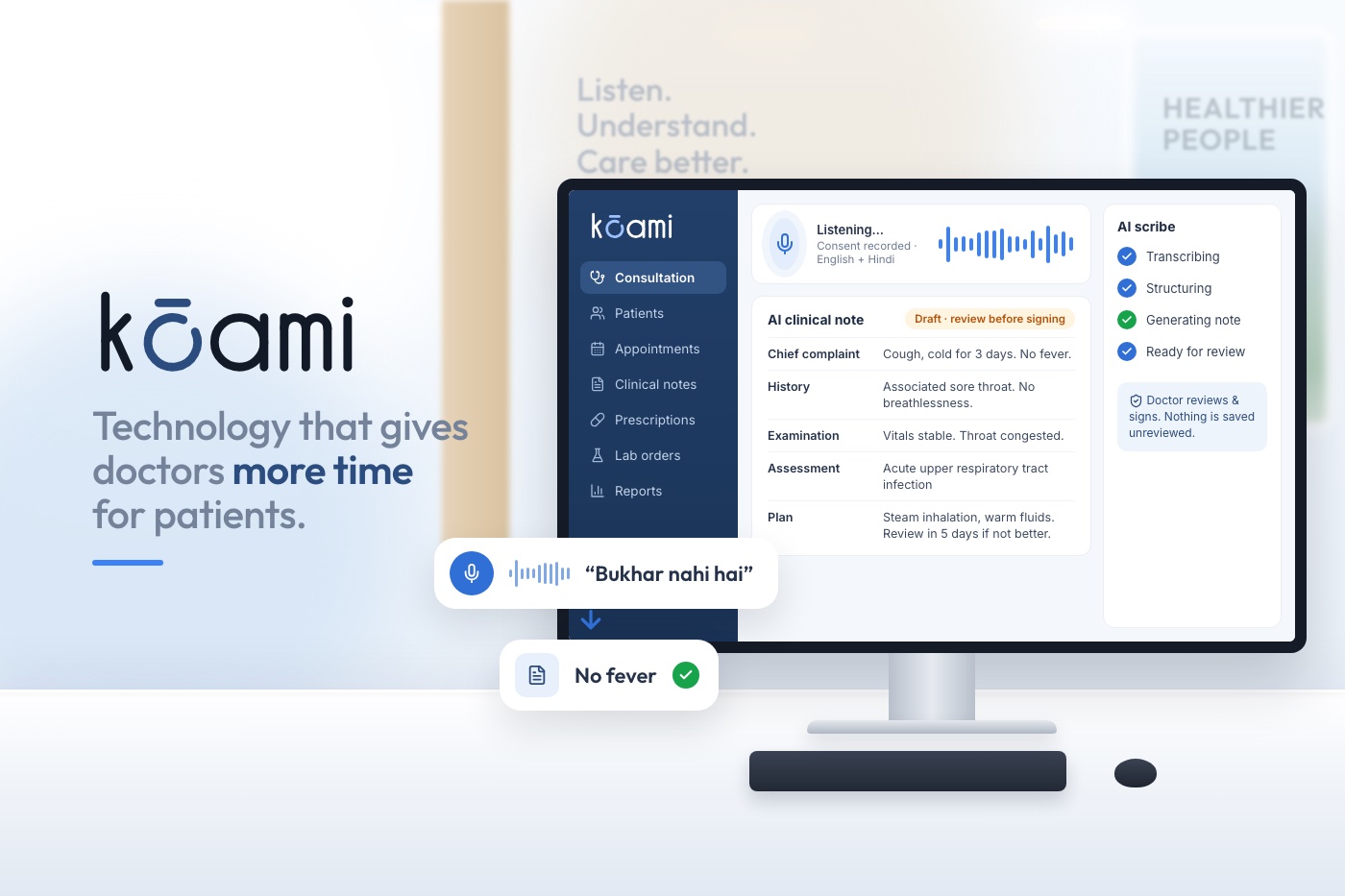
An AI medical scribe is software that listens to a doctor–patient consultation, with consent, and drafts a structured clinical note from it — history, examination, diagnosis, prescription and follow-up — for the doctor to review and sign.
It is also called ambient clinical documentation, because it works in the background of a normal conversation rather than requiring the doctor to dictate. That is the key difference from older voice-to-text tools. Dictation converts what the doctor says into text. An ambient scribe has to decide which parts of a conversation are clinically relevant, who said them, and where in the note they belong.
Why are Indian doctors adopting AI scribes now?
Because OPD volumes keep rising, digital records are becoming a requirement rather than a preference, and speech recognition on Indian accents has become good enough to use.
Three pressures meet in 2026. ABDM expects consultations to become structured, shareable health records linked to a patient's ABHA. Insurers and NHCX claims need documented clinical justification rather than a handwritten slip. And NABH assessors look for complete, timely notes. Each of these asks the doctor for more documentation at exactly the moment the OPD has fewer minutes to give it. An AI scribe is the first tool that offers to grow the record without growing the typing.
Can an AI scribe understand Hindi, Hinglish and regional languages?
Partly, and this is the question to test hardest. Most Indian consultations move between English and one or more Indian languages mid-sentence, and error rates on that kind of speech are markedly higher than on clean English.
The errors that matter are not spelling mistakes. They are clinical inversions:
- Negation. "Bukhar nahi hai" — no fever — recorded as fever.
- Drug names and doses. Brand names that sound alike, and twice a day heard as three times.
- Laterality. Left knee and right knee confused in a conversation where the patient pointed rather than said.
- Speaker attribution. A relative's description of symptoms recorded as the patient's own report.
- Numbers. Blood pressure, sugar readings and durations misheard in a noisy room.
No vendor demonstration will show you these, because demonstrations use clean audio. The only reliable test is your own consultations, in your own OPD, in your patients' languages, reviewed line by line by the doctor who conducted them.
Is it legal to use an AI medical scribe in India?
Yes, provided the patient is informed and consents, the doctor reviews and signs the final note, and patient data is handled in line with the Digital Personal Data Protection Act.
No Indian law prohibits AI-assisted documentation, but several existing obligations shape how it must be used:
- The doctor remains responsible. A prescription or clinical note is the registered medical practitioner's document. An AI draft signed without being read is still the doctor's error.
- Consent must be specific. Recording a consultation for documentation is a distinct purpose from treatment. Under the DPDP Act, the patient should be told that audio is being processed, why, and for how long it is kept — and be able to decline without being refused care.
- Retention should be minimal. The safest pattern deletes the audio once the note is signed and keeps only the reviewed record.
- Know where the data goes. Ask whether audio is processed in India, whether it is used to train the vendor's models, and who the sub-processors are.
- Governance applies. The ICMR's ethical guidelines for AI in biomedical research and healthcare, and a hospital's own AI governance policy, both expect human oversight, accountability and a route for reporting errors.
Standalone AI scribe or one built into the hospital system?
Built in, for any hospital. A standalone scribe produces a note that someone still has to copy into the EMR, and the copying is where the time saving disappears.
The difference is larger than convenience. A scribe inside the hospital system can check its draft against what the record already knows — the allergy the patient forgot to mention, the medicine they already take, this morning's lab result. It can turn "come back in two weeks" into an actual appointment, and a spoken prescription into a structured order the pharmacy receives. A standalone tool produces text; an integrated one produces a record. We described how that works in practice in cutting clinician typing with ambient notes.
Standalone scribes do suit one setting well: an independent consultant without a hospital system, who wants a better note and a printed prescription and will paste them wherever they need to go.
What should an AI scribe get right before it saves any time?
The parts of the note that change what happens to the patient. A scribe that writes a beautiful history and a wrong dose has saved nobody any time.
In a pilot, score these separately from overall note quality:
- Medication name, strength, dose, frequency and duration
- Allergies and current medications
- Negative findings stated in the consultation
- The diagnosis, and whether it maps to a code the system can report on
- Investigations ordered
- Follow-up interval and instructions given to the patient
- Anything the doctor said to the patient that was never meant for the note
The last item is easy to overlook. Doctors say reassuring things, and sometimes blunt things, that belong in the conversation but not in the permanent record.
How should a hospital pilot an AI medical scribe?
Small, measured and reversible: three to five willing doctors, four weeks, a baseline taken before the scribe is switched on, and every note reviewed.
A pilot that ends in a decision:
- Week 0: measure how long notes take today, how complete they are, and how late in the day they get finished.
- Weeks 1 and 2: doctors use the scribe with consenting patients and correct every draft, logging the type of each error.
- Weeks 3 and 4: measure time per note, the correction rate, and whether the doctors would choose to keep it.
- Decision: expand, change the configuration, or stop — against the numbers rather than against the demo.
Include at least one doctor who consults mostly in a regional language, and at least one sceptic. If the scribe works for both of them, it will work for the rest of the department.
What does an AI medical scribe cost?
Standalone scribes are usually priced per doctor per month, sometimes with a cap on consultation minutes; scribes built into a hospital system are more often included with the EMR or priced as an add-on to it.
The subscription is rarely the deciding cost. The costs worth comparing are the doctor time spent correcting drafts, the staff time spent moving notes into the EMR when the scribe is standalone, and the value of a structured record for claims, audits and ABHA-linked records. A cheaper scribe that produces a note someone has to retype is the more expensive one.
Where Kōami fits
Kōami's ambient documentation is part of the EMR inside Kōami Hospital rather than a separate app, so the draft note is written against the patient's existing record and lands in structured fields: diagnoses, orders, prescriptions and follow-up appointments. The doctor reviews and signs, and nothing enters the record unreviewed.
It is also the more affordable arrangement. Because the scribe works inside a premium hospital suite instead of arriving as one more subscription and one more integration, the hospital pays for one connected system and gets one record — the same record that feeds billing, pharmacy, ABDM linking and NABH audits. Role-based access and an audit log of every view and edit apply to AI-drafted notes exactly as they do to typed ones.
If documentation is costing your consultants their evenings, book a demo and bring a willing doctor. Run a few real consultations and judge the drafts yourself.