Cutting Clinician Typing with Ambient Notes
Published
Ask any clinician what they like least about their day and the answer is rarely a patient. It is the notes. The consultation that took twelve minutes generates twenty minutes of typing, and the typing does not happen between patients; it piles up and gets finished late in the evening, from home, long after the details have started to blur. Ambient documentation aims at this directly. It listens to the encounter, drafts the note, and hands the clinician back the minutes that used to disappear into the keyboard.
The documentation burden is a clinical problem, not an admin one
It is tempting to file paperwork under administration and move on. But documentation debt has clinical consequences. A note written six hours after the consultation is less accurate than one written during it. Details soften, exact figures get approximated, the specific phrasing a patient used gets lost. Worse, the sheer volume drives clinicians to shortcuts: cloned notes, copy-forward errors, templates padded with text nobody read. The record fills up while actually containing less.
There is a human cost layered on top. Time spent typing is time not spent looking at the patient, and it is time stolen from rest at the end of a shift. The burnout literature keeps returning to documentation load as a driver, and any OPD clinician running a full clinic recognises why.
- Notes written long after the encounter drift from what actually happened
- Copy-forward and cloned text bloat the record and hide real change
- Screen-facing data entry pulls attention away from the patient in the room
- After-hours charting eats into recovery and fuels burnout
What ambient capture actually does
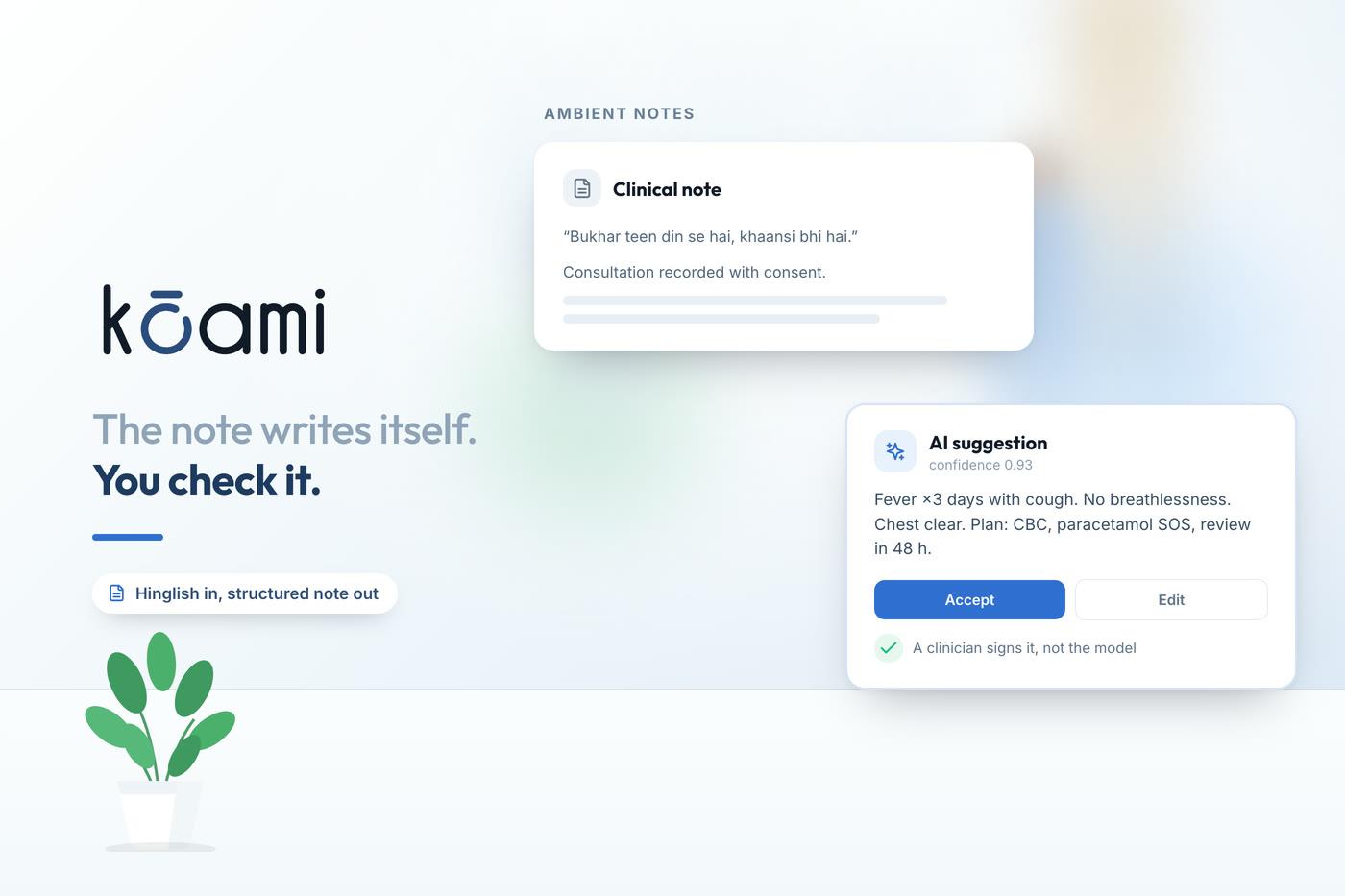
Ambient documentation uses the audio of a normal consultation, with the patient's knowledge and consent, and drafts a structured note from it. The clinician talks to the patient the way they always would. In the background the system distinguishes the clinical conversation from small talk, pulls out the history, examination findings, and plan, and lays them into the note structure the department already uses.
The important word is draft. What lands in the EMR is a starting point, not a finished record. The clinician reads it, corrects it, adds the reasoning that was in their head but never spoken aloud, and signs it. That review step is not a weakness of the approach; it is the whole safety model. The human who saw the patient is the one who commits the note.
The goal is not a note written by a machine. It is a note the clinician can finish in two minutes instead of twenty.
Fitting the note into a real record
A drafted paragraph of prose is only half the job. A clinical note has to slot into the actual record: the right patient under the right UMR, the correct OPD or IPD encounter, coded where coding is needed, with medications and follow-up landing in the fields the rest of the system reads. Ambient text that sits in a free-text blob helps the writer and nobody else.
This is where being part of the wider clinical system matters more than the transcription quality. Because Kōami's ambient layer writes into the same EMR that holds the patient's history, the draft can be checked against what is already known: the allergy the patient forgot to mention, the medication they are already on, the result that came back this morning. The note is not composed in isolation; it is composed against the record. A follow-up mentioned out loud can become an actual OPD appointment. A drug named in conversation can be reconciled against the current list rather than retyped blind.
Keeping the record trustworthy
Handing note-writing to a model raises fair questions, and they deserve concrete answers rather than reassurance.
- The clinician reviews and signs every note; nothing enters the record unread
- The draft is clearly marked as draft until a named clinician commits it
- The audio is handled as sensitive patient data, encrypted and access-controlled like the rest of the record
- What was captured, what was drafted, and who signed it are all logged, so the note has a clear provenance
- The clinician can always write or dictate manually; ambient capture is an option, not a mandate
The failure to avoid is a plausible-sounding note that quietly invents detail. Language models can produce fluent text that was never said. The defence is the review step and the discipline of checking the draft against the structured record, not trusting the prose on its own. A clinician who treats the draft as a colleague's rough notes, to be verified before signing, gets the benefit without the risk.
Measuring whether it actually helps
The promise is easy to state and worth checking honestly. Does documentation time per encounter fall? Do clinicians finish their notes before they leave rather than at home? Does the record get more specific, or just longer? A tool that produces beautiful prose but still needs heavy rewriting has not solved the problem; it has moved it.
The encounters where ambient capture helps most are the conversational ones: a complex history in OPD, a discharge discussion, a consultation where the clinician would otherwise be typing while the patient talks. It helps least where the work is procedural and the data structured, and that is fine. The aim is not to automate every note. It is to take the heaviest, most narrative documentation and make it fast enough that it gets done in the room, while the details are still fresh and the patient is still there to correct them.
Ambient notes will not, and should not, remove the clinician from the record. What they remove is the tax that turned a twelve-minute consultation into a thirty-minute one. Give a clinician back those minutes across a full clinic and you have not just saved time; you have moved their attention back to where it belongs, which is the person sitting across the desk.
Follow Kōami on LinkedIn
Get the next guide on hospital operations, software and compliance in your feed, as soon as it is published.