Catching Sepsis Earlier with Trend Signals
Published
Sepsis rarely announces itself. By the time it is obvious, with a crashing blood pressure and a patient who looks unwell to anyone walking past, the easy window has already closed. The difficult truth of sepsis is that the early hours, when treatment does the most good, are also the hours when the signs are subtle and scattered across a chart nobody is reading as a whole. Early warning is not about spotting the dramatic moment. It is about noticing the drift before it becomes a fall.
The signal is in the trend, not the snapshot
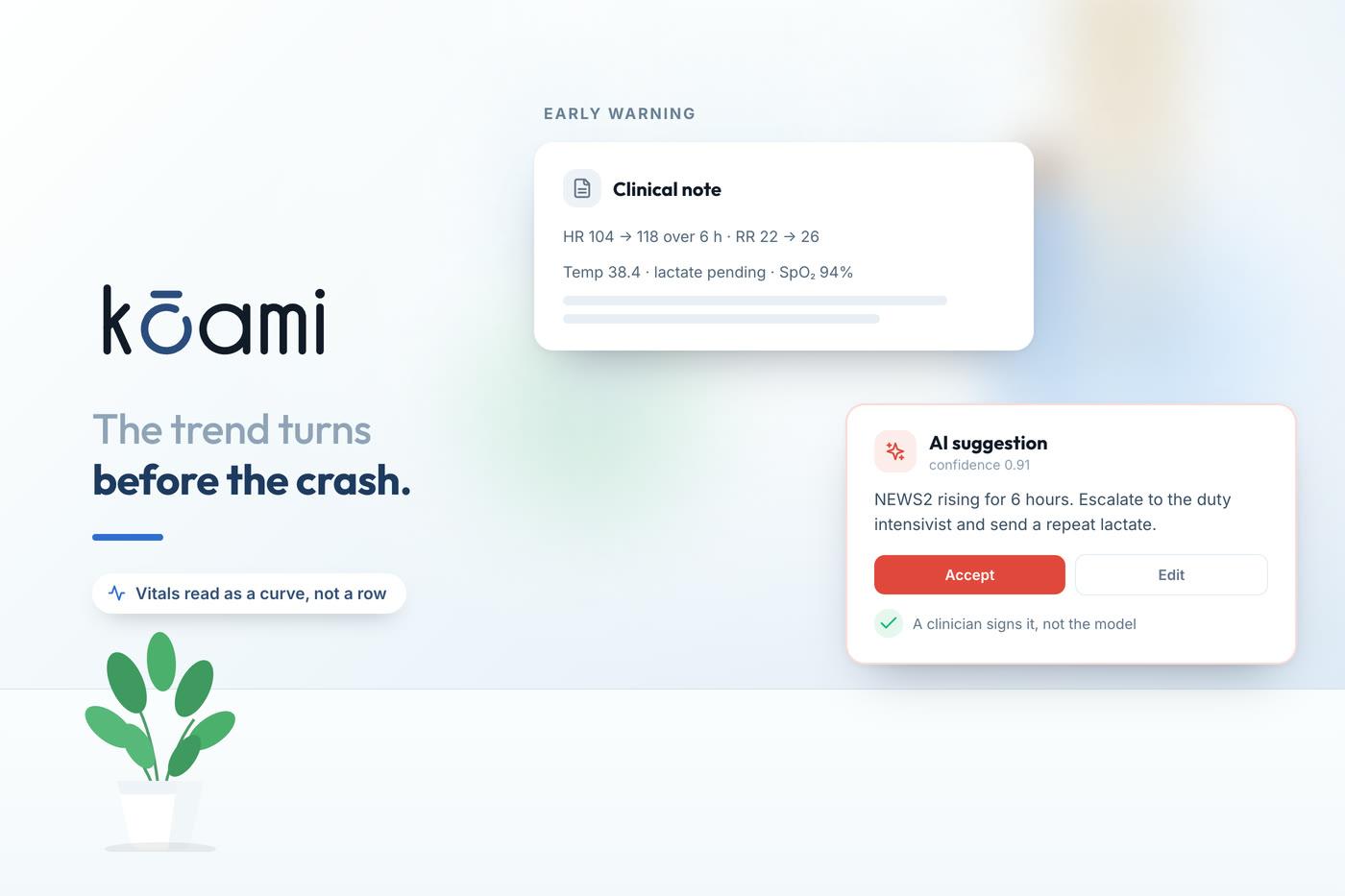
A single set of observations can look reassuring while a patient is quietly heading in the wrong direction. A heart rate of 96 is unremarkable. A heart rate that has climbed from 72 to 96 over six hours, alongside a respiratory rate creeping up and a temperature that will not settle, is a different story entirely. The individual numbers stay inside their normal ranges right up until they do not, and a clinician glancing at the latest vitals sees nothing wrong.
This is why trend beats snapshot. The information that matters is the direction and the rate of change, read across several parameters at once. Humans are not built to do this well across a busy ward. We anchor on the most recent reading, we compare it loosely to some remembered baseline, and we move on to the next of twenty patients. A model does not tire of watching the slope.
- Rising heart rate over hours, even within the normal band
- Respiratory rate climbing, often the earliest and most ignored sign
- Temperature instability, high or unexpectedly low
- Blood pressure trending down from the patient's own baseline
- Falling urine output and rising lactate where available
From MEWS to a moving picture
Most wards already run an early-warning score such as MEWS, and it is genuinely useful. It turns scattered vitals into a single number that triggers an escalation. But a periodic score is a series of snapshots. It fires when the patient has already crossed a threshold, and it does not see the six hours of drift that led there. It is a smoke alarm, not a thermostat.
A trend-based warning layer sits underneath the score and watches the movement between calculations. It combines the observation stream with what else the record knows: recent surgery, an existing infection, immunosuppression, the results that came back from the lab an hour ago. The result is not a replacement for MEWS but a sharpening of it. Where the score says this patient is now unwell, the trend layer can say this patient is becoming unwell, and here is why.
Sepsis care is a race against a clock that started before anyone noticed.
Why the alert has to be quiet and specific
Every clinician has been trained by bad alarms to ignore alarms. A sepsis warning that fires too often, or fires on patients who are obviously fine, will be muted within a week and rightly so. Alert fatigue is not a minor usability issue; it is the single most common reason these systems fail in the real world. The design constraint is brutal: the warning must be right often enough that people keep listening.
That means a few things in practice.
- The alert names the reason: which parameters are trending and over what period
- It fires early enough to matter but not so early that it cries wolf
- It routes to someone who can act, not to a screen nobody watches
- It supports escalation rather than replacing clinical judgement about it
- It can be acknowledged and its outcome recorded, so the system can be tuned
Because Kōami's early-warning layer reads the same observation and result streams that the rest of the record already captures, the clinician does not enter anything twice. The vitals charted at the bedside feed the trend analysis directly, and the warning appears where the ward already looks rather than in a separate application.
The clinician still owns the decision
A trend warning is a prompt, not a diagnosis. It says: look at this patient now, and consider whether the sepsis pathway applies. It does not order antibiotics, it does not diagnose the source, and it does not override the judgement of the person at the bedside who can see things no model can, such as how the patient actually looks and what the family is reporting.
This matters for adoption as much as for safety. Clinicians accept a tool that hands them a well-reasoned prompt and leaves the decision with them. They reject a tool that presumes to make the call. The correct division of labour is the one that already works in good clinical practice: the system watches tirelessly and flags the drift; the human assesses, decides, and acts. Every alert and its outcome are logged, so the ward can review its false alarms, tighten its thresholds, and see whether the tool is actually shortening the time to treatment.
The reward for getting this right is measured in hours saved at the front of a sepsis course, and those hours are the ones that change outcomes. Catching the drift at hour three instead of the fall at hour eight means antibiotics sooner, fluids sooner, and a senior review while the patient is still recoverable with less. No model catches every case, and none should be trusted to. But a tireless watcher on the slope of the numbers, handing a specific and timely prompt to a clinician who can act, turns some of those late falls back into early catches. In sepsis, that is the whole game.
Follow Kōami on LinkedIn
Get the next guide on hospital operations, software and compliance in your feed, as soon as it is published.