AI in Hospital Management Software: What Is Real in 2026 and What Is Still a Demo
Published · Updated
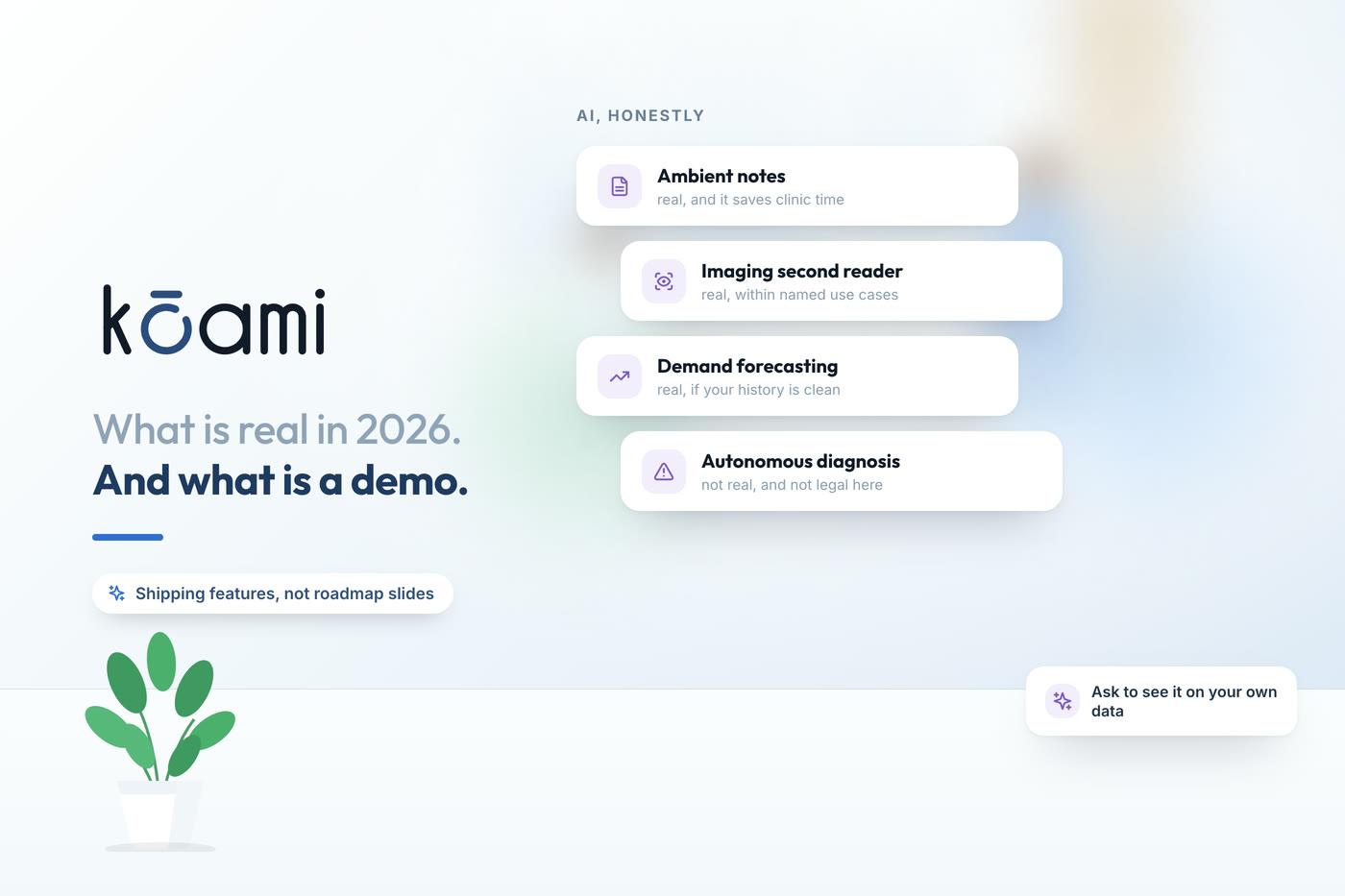
Every hospital software proposal in 2026 contains the word AI, usually on the cover. Some of what it describes is genuinely working in Indian hospitals today and paying for itself. Some of it works in a controlled demonstration and falls over on real data. And some of it is a feature that existed for a decade being renamed.
Sorting the three is not hard, but it does require asking a specific question of each claim: what does this do when it is wrong, and how would we know?
What AI features are genuinely working in hospitals today?
Five, in roughly descending order of how reliably they deliver.
Ambient documentation. A microphone in the consultation room, a transcript, and a structured note the clinician edits and signs. This is the clearest win available right now, because the task is language, the output is reviewed before it counts, and the time saved is directly measurable in minutes per consultation. Accuracy on Indian English, code-switching between languages, and drug names is the thing to test, not the demo video.
Imaging triage and second read. Algorithms that flag likely abnormalities on chest radiographs, CT head studies and screening mammography, reordering the worklist so urgent studies are read first. Several such tools have regulatory clearances and real deployments. They work as a second reader and a prioritiser, not as a replacement.
Coding and claim assistance. Suggesting diagnosis and procedure codes from the clinical note, and flagging claims likely to be rejected before submission. Unglamorous, easy to measure, and one of the fastest payback items in the list.
Deterioration and early warning scores. Models that watch vitals and lab trends and raise a flag before a patient crashes. These genuinely help, and they genuinely produce false alarms. The deployment succeeds or fails on the escalation protocol, not on the model.
Operational forecasting. Bed occupancy, OPD volume, theatre utilisation and stock demand. Mature, uncontroversial, and the least likely to be called AI on a brochure because it looks like statistics.
What is still mostly a demo?
Three categories, and each fails in a way worth understanding.
Autonomous clinical decision-making. Systems that propose diagnoses or treatment without a clinician in the loop. The technology is impressive and the accountability structure does not exist. Every serious deployment keeps a human decision-maker, and the ones that do not are not being run in a hospital.
Conversational interfaces to the whole record. Asking the system a free-form question about a patient and trusting the answer. Genuinely useful for summarising and searching, genuinely unreliable when it needs to be complete. The failure mode is confident omission, which is the worst possible failure mode in a clinical record.
Fully automated revenue cycle. Claims from note to payment with no human review. Works on the clean majority, and the clean majority was never the problem.
The useful question about any AI feature is not how accurate it is. It is what happens when it is wrong, who notices, and how fast.
What is agentic AI, and does a hospital need it yet?
An agent is software that takes actions rather than making suggestions, and the distinction is the whole of the risk. A model that drafts a discharge summary produces something a person signs. An agent that chases the missing investigation report, updates the claim and resubmits it has changed the state of the hospital without anyone having decided to.
The useful framing is not whether to allow agents but where an agent may act unsupervised. Three properties make an action safe to delegate, and an action needs all three:
- Reversible. Undoing it costs a click, not an apology. Re-sending a document qualifies. Discharging a patient does not.
- Bounded. The agent has a defined scope, a ceiling and a stopping condition. An agent that reorders below a par level within an approved value is bounded; one that "manages procurement" is not.
- Auditable. Every action is attributable, timestamped and visible to a named human afterwards. If the record cannot say what the agent did and why, the hospital cannot answer for it.
Against that test, the work that is genuinely ready to be delegated is administrative and unglamorous: chasing an incomplete file while the patient is still in the bed, drafting a pre-authorisation for a human to send, flagging a credential about to expire, raising a ward indent below a par level, reconciling a batch settlement to the claims it paid. What is not ready is anything that writes to the clinical record, administers, discharges, or moves money without a named person on the other end — and the boundary should be a configuration in the system rather than a convention in someone's head. Where an agent may act, and where it may not works through the same line in more detail, and the governance a hospital needs first is the thing to have in place before any of it.
The buying implication is short. A proposal offering agents should be answering, in writing, which actions the agent may take, what its ceiling is, what it does when it is uncertain, and where the log lives. A proposal that says "agentic" and cannot answer those four is describing a category, not a capability.
How should a hospital evaluate an AI claim in a proposal?
Six questions, and vague answers to any of them are informative.
- What exactly is the model doing, in one sentence, without the word AI?
- What data was it trained on, and does that population resemble ours?
- Is it regulated as a medical device anywhere, and what is its status here?
- What is its performance on our kind of case mix, and can we test it on our data before committing?
- Where does the data go? If inference happens outside the hospital, that is a data protection question with DPDP consequences.
- Who is accountable for a decision influenced by the output, and what does the audit trail record?
The last one is where most conversations end abruptly. If a model contributed to a clinical decision, the record should show that it did, what it said, and who acted on it. A system that cannot show this has not been designed for use in a hospital.
What governance does an Indian hospital need before deploying AI?
A named owner, an inventory, a review cycle and a documented escalation path. None of it is exotic and all of it is missing in most deployments.
Practically, this means the hospital knows which AI tools are in use and where, each has a clinical owner who is accountable for it, each has a defined performance review at a stated interval, and each has a rule for what staff do when they disagree with it. Add the data protection position: what data leaves the hospital, under what consent, to whom, and where it is stored.
This is also the point where the DPDP framework and NABH expectations converge. Consent for processing, purpose limitation, access logging and the ability to explain what happened to a patient's data are obligations regardless of whether a model is involved, and models make them harder to satisfy, not easier.
Does AI change how hospital software should be built?
Yes, in one specific way: it raises the value of structured data enormously.
Every AI capability in the working list above depends on data that can be read by a machine. Coded diagnoses, structured orders, results as values, medication records with actual administration times. A hospital whose clinical record is free text in a rich editor cannot use most of this, and no amount of model quality compensates.
This is the most practical AI-related decision a hospital will make, and it happens years before any model is bought. Choosing a system that captures structured data, and configuring it so staff actually produce structured data rather than pasting paragraphs into a notes field, is what makes the later options possible.
The second implication is API access. AI tools change faster than hospital systems do, and the ones you will want in three years do not exist yet. A platform with documented, standards-based interfaces can adopt them. A closed one cannot, whatever its own roadmap promises.
What changed when everyone started saying "agents"?
The word moved from describing a model that produces an output to describing software that plans a sequence of steps and executes them against real systems without a person confirming each one. That is a genuine distinction, and it is the one to hold on to while reading any 2026 proposal.
Most of what is sold as agentic is still assemble-and-approve: the software gathers a denial pack, drafts a summary, proposes a theatre list, and a human commits it. That is valuable and it is not autonomy. Actual autonomy — an action written to the hospital's records with no human in the loop — is a much smaller set, and hospitals have quietly run some of it for years in the form of auto-reorder rules and auto-posting.
So the governance question is not whether to allow agents. It is which action classes may be delegated, under whose named authority, logged how, and reversible by whom. Agentic AI in hospital operations works through the permitted and forbidden lists and how to run a pilot that produces a decision rather than an anecdote.
One market observation worth carrying into a vendor meeting: ambient documentation is the one healthcare AI use case with essentially universal adoption activity, while autonomous clinical action remains rare in production anywhere. If a proposal reverses that ordering — light on documentation, heavy on autonomous decisions — it is describing a roadmap, not a product.
How should a hospital start?
With one use case, measured, in a department that wants it.
Pick something with a clear metric and a low blast radius. Ambient documentation in one outpatient department, measured in consultation minutes and clinician satisfaction. Claim rejection prediction, measured in first-pass rate. Imaging triage, measured in time to report for urgent studies.
Run it for a defined period against a defined question, keep the human decision first, record the disagreements, and be willing to conclude that it did not help. The hospitals that get value from AI are not the ones that bought the most of it. They are the ones that measured.
Kōami's position is that AI belongs inside the workflow rather than beside it, and that the platform's job is to make the data structured, the access governed and the audit trail complete, so that whatever tools a hospital chooses can be adopted and, when necessary, removed. The model is not the hard part. The record it reads from, and the accountability around what it says, is.
Follow Kōami on LinkedIn
Get the next guide on hospital operations, software and compliance in your feed, as soon as it is published.