Best Hospital Management Software in India (2026): How to Compare Them Properly
Published · Updated
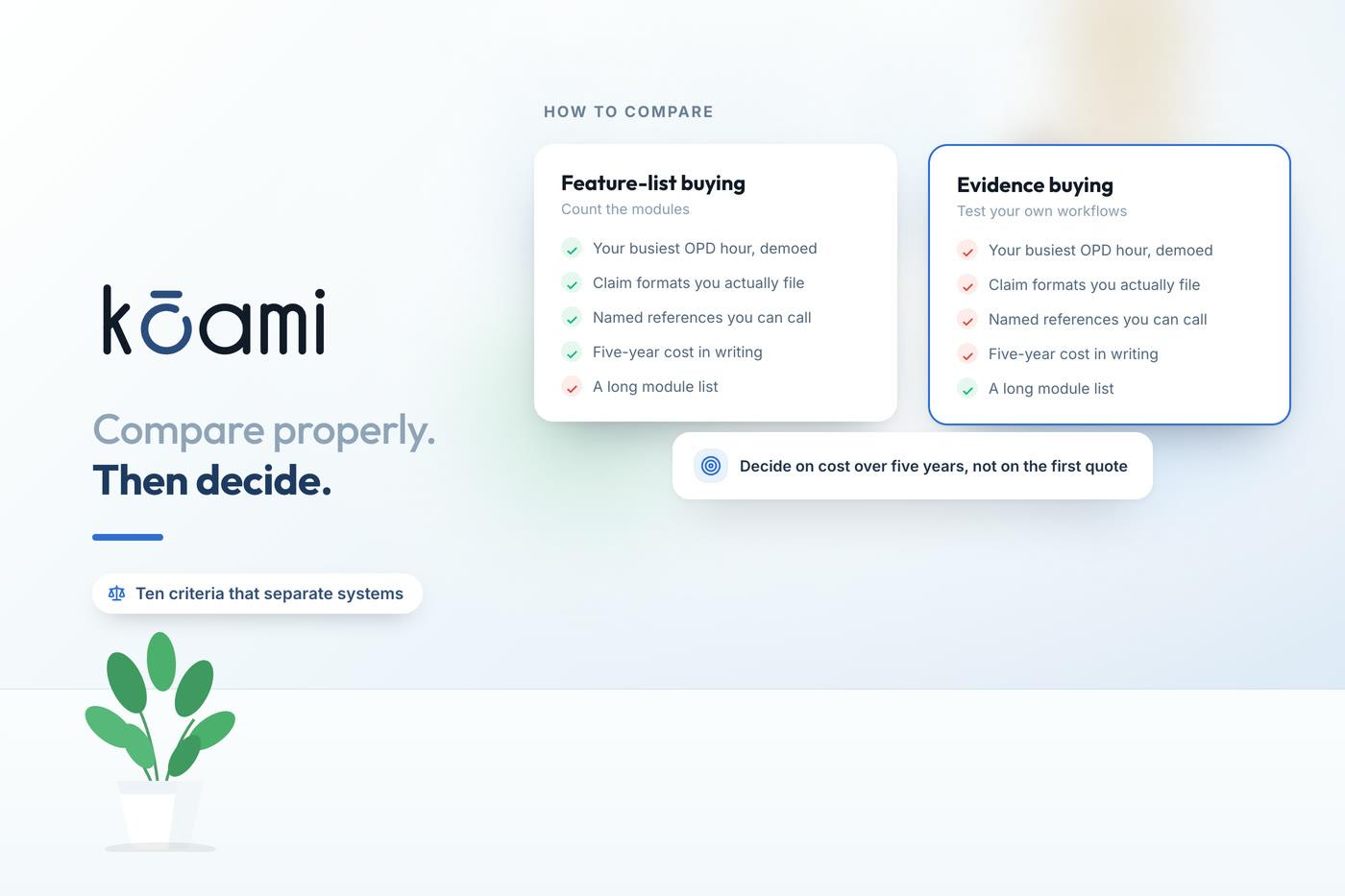
Search for the best hospital management software in India and you will get a dozen ranked lists, most of them written by vendors who placed themselves at number one. They are not useless. They tell you who is actively marketing. They tell you almost nothing about which system will still be serving your hospital in year six.
There is no single best HMS, and any list that claims otherwise is selling something. What exists is a best fit for a particular hospital: its size, its specialities, its appetite for change, and the compliance load it carries. This article is the comparison method rather than the ranking, because the method is what survives contact with your own shortlist.
What does "best hospital management software" actually mean for a buyer?
It means the system that fits your hospital's size, speciality mix and compliance obligations, and that your staff will still be using correctly two years after go-live.
Those two clauses do different work. The first is a matching problem you can assess in a demo. The second is an adoption problem you can only assess by talking to reference sites that went live eighteen months ago and asking what they stopped using.
A useful reframing: you are not buying features, you are buying the vendor's next five years of attention. The feature list is a snapshot. The roadmap, the support model and the implementation team are the thing you actually live with.
What are the main types of HMS vendor in India?
The Indian market has four recognisable categories, and knowing which one you are talking to explains most of what happens next.
- Enterprise international suites. Deep, standards-mature, expensive, and usually sold to large corporate chains. Strong clinical depth; localisation for Indian statutory registers and PM-JAY workflows varies and should be verified rather than assumed.
- Established Indian HIS vendors. Fifteen to twenty-five years in the market, heavily localised, often on-premise by origin with a cloud offering added later. Excellent at Indian billing and regulatory reality; user interfaces frequently show their age.
- Modern cloud-native Indian platforms. Built in the last decade, subscription-priced, ABDM-aware from the start, better interfaces. Range enormously in depth: some are genuinely full HIS platforms, some are clinic software with a hospital label.
- Custom builds and system integrators. A development shop building to your specification. Fits exactly, until you need it changed and the two engineers who understood it have left.
None of these categories is wrong. They fail in different ways, which is the useful part. Enterprise suites fail on cost and configuration time. Legacy Indian vendors fail on usability and API access. Cloud-native platforms fail on depth in the corners: blood bank, NDPS register, complex package billing. Custom builds fail on continuity.
Which capabilities actually separate systems, rather than brochures?
Every proposal will claim registration, OPD, IPD, billing, pharmacy, lab and reports. Those are table stakes and tell you nothing. The differences show up in the places nobody demos.
- Billing depth. Package billing against open billing, mid-stay tariff changes, insurance and cash split on one bill, credit notes, partial refunds, and how a corporate rate card is applied without manual intervention.
- The clinical record. Genuinely structured data with coded diagnoses and orders, or free text in a rich editor. The second one demos beautifully and reports on nothing.
- Multi-branch behaviour. One patient identity across sites, consolidated financials, per-site tariffs, and stock visible across stores.
- Statutory registers. NDPS, blood bank, birth and death, biomedical waste. Ask to see them generated from live data, not as a report template.
- Concurrency and print. What happens at nine in the morning when forty terminals are billing at once, and whether the pharmacy label prints in under two seconds.
- Downtime behaviour. What the hospital does when the link drops. Any vendor without a real answer has not run a hospital through an outage.
The features that decide a deployment are almost never the ones on the comparison table. They are billing edge cases, print speed, and what happens when the network fails.
What should an Indian hospital check on compliance in 2026?
Four things, and all four are now answerable with a yes or a no rather than a roadmap promise.
ABDM. The mission has moved from pilot to infrastructure. India crossed one hundred crore health records linked to ABHA accounts, with more than four hundred and fifty health technology solutions integrated into the ecosystem. Ask whether the vendor holds current M1, M2 and M3 milestone certification, and ask to see the certificate rather than a claim.
DPDP. The Digital Personal Data Protection framework reaches hospitals as consent capture, purpose limitation, breach notification timelines and the ability to honour a data principal request. Ask how consent is recorded and how a patient's data would be produced or erased on request.
NABH. If you are accredited or intend to be, the digital clauses in the current edition are specific about access control, audit trails, and the completeness of the medical record. A system that cannot show who viewed a record will cost you at audit.
PM-JAY and insurance. If a meaningful share of your revenue is scheme or TPA driven, claim preparation, document attachment and rejection handling are not a module, they are the revenue cycle.
How much should it cost, and what makes the number move?
Expect the licence or subscription to be somewhere between a third and a half of the five-year cost, with implementation, migration, training, integrations and hardware making up the rest.
Per-bed subscription pricing is the commonest Indian metric, and it needs defining in the contract: sanctioned, operational and occupied beds are three different numbers. Perpetual licences carry an annual maintenance charge, typically fifteen to twenty-two percent of licence value. Neither model is inherently cheaper; they distribute risk differently.
What actually drives the number is scope, site count, integration count and how bad your legacy data is. Bed count is the metric everyone quotes and the weakest predictor of the three.
What questions expose a weak system inside a demo?
Ask for the ugly cases. A scripted demo is designed to avoid them, so requesting them by name changes what you learn.
- Admit a patient, change the tariff mid-stay, add a package after two days, then discharge and produce the bill.
- Show me a partially rejected PM-JAY claim and what the team does next.
- Create an ABHA number at registration and link a care context, live.
- Show the audit trail for a record that was viewed but not edited.
- Cancel a dispensed medicine, reverse the stock, and show the ledger.
- Take the network away and tell me what the front office does for the next two hours.
- Export my data. Show me the format.
The last one matters more than it looks. A vendor with a clean, documented export has told you they expect to be judged on merit rather than lock-in.
Which ABDM and NHCX questions belong on the shortlist?
Five, and each has an answer a vendor can be held to rather than a roadmap.
Show the milestone certificates, not the claim. M1, M2 and M3 are distinct, they expire, and "ABDM ready" is not one of them. Ask which the vendor currently holds and for which product — what each milestone actually requires is public, so the answer is checkable in an afternoon.
Demonstrate ABHA capture at a counter with a queue behind it. The integration that matters is not the one in the demo environment; it is the one that adds seconds rather than minutes to registration on a Monday morning, and that has a defined behaviour when the network or the gateway is down. Watch it happen at a real registration counter before believing it.
Ask what the system's internal representation of a record actually is. FHIR R4 as the native shape of the data is a different product from a converter that assembles a bundle at the boundary out of free text and scanned PDFs. Both pass transport validation. Only one of them makes the next integration cheap instead of another project.
Name the payers. NHCX is operating, with payers and tens of thousands of provider facilities onboarded and claims processed in the tens of millions — take the current figures from the National Health Authority's own dashboards rather than from any comparison article, this one included. The question that decides your year is narrower: which of *your* insurers and TPAs accept pre-authorisation and claims over the exchange for your facility today, and how long you will run the exchange and the portals in parallel.
Ask what it reports back to you. Record volumes linked to ABHA are what the Digital Health Incentive Scheme pays against, above a monthly threshold. A system that creates those records but cannot count them leaves a hospital unable to claim for work it has already done — which is a reporting gap, and the cheapest of all of these to fix before signing rather than after.
How do you run a shortlist in two weeks?
Write the process down before you see a single demo, because the demos are designed to reset your criteria.
Start by listing your ten non-negotiables, agreed with the people who will use the system rather than only the people signing for it. Score every vendor against the same ten. Then insist on three things: a demo using your own tariff sheet and two of your real workflows, a reference call with a hospital of your size that went live at least a year ago, and a written five-year total cost including everything in the paragraph above.
Anything a vendor will not put in writing during the sales cycle will not improve after the contract is signed.
Where Kōami fits, stated plainly
Kōami is a cloud-native Indian platform in the third category above, built as one connected system rather than a hospital product with satellite tools bolted on: hospital management, workforce, inventory, imaging, fertility and biomedical equipment share one identity and one data model.
That design suits hospitals and multi-site groups tired of re-keying the same patient and stock data between disconnected systems, and it suits organisations that want ABDM and DPDP handled as platform behaviour rather than a project. It suits less well a hospital that wants a single narrow module and nothing else, where a focused point product will be cheaper and simpler.
That is the honest shape of the fit. Judge it, and everyone else on your shortlist, against your own ten non-negotiables rather than against anybody's ranked list.
Follow Kōami on LinkedIn
Get the next guide on hospital operations, software and compliance in your feed, as soon as it is published.