Best IVF Software in India (2026): How Fertility Clinics Should Compare ART Systems
Published
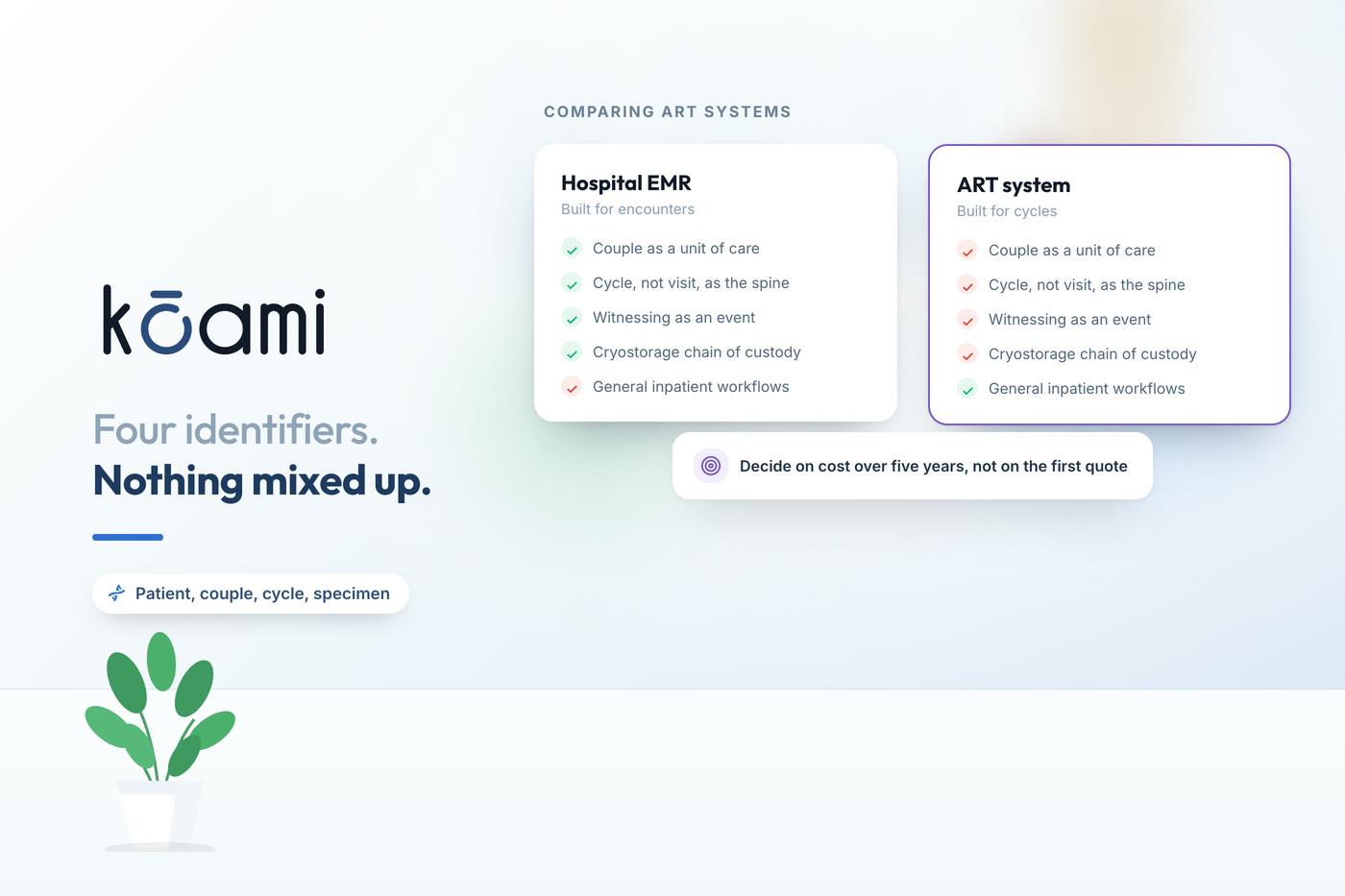
Most fertility clinics in India start on a general clinic EMR, because that is what was available when they opened. It works until the first ART audit, or the first time somebody has to reconstruct which straw in which goblet in which tank belongs to a couple who moved cities four years ago. At that point the clinic discovers that a system built for consultations is not a system built for cycles.
The market for IVF software is small, noisy and full of general EMRs describing themselves as fertility platforms. Telling them apart is not difficult once you know what to ask for.
What makes IVF software different from a clinic EMR?
An IVF system is organised around the cycle and the specimen, not around the visit.
That single structural difference cascades through everything. A clinic EMR records encounters: the patient came, this was noted, this was prescribed. An ART system records a treatment cycle with a defined start, a stimulation protocol, a monitoring series, a retrieval event, a laboratory phase in which biological material is handled and tracked, a transfer, and an outcome that may arrive nine months later and must attach back to the cycle that produced it.
If the software cannot represent a cycle as a first-class object, everything downstream is spreadsheets. Your success rates will be counted by hand, your registry submission will be assembled by hand, and your chain of custody will live in a register that nobody can query.
Which capabilities are genuinely ART-specific?
Seven, and a general EMR will usually be missing five of them.
- Cycle management across modalities. IVF, ICSI, IUI, frozen embryo transfer and donor cycles each have different steps and different denominators. One generic pathway does not cover them.
- Stimulation monitoring. Day-wise dosing, follicular measurements recorded as structured values, and a chart that lets the clinician see the response rather than read it in prose.
- The embryology worksheet. Fertilisation check, cleavage stage, day-wise grading, blastocyst scoring, biopsy and vitrification events, all recorded against a specific specimen rather than against a patient in general.
- Electronic witnessing. Every point at which gametes or embryos are handled, recorded as a timestamped event with two identities attached, not a signature in a book.
- Cryostorage inventory. Tank, canister, goblet, cane, straw. Location down to the position, with movement history, consent status and storage expiry on the same record.
- Consents under the ART Act and ICMR framework. Versioned templates, the specific consents each cycle type requires, and evidence of when each was taken.
- Outcomes and registry. Clinical pregnancy, ongoing pregnancy, live birth, linked back to the cycle, with National ART Registry submission produced from live data rather than compiled.
If the demo cannot show you a specific straw in a specific position with its full movement history and consent status on one screen, it is a clinic EMR with an IVF label.
What does the ART Act require the software to hold?
The ART (Regulation) Act and the ICMR framework turn record keeping from good practice into a licensing condition, and the records are specific.
Clinics and banks must maintain records of donors, commissioning couples, cycles performed, gametes and embryos handled and stored, and outcomes, retained for the period the regulations specify and produced on demand to the registering authority. Donor identity handling, the limits on donor use, and the consent chain are all evidenced by what your records show.
The practical test for software is not whether it can store this. Anything can store it. The test is whether it can produce it: a defensible, timestamped, queryable record set for a named couple or a named donor, generated in minutes rather than assembled over a fortnight before an inspection.
Ask any vendor to demonstrate exactly that, with a search rather than a report request to their support team.
How should a clinic compare success-rate and KPI reporting?
Insist on seeing the denominator, and insist on being able to change it.
Fertility KPIs are the most misused numbers in the sector, and the misuse is almost always denominator selection. Clinical pregnancy rate per transfer, per retrieval and per cycle started are three different figures from the same clinic, and the gap between them can be very large. A system that reports one hard-coded rate is not giving you a KPI, it is giving you a marketing number.
What a clinic actually needs is the ability to slice outcomes by cycle type, by age band, by fresh against frozen, by own gametes against donor, and by clinician, with the denominator visible on the face of the report. That is also what the KPI frameworks used in accreditation expect, and what an honest patient conversation requires.
Does the clinic need a full HMS as well?
Usually yes, and this is where most fertility software decisions go wrong.
A fertility centre is still a healthcare facility. It registers patients, bills them, runs a pharmacy that dispenses expensive gonadotropins with batch and expiry tracking, orders and receives laboratory work, may run day-care theatre lists for retrievals, employs staff whose credentials expire, and answers to the same data protection and accreditation regimes as anyone else.
Clinics that buy a specialist ART module and keep a separate billing system end up reconciling two patient identities forever. Clinics that buy a general HMS and try to run embryology inside it end up with the spreadsheets described earlier.
The workable answers are a single platform that genuinely covers both, or two systems with a real, tested integration on patient identity and billing events. What does not work is two systems with a promise of integration and a shared login page.
What should a fertility clinic ask in a vendor demo?
Ask for the awkward operations, because the routine ones all look the same.
- Show me a couple with two failed fresh cycles and one frozen transfer, and give me their complete history on one screen.
- Locate straw number 1188 and show its movement, consent and expiry history.
- Witness a fertilisation step, then show me the event log entry it produced.
- Change the denominator on the clinical pregnancy rate report from per transfer to per cycle started.
- Generate the National ART Registry submission for last quarter.
- Show me the consent set for a donor oocyte cycle and the version of each template used.
- A patient asks for all their data under the DPDP framework. Produce it.
What does it cost, and what should the contract say?
Fertility software in India spans a wide range, from low tens of thousands of rupees a year for a small single-site clinic to several lakhs annually for a multi-branch network with embryology, cryostorage and integrated billing.
The variables that move it are branch count, whether embryology and cryobank are included or priced separately, whether witnessing hardware is involved, and the depth of the billing side. As with any healthcare system, ask for a five-year total including implementation, migration of existing cycle history, training and support, not a per-year headline.
Two contract clauses matter more here than in general hospital software. First, data export: cryostorage and cycle history are records you may need to hold for years and produce to a regulator, so the format and cost of getting them out must be written down. Second, retention: the software must let you keep records for the statutory period even for patients who have long since finished treatment.
Where Kōami Fertility sits
Kōami Fertility is the ART product inside a broader connected platform, which is the specific trade-off worth understanding.
It covers couple and cycle records, stimulation, retrieval, the embryology worksheet with grading, electronic witnessing, cryobank chain of custody down to the straw, transfer, pregnancy outcome, ART KPIs with visible denominators, and registry export. Because it shares identity, billing, pharmacy and workforce with the rest of the platform, a clinic does not run two patient masters.
For a single-site clinic that already has billing it is happy with and wants only an embryology tool, a narrower product may be the better buy. For a fertility network that is tired of reconciling systems, the integrated shape is the point. Either way, take the demo list above into every conversation you have, including ours.
Follow Kōami on LinkedIn
Get the next guide on hospital operations, software and compliance in your feed, as soon as it is published.