Opening an IVF Centre: The Systems Checklist
Published
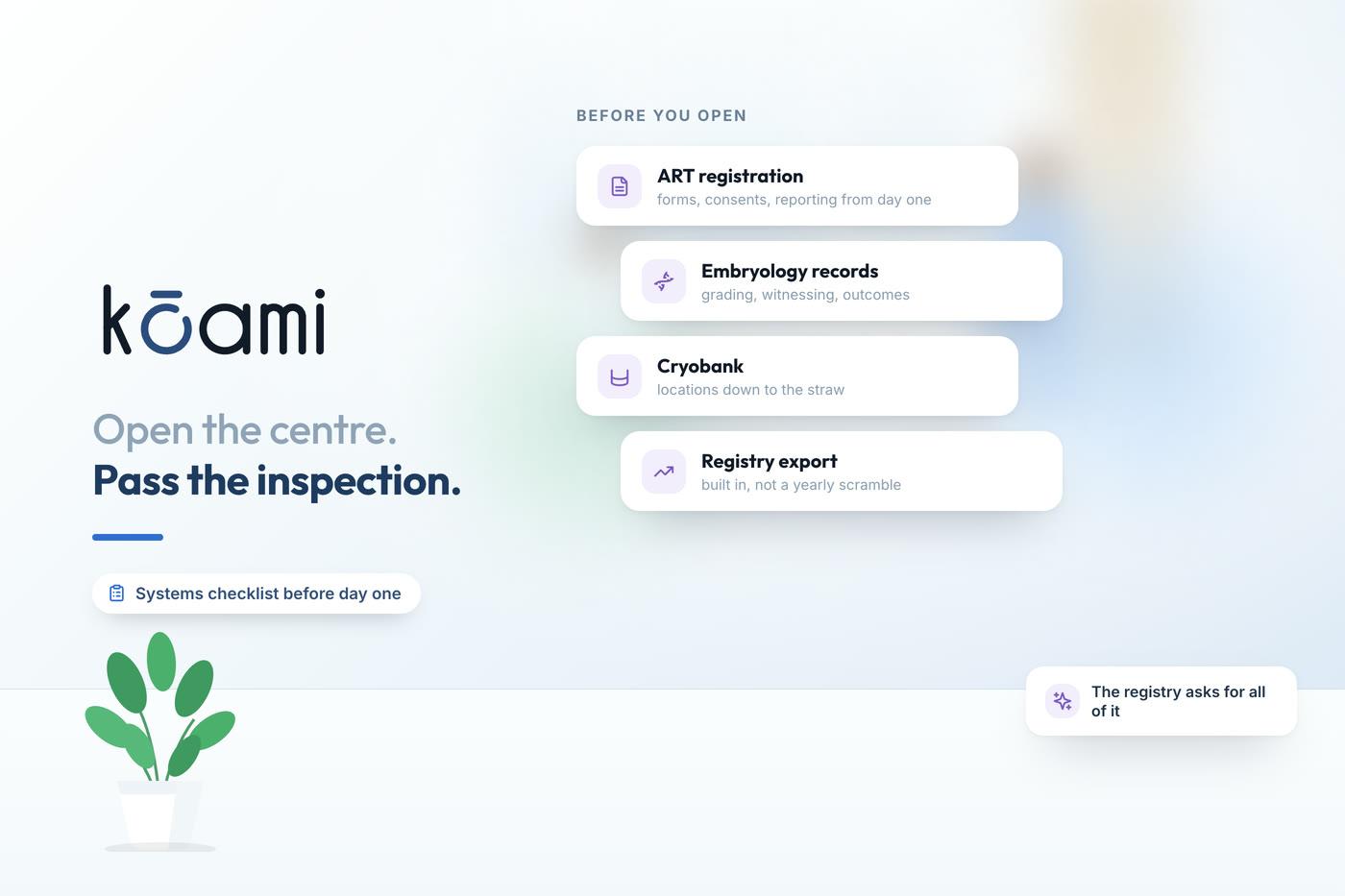
The clinical plan for a new fertility centre is usually excellent. There is a consultant with a following, an embryologist being recruited, a quotation for incubators and a workstation, and a lease on a floor with the right air handling. What is almost never in the plan, at the point the money is committed, is how the centre will record what it does — and that decision gets made eight weeks before opening, under time pressure, by whoever is least busy.
It is a strange omission, because the record is the one part of a fertility centre that regulators, patients and your own future self will all interrogate.
What has to be in place before the first cycle?
Registration under the ART legislation, the physical and staffing standards that go with it, and a record system capable of producing what the law asks for.
The clinical and regulatory prerequisites are the obvious half:
- Registration of the clinic, and of the bank if you are operating one, at the level of service you intend to provide.
- Premises and equipment meeting the prescribed standards, including the lab environment.
- Qualified staff in the roles the rules specify, with their credentials documented.
- Consent forms in the prescribed formats.
- A relationship with a registered ART bank if you will use donor gametes.
Work from the Act, the rules and your state authority's requirements directly. What follows is the half that gets forgotten.
The four identifiers, decided on day one
A fertility centre needs to identify four things, and retrofitting the fourth is painful.
- The patient: one person, one permanent record.
- The couple: both partners linked as a treatment party without their individual records being merged.
- The cycle: every IUI, IVF, ICSI, frozen transfer, donor or preservation attempt, with its own identity and outcome.
- The specimen: every semen sample, oocyte, embryo, biopsy and straw.
The first three exist in most systems in some form. The fourth is what makes witnessing, cryostorage traceability and any future lineage question possible, and a centre that opens without it will be adding it later, with material already in the tanks and cycles already completed.
Everything expensive to fix later comes from the same source: a record designed around the bill instead of around the cycle and the specimen.
Consent, before the first patient rather than after the first problem
Consent has to be versioned and it has to gate procedures, and both are cheap to build at the start.
Versioned means the exact text a couple signed is stored as a snapshot, not as a pointer to a document that will be revised next year. Gating means the system refuses to record a procedure whose consent is missing or withdrawn, and says why. Withdrawal has to be modelled, because it happens and because it has immediate consequences for stored material.
A new centre has the advantage here. There is no backlog of scanned forms in inconsistent formats and no legacy vocabulary to reconcile. Getting this right on day one costs a configuration decision; getting it right in year three costs a migration and a legal review.
The cryobank you have not filled yet
Structured storage addresses and an insert-only movement log are trivial to adopt when there is nothing in the tanks, and expensive once there is.
Decide now that location is tank, canister, cane and goblet rather than three free-text fields, that every straw has a permanent identifier, and that moving material is recorded as a new event rather than by editing the old one. Add the consent linkage, the storage term, the renewal reminder and the disposition instruction while the table is empty.
Also decide the unglamorous operational half: who monitors nitrogen, how alarms are acknowledged and recorded, what the escalation is at two in the morning, and what happens on the day a tank has to be evacuated. Cryostorage incidents are overwhelmingly equipment failures, and they give warning in consumption data that nobody was reviewing.
What to record from cycle one, because you cannot recreate it
A centre that records outcomes properly from the beginning can report honestly in year two. One that does not will spend year two reconstructing.
The minimum set is small and non-negotiable: cycle type and protocol, age at treatment, oocytes retrieved and mature, fertilisation, embryo development and grading, what was transferred and what was frozen, and the outcome through to birth including multiples. Each with a denominator you defined in advance and wrote down.
The tempting shortcut is free text, because at fifteen cycles a month it feels sufficient and it is faster at the bench. It is also the decision that makes your first registry submission a manual reconstruction and your first honest look at your own results impossible.
The systems checklist
- Patient, couple, cycle and specimen identifiers, all four, from the first registration.
- Cycle types configured so an IUI cycle does not expose embryo transfer fields.
- Versioned consent that blocks the procedure it covers.
- Pre-cycle readiness check enforced where records are written, not only in the interface.
- Structured embryology grading, not notes.
- Witnessing as an authenticated event with an immutable record, including at transfer.
- Structured cryo addresses with an insert-only movement log, and a witness on freeze, thaw, transport and discard.
- Per-sac and per-baby outcome, because twins are common in ART.
- Registry fields captured as fields, so the annual return is an export.
- Donor identity in an access-controlled compartment, with linkage still provable.
- Billing that understands cycle packages, since a cycle is not an admission.
- Backups that have been restored at least once, with the time written down.
The one thing worth spending on early
Of everything on that list, specimen identity and witnessing are the items to insist on before opening.
They are the hardest to add later, they are what an inspection and an incident both turn on, and they are the difference between a centre that can explain what happened and one that can only apologise. Everything else on the list can be improved incrementally. Those two are foundations, and foundations are poured before the building goes up.
Follow Kōami on LinkedIn
Get the next guide on hospital operations, software and compliance in your feed, as soon as it is published.