What an IVF Clinic Actually Needs From Its Software
Published
A couple walks into a fertility centre for the second time in three years. The first attempt was at another clinic in another city. She remembers the protocol was "the one with the injections in the evening" and that they got to day three. He remembers nothing except the cost. Somewhere in a cardboard folder at home there is a discharge summary and a photograph of an embryo with a number printed under it. The consultant now has to decide whether to repeat what failed.
This is the problem fertility software exists to solve, and it is not the problem most hospital systems are built for.
A hospital system tracks one person. Fertility tracks four things at once
A hospital information system is built around an episode: one patient, one admission, one bill. That model breaks the moment you walk into an ART unit, because fertility care is not one patient having one episode. It is four identities that all have to hold at the same time.
- The patient. One person, one permanent record, whichever partner they are.
- The couple, or treatment party. Two people who must be linked without their records being merged, because each keeps their own history, their own serology and their own consent.
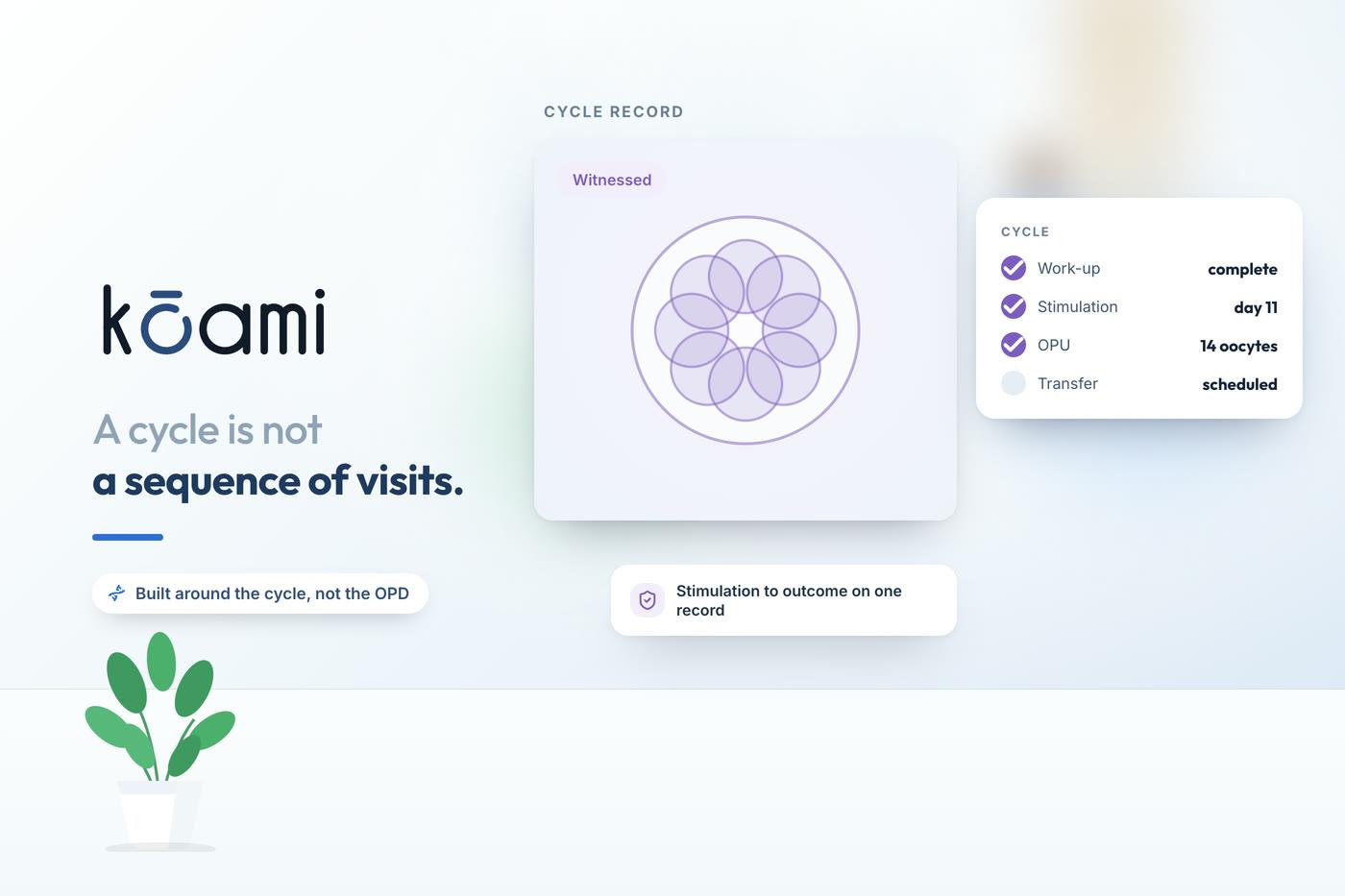
- The cycle. Every IUI, IVF, ICSI, frozen transfer, donor or fertility-preservation attempt, with its own protocol, its own drugs and its own outcome.
- The specimen. Every semen sample, every oocyte, every embryo, every biopsy, every straw in a tank.
Miss the fourth and the whole edifice wobbles. You cannot witness a transfer if the embryo has no identity. You cannot prove a chain of custody for a straw that is described as "second cane, blue top". You cannot answer, five years later, which gametes a child came from. Clinics that run fertility on a general hospital module usually have the first three in some form and the fourth almost never.
The specimen identifier is the one most systems skip, and it is the one every serious safety and traceability question depends on.
The cycle is the unit of work, and it is not a bill
The commonest structural mistake is hanging clinical events off a billing number. It happens because the billing number is what exists first and what the counter staff already know. Then a couple takes a break, comes back four months later, and a second bill is raised for the same stimulation that was never completed. Now there are two cycle records for one cycle, or one cycle record split across two bills, and the outcome cannot be attributed to either.
A cycle needs its own identity, created deliberately, with a guard against duplicates. It carries the cycle type and sub-type, and that distinction is not cosmetic. A natural-cycle IUI and a stimulated IUI are different treatments with different costs and different expectations, and if the software cannot record which one happened, the clinic cannot report its own results honestly.
The cycle type should also drive what the chart shows. An IUI cycle has no embryo transfer step. A frozen transfer starts at the thaw, not at day two of stimulation. Software that shows every step for every cycle type is inviting somebody to file embryo data against an IUI, and one day somebody will.
Where paper actually survives
Ask a clinic which parts are still on paper and the answer is rarely "the whole thing". It is specific, and the same list comes up everywhere.
- Consent forms, signed and scanned, findable only by date.
- The embryology day sheet, filled in at the bench and typed up later, if at all.
- The cryo register, which is often a physical book near the tanks because that is where the work happens.
- The witness signature, which is a name and a squiggle in a column.
- Follow-up, which lives in a WhatsApp thread and a nurse's memory.
These survive because the software asked people to walk away from the work to use it. The embryologist is at a hood with gloved hands. The nurse is on the phone. The counter is busy. Any system that wants those five things off paper has to be usable at the exact moment the work happens, which usually means the record follows the workflow rather than the workflow bending to the record.
Consent has to be a gate, not a document
Most systems treat consent as an attachment. The form is signed, scanned, uploaded, and nothing in the software behaves differently afterwards. That is a filing cabinet with a search box.
Consent in ART is a precondition for a procedure. The versioned text that was signed matters, because consent text changes and you must be able to show what this couple actually agreed to, not what the current version says. The identity of each signer matters. Withdrawal matters. And the system should be able to refuse: if the consent covering embryo freezing is missing or withdrawn, the freeze should not be recordable, and the refusal should say why.
The same logic applies to the pre-cycle checklist. Serology within validity, screening complete, consents in place, counselling done. A checklist that only prints is decoration. A checklist that blocks cycle creation until it passes, or until a named person overrides it with a reason that is stored, is a control. And it has to be enforced where the record is written, not in the browser, or the first workaround someone finds becomes the new normal.
The lab is where software usually gives up
Everything upstream of the embryology lab is recognisably clinical software: appointments, scans, drugs, procedures. Inside the lab, the requirements change shape.
Grading is structured, not free text: oocyte maturity, fertilisation check at the right hour, day-three cell counts and fragmentation, blastocyst expansion with inner cell mass and trophectoderm grades. Free-text notes here feel faster and cost the clinic its own data, because nothing that follows can be counted.
Timings are clinical facts. The interval from trigger to retrieval, the hour of the fertilisation check, the day of transfer. These should be configurable per clinic rather than baked into the code as a constant, because protocols differ and they change.
And every step where material could be confused needs a witness. Which brings us to the part that is easiest to fake.
Witnessing, cryostorage and the things you only need once
A witness typed as a name into a text box proves nothing. Anybody can type any name, the field is often not required in the first place, and it can be edited afterwards. A witness needs to be an event: an authenticated second person, at a recorded time, against a specific specimen, in a record that cannot later be altered or deleted. The system should also refuse to accept the operator as their own witness, which sounds obvious and is frequently not enforced.
Cryostorage has the same character. "Straw 12, blue, second position" is three free-text fields, and the moment a straw is moved, the old position is usually overwritten. The address should be structured, down to tank, canister, cane and goblet, and every movement should be an insert, never an update. A cryobank whose history can be overwritten cannot answer where material was in March, which is exactly the question an inspection, an incident review or a distressed patient will ask.
You will not need this most days. You will need it completely on the day something goes wrong, and on that day you cannot build it retrospectively.
Outcome, and the honesty of denominators
Fertility software that stops at the transfer has stopped one step early. The outcome is the point: beta hCG, the scan series, the number of sacs, and the eventual birth. Systems that model a single baby cannot represent twins, and twins are not rare in ART. Per-sac and per-baby outcome is not an edge case; it is the normal case often enough to matter.
Once outcomes are structured, the clinic can finally do arithmetic on itself: fertilisation rate, blastocyst conversion, clinical pregnancy per transfer, cumulative live birth per retrieval, broken down by age band and protocol. Those numbers should always carry their denominator, and a good system refuses to publish a rate computed from a handful of cycles rather than printing a flattering percentage with nothing behind it.
The practical test
If you are evaluating a system, the demo will look fine. Ask instead for the six things that separate a fertility system from a hospital module wearing a fertility badge.
- Show me a couple record where both partners keep their own history.
- Create a second active cycle for the same couple and show me what stops you.
- Freeze an embryo without the consent that covers freezing.
- Show me every place straw ST-1188 has been since the day it was frozen.
- Edit a witness record from last week.
- Show me the clinical pregnancy rate for women under 35 on an antagonist protocol, with the denominator on the screen.
A system built for this work answers all six in a few minutes. One that was adapted for it will manage two or three, and the gaps will be exactly the places where the clinic is still running on paper, memory and trust.
Follow Kōami on LinkedIn
Get the next guide on hospital operations, software and compliance in your feed, as soon as it is published.