What Hospital Management Software Actually Costs in India
Published · Updated
The question arrives in the first meeting, usually within ten minutes, and it is always the same: what will this cost. The honest answer annoys everybody, because it is that nobody can tell you yet. Two 150-bed hospitals in the same city can pay amounts that differ by a factor of four, and both can be getting fair value.
What can be explained is where the money goes, which parts are negotiable, and which costs are systematically left out of the first quotation.
What does hospital management software cost in India?
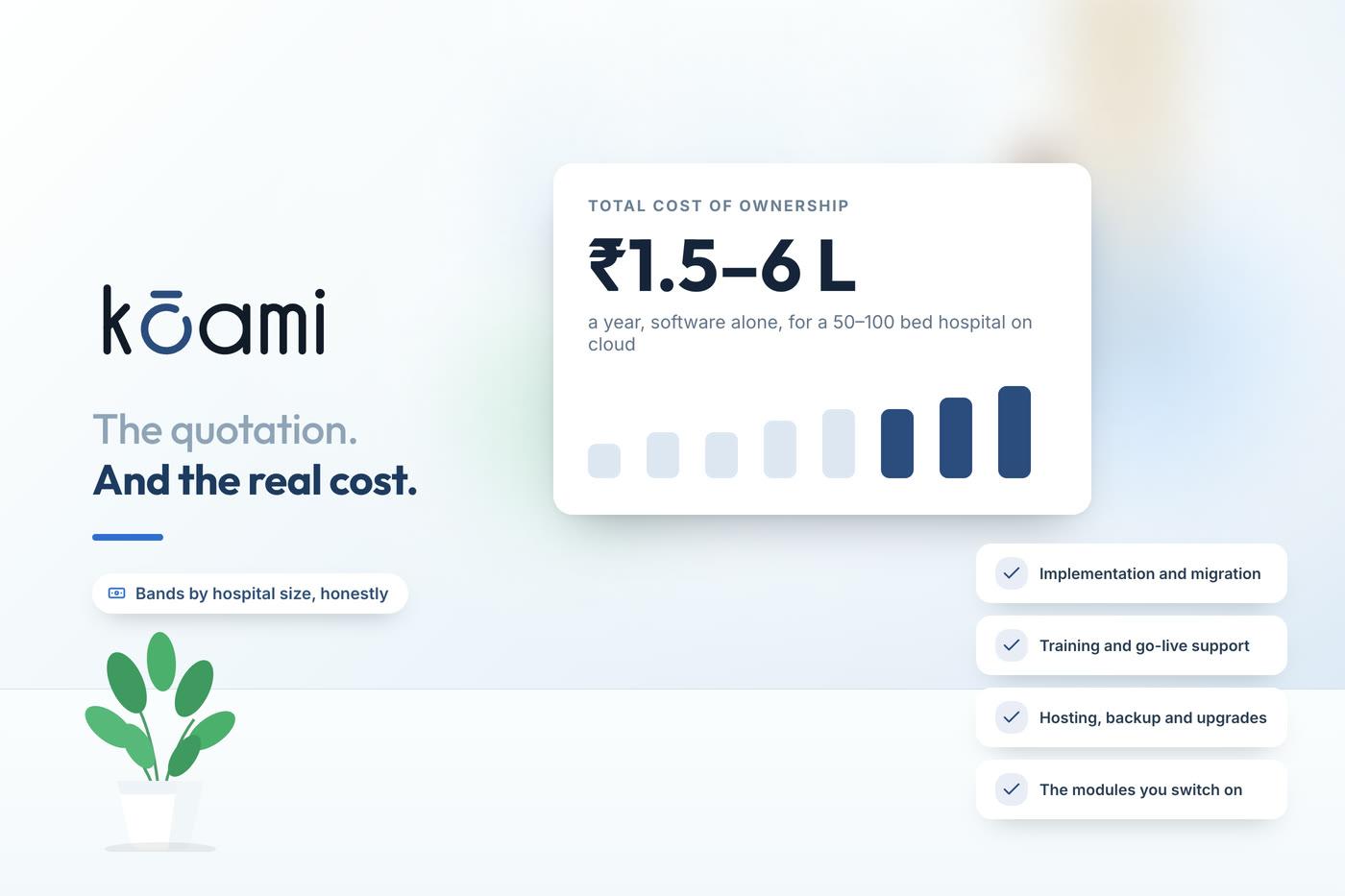
Indicative 2026 bands, software only, before implementation: a single-doctor clinic pays roughly ₹1,500 to ₹5,000 a month; a polyclinic or small nursing home ₹5,000 to ₹15,000 a month; a 50 to 100 bed hospital on cloud around ₹1.5 to ₹6 lakh a year; a 100 to 300 bed hospital ₹5 to ₹20 lakh a year; and a 300-bed-plus or multi-site group from ₹20 lakh upward, past ₹1 crore where imaging, a large user base and several sites are involved. A perpetual on-premise licence for a mid-sized hospital typically lands between ₹8 lakh and ₹60 lakh once, plus fifteen to twenty-two percent of the licence value annually for maintenance.
Those are the shape of the market, not a quotation, and the spread inside each band is the honest part. Two 150-bed hospitals in the same city routinely pay amounts that differ by a factor of four, for the reasons the rest of this article sets out.
What reliably sits outside the software line and inside the actual bill:
- Implementation, migration and training, commonly twenty to sixty percent of the first year's software cost, and the single most under-quoted item. A quotation that shows it as a token figure is describing a project it does not intend to staff.
- Interfaces. Analysers, modalities, biometric devices, payment terminals, a state or scheme portal. Each is quoted separately or discovered later; see lab analyser interfacing for what one of them actually involves.
- Infrastructure. Servers, storage and their five-year refresh on-premise; connectivity and its redundancy either way — the cloud or on-premise decision moves this line more than it moves the licence.
- Your own people. The clinical and administrative hours spent on configuration, parallel running and rework are real cost, and they are the cost nobody puts in the comparison sheet.
Two adjustments belong on the other side of the ledger, and most hospitals never make them. ABDM-linked records earn against the Digital Health Incentive Scheme, and claims routed over NHCX carry their own incentive — neither justifies a purchase on its own, and both are large enough that a hospital doing the work anyway should be counting them. The counterweight is that recovering what the system saves takes a year of disciplined measurement, not a slide.
The only number worth comparing across vendors is the five-year total: licence or subscription, implementation, interfaces, infrastructure, maintenance and the escalation clause, added up. Ask for it in that form. A vendor who will not produce it is telling you something about the years after the first one.
The three shapes of a price
Almost every proposal you will receive is one of three structures, and the structure matters more than the headline number.
Perpetual licence with annual maintenance. You pay a large sum once for the right to use the software, then an annual maintenance charge — usually somewhere between fifteen and twenty-two percent of the licence value — for support and updates. Heavy capital expenditure, lower ongoing cost, and the software is yours to keep running even if the relationship ends. Common with on-premise deployments and with hospitals that have capital budgets but tight operating ones.
Subscription, priced per bed or per user per month. Lower entry cost, everything bundled, and the vendor carries the infrastructure. Over five to seven years the total often exceeds the perpetual route, but the risk profile is different and the hospital is not left maintaining its own servers.
Hybrid. A smaller licence fee plus a subscription for the hosted components. Increasingly the default, and the one that most needs reading carefully, because it is easiest to hide a growth term in.
Per-bed pricing is the commonest metric in the Indian market, and it needs a definition in the contract. Sanctioned beds, operational beds, or occupied beds are three quite different numbers, and hospitals that agree to per-bed pricing without defining which one have handed the vendor a lever.
What does the first quotation usually leave out?
The gap between the quoted figure and what the project actually costs is rarely the vendor being dishonest. It is that the quotation covers software and the project involves a hospital.
- Implementation and configuration. Master data, tariffs, packages, user roles, department structures, document templates. This is real work, usually costs between a quarter and a half of the licence value, and is the single biggest determinant of whether the system succeeds.
- Data migration. Bringing over patient master records, outstanding balances, stock on hand and open admissions. Priced by how bad the old data is, which nobody knows until they look.
- Training. Not one session. Initial training, refresher training after go-live, training for the next intake of staff, and material that survives the trainer leaving.
- Go-live support. On-site presence for the first week or two. Some vendors include it, some price it separately, and the difference in the quotation can be substantial.
- Hardware and network. Servers or cloud capacity, workstations, label and barcode printers, scanners, tablets for wards, uninterruptible power, and the wireless coverage that ward-side use depends on. Wi-Fi in older buildings with thick walls is a recurring surprise.
- Third-party components. Database licences if the platform needs commercial ones, SMS and WhatsApp gateways, payment gateway charges, digital signature certificates, analyser interfacing licences that are often charged per instrument.
- Integrations. PACS, lab analysers, ABDM and ABHA, insurance and claims connectivity, accounting systems, biometric devices. Frequently quoted as "included" in the sales conversation and as a line item in the contract.
- Customisation. Every hospital has processes it will not change. The first year of change requests is a predictable cost that no first quotation contains.
- Internal cost. The staff time given to the project. This is real money and never appears in any document, but it is often the largest number of all.
Ask for the total cost over five years, including implementation, migration, training, hardware, integrations and annual maintenance. A vendor who cannot produce that has not thought about your project.
What actually drives the number?
Bed count is the metric everyone uses and it is a weak predictor. The things that genuinely move the price are these.
Scope. A registration, billing and pharmacy deployment costs a fraction of one that includes EMR, nursing charting, theatre, lab, radiology, blood bank and specialist modules. Most cost surprises are scope creep in disguise.
Number of sites. Multi-branch adds consolidated reporting, cross-site master data, per-site configuration and considerably more testing.
Integration count. Each interface is a small project. Ten of them is not ten times a little; it is a programme.
Data migration difficulty. Twelve years of inconsistent records with duplicate patient identities and free-text diagnoses costs far more to migrate than three years of clean data.
Deployment model. On-premise means servers, redundancy, backup infrastructure and somebody to run it. Cloud shifts that into a recurring line and into somebody else's competence.
Customisation appetite. The hospitals that spend most are the ones that ask the software to reproduce their existing forms exactly rather than adopting a workable standard.
Compliance requirements. NABH, NABL, statutory registers and regulatory reporting each imply configuration and validation work.
Where do hospitals genuinely waste money?
Some patterns repeat often enough to be worth naming.
Buying modules that will not be used for three years, because the bundle was discounted. The discount is real; the maintenance you pay on unused modules for three years is also real.
Under-investing in implementation to protect the licence budget. This is the most expensive saving available. A well-implemented mid-range system beats a badly implemented premium one, every time and by a wide margin.
Skipping the data cleanup and migrating the mess. The mess follows you, and it is more expensive to fix once it is live.
Treating training as a one-off. Staff turnover in Indian hospitals is high enough that a system trained once is a system half-used within eighteen months.
Signing without an exit clause. Ask what happens to your data if you leave: in what format, at what cost, over what timeline. A vendor who has not thought about this has told you something important.
What are the actual price bands in India?
Published 2026 pricing across the Indian market clusters into recognisable bands, and it is more useful to know the bands than to be told that it depends.
Cloud subscriptions quoted per facility commonly run from a few thousand rupees a month for a small clinic to the mid five figures a month for a hospital, while per-user pricing typically sits in the low hundreds of rupees per user per month. Per-user looks cheaper on the first page and frequently is not: at fifty users, a few hundred rupees a month each becomes a materially larger annual number than a flat facility plan, and hospitals rarely model it at the headcount they will actually have in year three.
Perpetual licences with annual maintenance still exist, mostly from on-premise-origin vendors, and are usually quoted as a large first-year number with maintenance at a percentage of licence value each year afterwards. Custom builds occupy their own range entirely and should be compared against the sections above on continuity risk rather than on price.
Treat all of these as the shape of the market rather than as a quotation. The band a specific hospital lands in is set by the drivers in the previous section — bed count, module scope, sites, integrations and migration — and any vendor quoting from a rate card without asking about those has not scoped your project.
What should a small hospital expect to pay?
Less than the enterprise band and on a simpler shape, and the shape matters more than the number.
A 10-to-80 bed hospital or nursing home should be looking for flat, predictable pricing, a go-live measured in days rather than quarters, and OPD, IPD, billing and pharmacy without the configuration overhead of an enterprise deployment. The trap at this end of the market is a low monthly figure attached to a system that cannot do package billing, statutory registers or a second branch — the price is real and so is the ceiling you will hit in year two. The small hospital guide covers what to insist on without paying for what you do not need.
One credit that belongs in a small hospital's model and almost never appears: facilities on the Health Facility Registry with ten or more beds may be eligible under the Digital Health Incentive Scheme for ABHA-linked records they were going to create anyway.
How should you compare two quotations?
Reduce every proposal to the same shape before comparing.
- Total five-year cost, all lines included, no exceptions.
- What is in scope at that price, module by module, in writing.
- What each additional module, site and integration costs, with the numbers in the contract rather than in a conversation.
- Annual escalation on maintenance and subscription. An uncapped escalation clause is worth more than most negotiated discounts.
- Support terms: hours, response times, whether on-site support is included, and what happens at 2am on a Sunday.
- Implementation timeline with payment milestones tied to delivered outcomes, not to elapsed calendar time.
- Data exit terms.
Then, before signing anything, run a paid pilot in one department with your own data and your own staff. It costs a little and reveals more than any demonstration, because a demo shows the software working on the vendor's data with the vendor driving. The number that matters is not what the system costs. It is what it costs you when it does not work.
Follow Kōami on LinkedIn
Get the next guide on hospital operations, software and compliance in your feed, as soon as it is published.