What Actually Happens on HMIS Go-Live Weekend
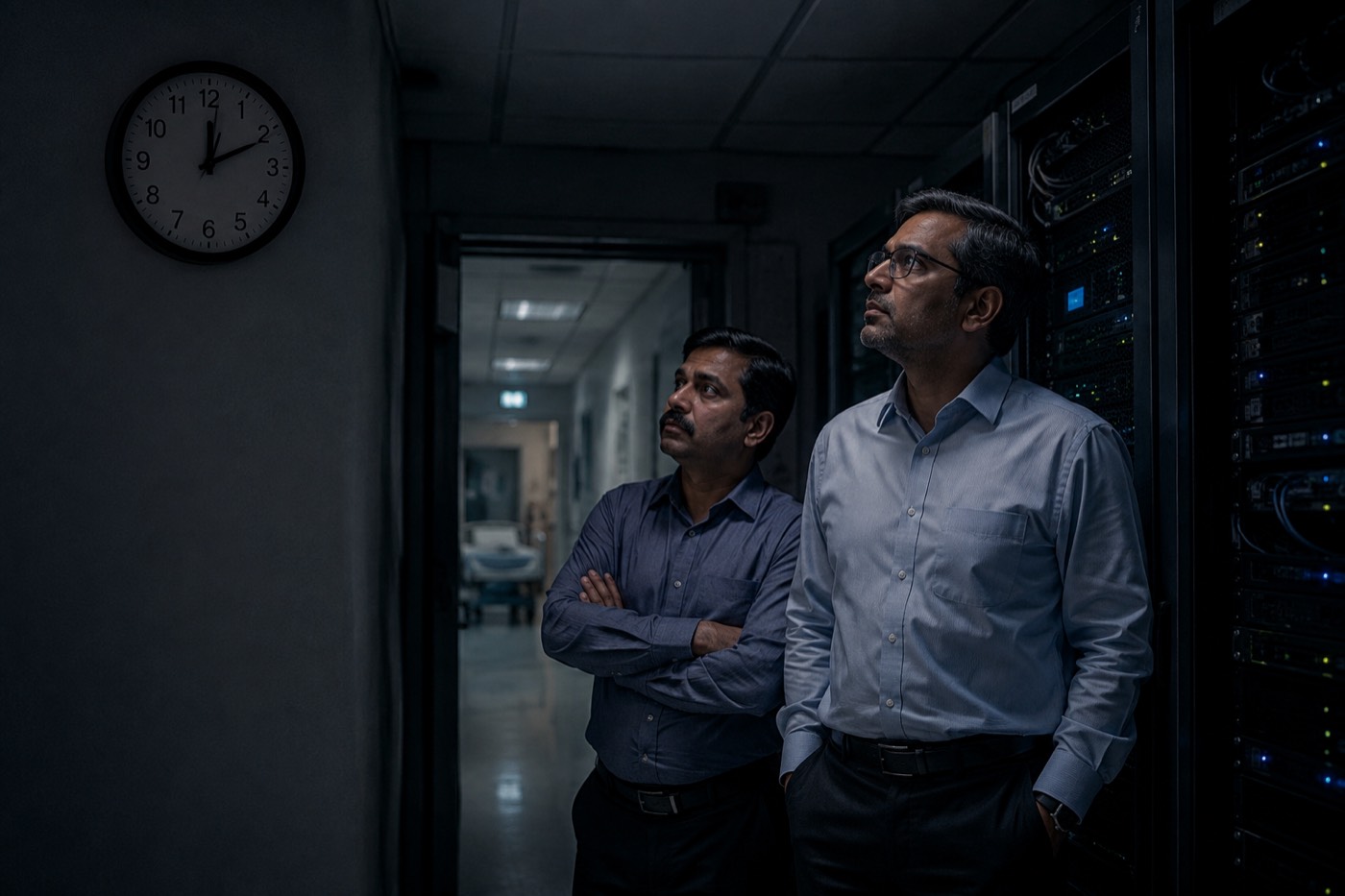
The last bill on the old system goes through at 11:40 on a Saturday night. Casualty is still open, there is a caesarean running upstairs, and in a server room behind the pharmacy a database holding twelve years of a hospital's memory is about to be set to read-only. Nobody claps. The IT head looks at the clock, looks at the general manager, and says the word everyone has been circling all week: freeze.
That is what a go-live actually is. Not a launch. A controlled handover between two systems, carried out while the hospital keeps running, because a hospital cannot be switched off for a weekend.
The cutover plan is a timetable, not a strategy
By the time the weekend arrives, the strategy is finished. What you need now is a timetable with names against it, hour by hour, and a phone number beside every name. For a 200-bed hospital in a tier-2 city it reads roughly like this:
- Friday 18:00 — final master data sign-off. Tariff master, TPA package rates, consultant list, service codes, room categories. After this, nothing changes.
- Saturday 23:00 — last transaction on the legacy system. Billing counters close, casualty moves to manual slips.
- Sunday 00:30 to 06:00 — final delta migration. Open IPD admissions, unpaid bills, advance deposits, stock on hand, unclosed lab orders.
- Sunday 06:00 to 14:00 — reconciliation. Admitted patients on the floor counted against admitted patients in the system, twice, by two different people.
- Sunday 14:00 — every counter verified physically, by a person standing at it.
- Monday 08:00 — OPD opens on the new system.
What separates a calm weekend from a bad one is the open-items list: patients currently admitted, bills raised but unpaid, TPA cases awaiting pre-authorisation, samples collected but not reported, indents raised but not issued. Everything else is history and can follow later.
The parallel-run decision
Somebody will suggest running both systems together for two weeks. It sounds prudent. It is usually the most dangerous option on the table. Every registration, every bill, every lab order gets entered twice, by the same tired staff, at the same counters — and within four days they quietly pick one and neglect the other, usually abandoning the new one because the old one is faster. Now there are two half-true records and no way of telling which is authoritative.
A parallel run does not halve your risk. It doubles your data entry and hides which system is telling the truth.
The one defensible use is the first month-end close, where finance re-runs a frozen period in both systems and compares totals. Everywhere else, a clean cutover with rehearsed rollback criteria beats a fortnight of ambiguity.
The first OPD morning
Eight o'clock on Monday is the only test that counts. Registration opens, and by ten past eight there are forty people in the queue, several waving OPD cards printed in the old MRN format. Two questions decide the morning:
- Can a returning patient be found in under fifteen seconds? By phone number, by old MRN, by name and age. If a clerk has to search three ways before finding someone, the queue builds faster than it clears.
- Does the OPD slip print, correctly, first time, at that counter? Not at the test terminal in the IT room. At counter three, on that printer, on the actual stationery.
Staff the counters at roughly double normal strength on day one. Put your trained super-users at the counters and the vendor engineers behind them, never the other way round. The moment an engineer sits down and does the clerk's job, the clerk stops learning and the hospital has bought a dependency lasting months.
The war room, and what always breaks
The command centre should be a real room with a whiteboard, close enough to OPD and billing to walk there in ninety seconds. Three columns: blocked, being worked on, resolved. One person, usually the IT head or the operations manager, decides what counts as blocked. Everything else is noise.
Physically present, not on call: two people who know the application configuration, one who owns network and printers, a senior person from billing, a ward sister with authority, and one consultant other consultants respect. That last one is not decoration. When a senior consultant declares the system unusable, the fix is usually five minutes of orientation, and it lands better from a peer.
Then there is the list that repeats at every hospital, regardless of which system is going in:
- Printer mappings. Label printers, OPD slip printers and pharmacy bill printers assigned to the wrong counter, or dropping off after a workstation restart. The commonest day-one complaint, and almost never the application.
- Tariff master gaps. A service exists but carries no rate, or has a general-category rate and nothing for the TPA or scheme tariff. Billing stops mid-queue. Every uncosted service found on Monday should have surfaced in the dry run.
- User logins and rights. Relief staff, visiting consultants, the third shift, the person on leave during training week. Somebody will need an account at 08:20 with the correct role and department mapping.
- Barcode scanners. Configured for the old system's prefix and suffix characters, now producing sample IDs with a stray character on the end.
A system like Kōami narrows the surface area — masters validated before the switch, roles templated by department, failed transactions logged with enough context to be fixed rather than guessed at. None of it survives counter three's printer unless somebody has stood at counter three and printed something.
Rollback is a decision, not a feeling
Write the rollback criteria before the weekend, get them signed, put them on the wall. Make them specific enough that nobody can argue: registration down for more than thirty minutes, billing unable to raise bills for more than an hour, any patient safety event traceable to the system. Name the one person who can call it, and set a deadline — usually end of day Monday — after which rollback is off the table, because unwinding three days of clinical and financial data is a larger risk than pushing through.
The value of written criteria is not that you will use them. It is that on Monday morning, when a consultant is angry and the queue is forty deep and somebody says go back, you can look at the wall and answer honestly. None of these have happened. This is friction, not failure.
The quiet Tuesday
Almost nobody remembers go-live weekend as the hard part. The hard part is the third week, when the vendor team has thinned out, the novelty has worn off, and the workarounds invented on day two have hardened into habits. The clerk who registers every follow-up as a walk-in because it is quicker. The ward quietly keeping a parallel register in a notebook.
Go-live is the day the software starts running. It is not the day the hospital changes. That takes another two months, and it is done by ward sisters and billing supervisors who keep insisting on the new way long after the war room has been dismantled.