Paperless Hospital in India: A 2026 Roadmap From the Registration Desk to Discharge
Walk through almost any Indian hospital that calls itself digital and you will still find paper everywhere it matters. Registration is on a computer, and the case sheet is in a folder. Billing is in the software, and the nursing chart is on a clipboard at the foot of the bed. The discharge summary is typed — by someone reading a handwritten file.
That half-digital state is the most expensive one a hospital can be in. Staff do the work twice, the software holds an incomplete record, and the paper file is still the thing everyone trusts. Going genuinely paperless is less about buying software than about deciding, one workflow at a time, that the digital record is the record. This roadmap sets out the order that works.
What does a paperless hospital actually mean?
A paperless hospital is one where the digital record is the clinical and legal source of truth for every patient encounter, so paper is never needed to know what happened, what was ordered, what was given or what was billed.
It does not mean zero paper. Patients will still want a printed prescription, some consent forms will still be signed by hand and scanned, and a downtime kit of paper forms is essential. The test is simpler: if every paper document in the hospital disappeared tonight, would tomorrow's care and tomorrow's billing carry on? In a paperless hospital, they would.
Why are Indian hospitals going paperless in 2026?
Because paper now costs hospitals money it did not used to: insurance queries, scheme rejections, audit findings, and incentives they cannot claim.
Four forces have converged:
- ABDM. Health records linked to a patient's ABHA must be digital and structured, and facilities earn under the Digital Health Incentive Scheme only for records they actually create and link.
- Insurance. NHCX moves claims as structured data, and a claim assembled from scanned pages generates exactly the queries that delay payment.
- Accreditation. NABH assessors ask for evidence — consent, medication administration, incident reports, access logs — that is hard to produce from paper on the day and easy to produce from a system.
- Data protection. The DPDP Act expects a hospital to know where patient data is and who accessed it. A file trolley has no audit trail.
Which departments should go paperless first?
Start where paper blocks revenue and the workflow is simplest, then move toward the bedside. The order that works for most hospitals is below.
Step 1: Registration, billing and deposits
Every other module depends on one patient identity and one bill. Digitise these first, with ABHA creation at the counter, and paper receipts become printouts of a digital record rather than the record itself.
Step 2: OPD consultation and e-prescription
Structured consultation templates by speciality, and electronic prescriptions that reach the pharmacy directly. This is where doctor adoption is won or lost, so the templates must be built with the consultants who will use them.
Step 3: Laboratory and radiology results
Orders from the chart, barcoded samples, and results attached to the patient automatically. Once results are digital, nobody walks a report to a ward.
Step 4: Pharmacy
Inpatient issues against the electronic prescription, batch and expiry tracking, and every issue charged to the bill without a manual slip.
Step 5: Inpatient nursing and medication administration
The largest and hardest step. Vitals, medication administration, intake and output and shift handover recorded at the bedside replace the clipboard chart.
Step 6: Operation theatre, consent and discharge
OT notes, implant records and checklists, consent recorded against the procedure, and a discharge summary built from the stay rather than typed from a file.
Is a paperless IPD realistic for nurses?
Yes, if charting happens at the bedside on a device and takes less time than the paper chart it replaces. It fails when nurses are asked to chart on paper and then enter the same data again at a nursing-station computer.
What makes paperless nursing work:
- Devices where the work is. Tablets or bedside terminals, enough of them for the busiest shift rather than the average one.
- Short screens. Recording vitals, a dose given or a handover note should each take seconds, not a form.
- Medication administration linked to the prescription. The nurse confirms what was ordered rather than retyping it, and a missed dose is visible to the next shift.
- Early-warning scores calculated automatically from the vitals already entered.
- Night-shift support. A named super-user on every shift for the first month, not only during office hours.
What about consent forms and signatures?
Capture them digitally where you can and scan what must stay on paper, but attach every consent to the patient and the procedure in the system on the day it is signed.
Signatures taken on a tablet against a versioned consent template are faster to find and harder to lose than a signed page in a file. Where a hospital's legal advice requires wet-ink signatures for particular procedures, the discipline that matters is scanning and indexing the page against the encounter before the patient leaves the ward, so the digital record stays complete.
What happens when the hospital system goes down?
The hospital switches to a rehearsed downtime procedure on paper forms, and the system is updated when it returns. Planning for downtime is part of going paperless, not an argument against it.
A working downtime plan has printed downtime kits on every ward, a read-only view of current patients and medications available on a separate device, redundant internet from two providers, and a named person who decides when downtime starts and ends. We described what a real outage looks like in the day the fibre line was cut. Hospitals that rehearse downtime twice a year recover in minutes; hospitals that never rehearse recover in days.
How much does it cost to go paperless?
The software is usually the smaller part. Budget for the hospital management system, devices for wards and counters, reliable Wi-Fi coverage, redundant internet, and the staff time spent on training and parallel running.
Against that, a paperless hospital stops paying for pre-printed stationery, medical records storage, file retrieval, and the staff time spent transcribing. The larger returns are faster discharge, fewer claim queries, quicker audit preparation and incentives claimed for records the hospital was already creating. Our article on what the HMS actually saved sets out how to measure that honestly, and affordable hospital management software explains how to keep the software line from dominating the budget.
How long does it take to become a paperless hospital?
Six to twelve months for most hospitals doing it properly in phases, with registration and billing live in the first month and inpatient nursing last.
Trying to go paperless everywhere over one weekend is the most common way to fail. Each phase needs a few weeks of both systems running, a clear date on which the paper version is withdrawn, and someone checking that it actually was. Smaller facilities move faster: a 30-bed hospital can often complete the sequence in three to four months, as our guide to digitising a small hospital describes.
How do you know the hospital is actually paperless?
Measure it. Five numbers show whether paper has really gone or has only moved somewhere else.
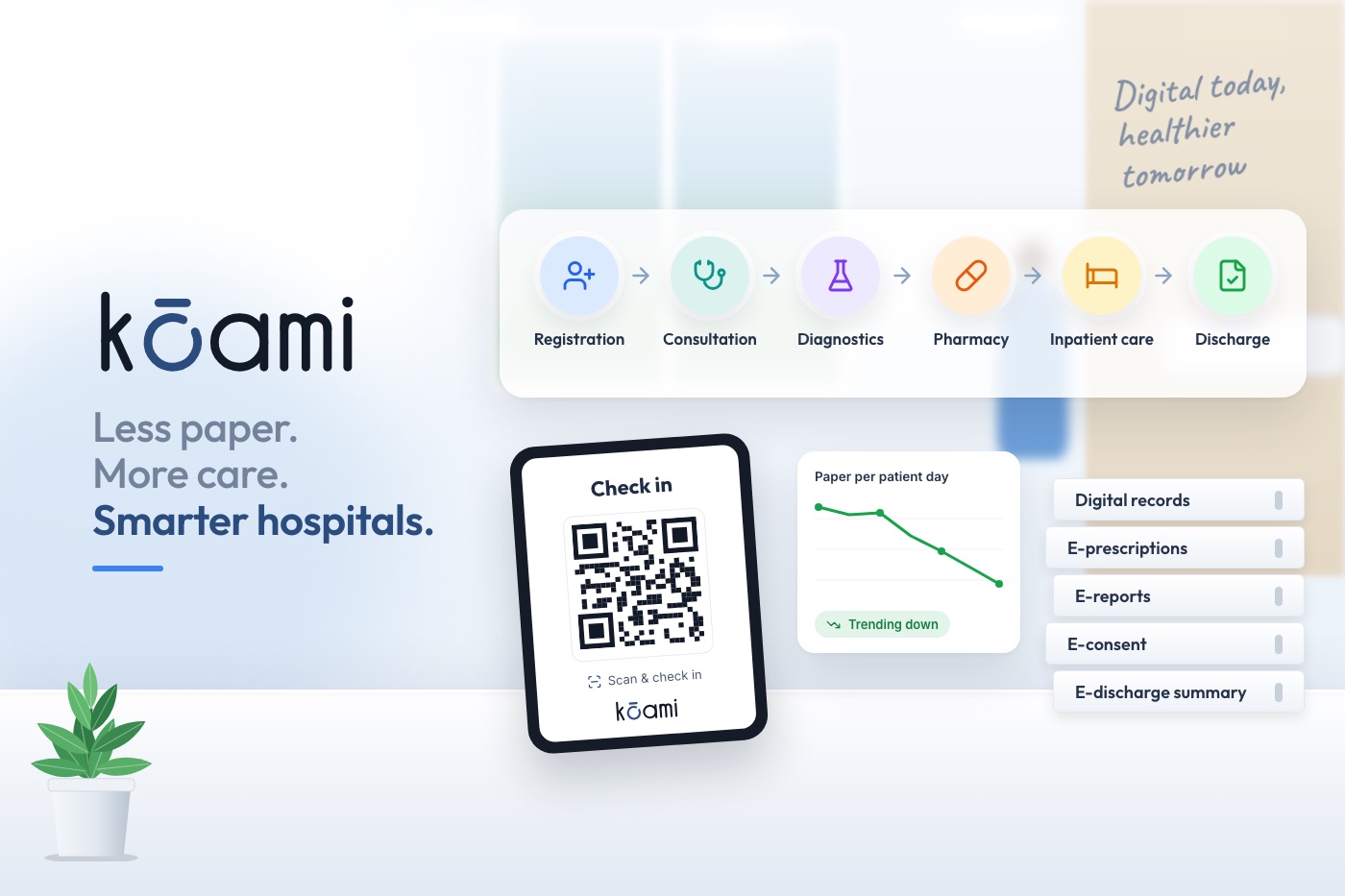
- Pages printed per patient day, trending down month on month
- The share of discharge summaries generated from the system without retyping
- The share of medication doses recorded at the time they were given
- Insurance claim queries per hundred claims
- Time from discharge decision to the patient leaving the ward
If printing stays flat while the software is live, staff are still running the paper process alongside it, and the paper is still the record.
Where Kōami fits
Kōami Hospital is a premium, complete hospital suite built to make a paperless hospital affordable. Registration and ABHA, OPD with e-prescribing, IPD with bedside nursing charting, medication administration and early-warning scores, laboratory, radiology, pharmacy, the operation theatre, billing and discharge all write to one patient record. Because the modules share that record, each phase of the roadmap builds on the last instead of adding another system to reconcile.
Secure cloud hosting is included, so going paperless does not start with a server room, and you pay only for the modules you switch on, so a hospital can digitise in the order above and spread the cost across the phases. Role-based access and a log of every view give the audit trail that paper never had. To plan your own sequence, book a demo and bring one complete inpatient file. We will show you where every page of it lives in the system.