Local SEO for Hospitals and Clinics: How to Win “Near Me” in Every Branch
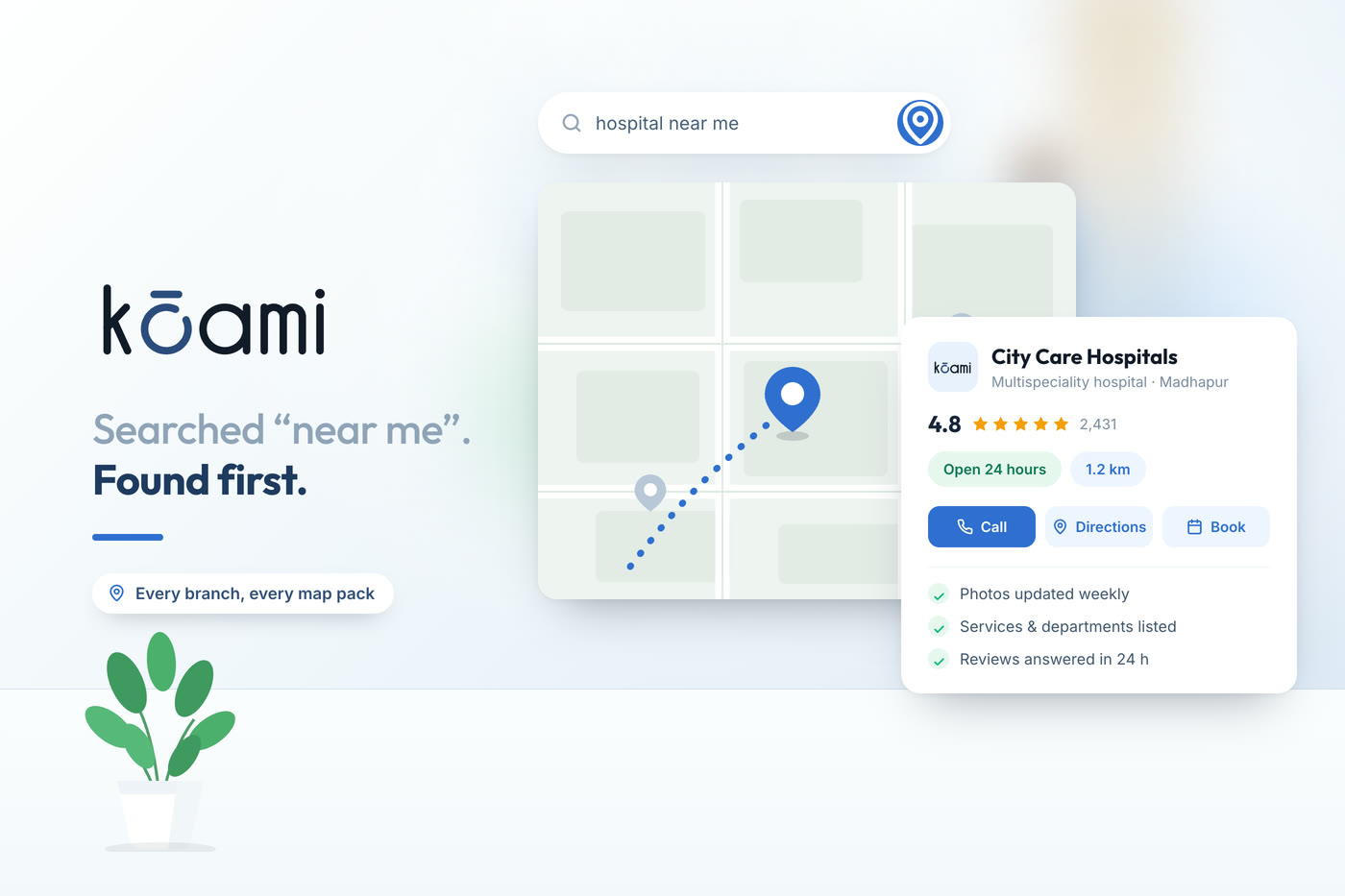
A patient with chest pain at eleven at night does not read your website. They type "hospital near me", look at three listings on a map, and call the one that is open, close and well reviewed. That result — the map pack — is the most valuable piece of screen real estate in healthcare marketing, and it is won by a different discipline from the one that wins a blog post.
Local SEO is the work of being the listing that gets chosen: one accurate, complete, actively managed profile per location, consistent information everywhere else, and a steady flow of genuine reviews. It is cheap relative to everything else in marketing and it is the thing Indian hospitals most reliably neglect.
What is local SEO for a hospital?
It is the practice of ranking in the map results and "near me" searches for each physical location you run, as distinct from ranking your website pages in the ordinary blue-link results.
The two are related but not the same. Your website can rank for "knee replacement cost in India" while your Kukatpally branch is invisible for "orthopaedic hospital near me", because the map pack is drawn from Google Business Profiles, not from pages. A hospital group with twelve branches has one website and twelve local SEO problems.
How does Google decide who appears in the map pack?
Google publishes the answer: relevance, distance and prominence. Relevance is how well the profile matches what was searched. Distance is how far each candidate is from the searcher or the place they named. Prominence is how well known the business is, which Google derives from links, articles, directories and review signals.
Distance you cannot change. The other two you can, and the work divides accordingly:
- Relevance is fixed by completing the profile properly — the right primary category, the services and departments actually listed, hours including emergency, attributes, photographs and a description that reads like a hospital rather than a keyword salad.
- Prominence is built by everything outside the profile: citations in Indian directories and health aggregators, mentions in local press, links to the location page on your own site, and reviews.
How do you set up profiles for a hospital with many doctors?
One profile per physical location, plus — where it is genuinely warranted — individual practitioner profiles, each pointing at a distinct landing page.
A few rules that trip Indian hospitals up. Departments inside a single building are generally not separate listings; a practitioner may have their own listing where they are a public-facing professional, and it must not duplicate the location's listing for the same person at the same address. Your business name field takes your actual business name — adding "Best Multispeciality Hospital in Hyderabad" to it violates Google's naming rules and is one of the most common reasons a listing is suspended or edited without warning.
Get these right on every profile before doing anything else:
- Primary category chosen precisely — "Hospital", "Private hospital", "Fertility clinic", "Diagnostic centre" — with secondary categories for the rest.
- Every service and department listed, using the words patients use.
- Hours, holiday hours and a clearly marked 24×7 emergency where it applies.
- Real photographs of the building, reception, wards and equipment, refreshed regularly.
- A booking link that goes to that branch's booking page, and a phone number that rings at that branch.
- Posts used for camps, new services and health days — the profile is a channel, not a form.
How many reviews do you need, and how do you get them without breaking the rules?
Enough to be comparable with the hospitals you compete with in that locality, arriving steadily rather than in bursts — and every one of them unincentivised, because paying for reviews or offering anything in return violates Google's policies and is grounds for removal of the review and action against the profile.
What works is systematic and dull: ask at the right moment, which is discharge or a successful follow-up, not at admission; make it one tap with a short link; ask by WhatsApp or SMS, which is where the patient already is; and never filter by expected sentiment, which is its own violation.
Replies matter as much as the reviews. Every review should be answered, quickly, in a way that never confirms clinical detail. This is where Indian hospitals get into trouble: a reply that says "we are sorry your surgery on the 14th was delayed" has just confirmed to the internet that this person had surgery with you. Under the DPDP Act and ordinary medical confidentiality, the safe reply thanks the reviewer, apologises for the experience in general terms, and moves the conversation to a phone number.
Negative reviews are not a crisis; an unanswered wall of them is. A visible, courteous reply is read by every future patient scrolling past it.
What breaks local rankings for multi-branch groups?
Four things, in order of how often we find them:
- Duplicate and unclaimed listings. Old listings created by staff or auto-generated years ago, still carrying a disconnected phone number and the wrong address, splitting your reviews and confusing Google about which is real.
- Inconsistent NAP. The name, address and phone number differing between your website, your profile, Practo, Justdial and a dozen directories. Pick one canonical format per branch and enforce it everywhere.
- One phone number for everything. A single central number on all twelve profiles makes every branch look like the same entity and makes call attribution impossible.
- Location pages that are copies. Twelve pages differing only in the city name compete with each other and convince nobody. Each should carry its own doctors, timings, photographs, directions and services.
How do you know local search is working?
Track three things per branch, monthly: calls from the profile, requests for directions, and clicks to the booking page. Google reports these; a call-tracking number per location makes the first one auditable and lets the front desk log where the call came from.
The number that matters more is what happened after the call. If a branch's profile produced 300 calls and the hospital cannot say how many became appointments, the programme is still being run on faith. Joining that chain is the subject of following a patient from ad click to admission, and it applies to organic calls exactly as it does to paid ones.
Where Kōami fits
Kōami Studio runs this work for hospital groups and clinic chains: claiming and de-duplicating profiles, fixing categories and services per branch, building the review flow into discharge, writing location pages that do not cannibalise each other, and reporting calls, directions and bookings by location.
We also build the hospital system behind the front desk, which is why we tend to wire the review request into discharge and the booking link into real OPD slots rather than leaving both as a monthly task somebody forgets. If you run more than one branch and are not sure how many listings exist in your name, ask us for an audit — the answer is usually more than you think.
Keep reading
Affordable Hospital Management Software in India (2026): A Premium Suite Without the Enterprise Price
Nursing Home Management Software in India (2026): Features, Price and a Buyer’s Checklist