Healthcare Marketing ROI: Following a Patient From Ad Click to Admission
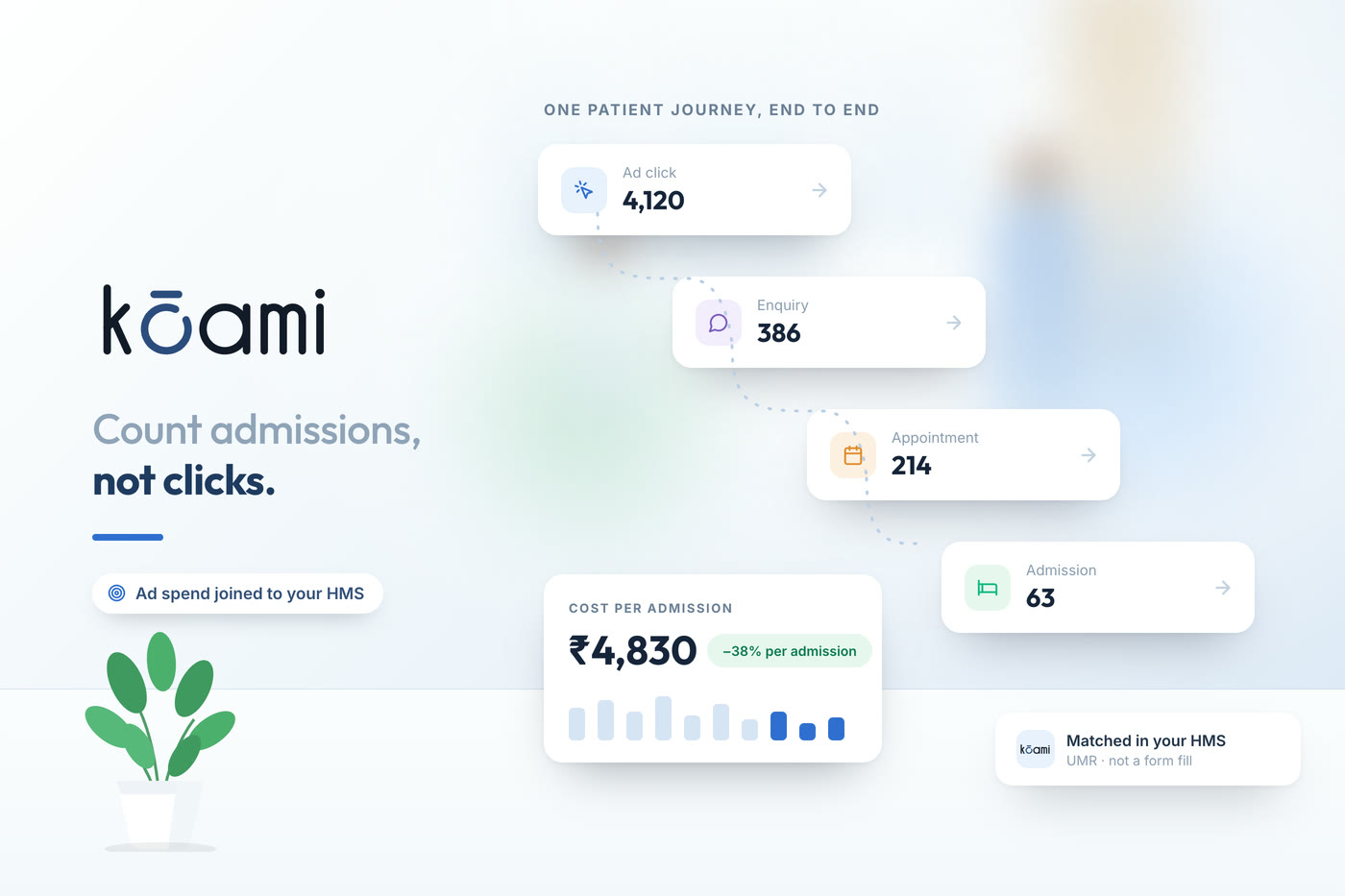
Every monthly marketing report a hospital receives says the same thing: impressions up, clicks up, cost per lead down, a chart of keyword positions, and a number of "leads" that nobody in the hospital recognises. Meanwhile the medical superintendent knows how many patients were admitted in cardiology last month, to the person, because the system counts them.
Those two worlds almost never meet, and the gap between them is where marketing budgets go to die. This article is about closing it: carrying one identifier from an advertisement all the way to a registration, so a hospital can say what a cardiology admission cost to acquire, by channel, and stop arguing about it.
Why is cost per lead the wrong number for a hospital?
Because a lead is a form, and a form is not a patient. The channels that produce the cheapest leads are frequently the ones producing the least treatment, and optimising towards cheap leads actively moves money away from the campaigns that fill beds.
A worked example from the shape of accounts we see. A display campaign produces 600 enquiries at ₹120 each — a beautiful cost per lead. A search campaign on "angioplasty cost in Hyderabad" produces 90 enquiries at ₹900 each, which looks seven times worse. Follow both to registration: the display enquiries were mostly people clicking an interesting image, and produced four admissions; the search enquiries came from people with a diagnosis in hand, and produced twenty-two. Cost per admission: ₹18,000 against ₹3,680. The report that ranks these campaigns by cost per lead recommends spending more on the wrong one, every month, until someone checks.
How do you connect an ad click to an admission?
By making sure one identifier survives each handover. There are four handovers, and each has a standard solution:
- Click to visit. Tag every campaign link with UTM parameters so the source arrives with the visitor and is stored — not just in analytics, but in a field you control.
- Visit to enquiry. Capture the source in a hidden field on the form, and for calls, use a tracking number per channel so a phone enquiry carries a source too. WhatsApp click-to-chat links can carry a reference in the prefilled message.
- Enquiry to appointment. This is the handover that breaks in Indian hospitals, because the front desk creates the appointment in the HMS from a phone call and the origin is lost. It is fixed with a mandatory "source" field on appointment creation, ideally pre-filled when the booking comes from the website.
- Appointment to registration and admission. Once an appointment carries a source and becomes a UMR, the hospital's own system holds the rest: OPD visit, investigations, admission, and the revenue attached.
Nothing here is exotic. It is four small pieces of discipline, and the reason it is rare is that it crosses a boundary — the first two belong to the marketing agency, the last two belong to the hospital system, and normally nobody owns both.
What should a hospital actually measure?
Six numbers, by channel and by department, monthly:
- Cost per enquiry — the only number most reports contain.
- Enquiry-to-appointment rate — how good the follow-up is. A hospital losing 70% here has a front-desk problem, not a marketing problem.
- Appointment show rate — how many booked patients arrive. Reminders move this more than any campaign.
- Cost per appointment.
- Cost per admission, for the service lines where admission is the point.
- Revenue per channel, where the hospital is comfortable attaching it.
The pair that changes behaviour fastest is enquiry-to-appointment and show rate, because they are usually operational rather than marketing failures — and no amount of ad budget fixes a number that rings at a desk nobody staffs after six.
What does healthcare advertising cost?
Enough that the questions above are worth answering. Published benchmark sets for the United States put average healthcare search CPCs in the region of five to six dollars, with dentistry among the most expensive service lines — figures that are useful as a picture of how competitive medical keywords are, and useless as a budget for an Indian hospital, where click prices are a fraction of that.
For India, the shape is what matters: terms with a treatment and a city attached cost the most, generic health terms the least, and metro competition sets the price more than anything in your account. Elective, high-value service lines — cardiac, ortho, oncology, IVF, bariatric — are bid up hardest, because everybody wants the same patient. The workable approach is to start narrow on the terms with a diagnosis in them, measure to admission, and expand only where the last number justified it.
What about consent, privacy and the law?
Marketing that touches patient data is regulated, and the rules changed recently in both directions.
In India, the Digital Personal Data Protection Act, 2023 applies to the enquiry form, the call log, the WhatsApp list and the retargeting pixel. Personal data is collected for a stated purpose with consent, and "they enquired about a knee replacement" is not licence to market unrelated services indefinitely. Practically: say what you collect and why, keep the consent record, let people withdraw, and do not push patient identifiers into advertising platforms.
For hospitals with United States patients, the HIPAA position on web tracking moved in 2024. Federal regulators had said that an IP address combined with a visit to a page about a health condition could itself be protected health information; in June 2024 a federal court in Texas vacated that part of the guidance, and the agency withdrew its appeal later that year. The practical advice survives the litigation unchanged: keep third-party trackers off authenticated portal pages, be careful with pixels on condition-specific pages, and have a written agreement with anyone processing the data.
The engineering answer to all of it is the same. Keep the identity inside your own systems, send only aggregate or properly hashed conversion signals to the ad platforms, and do the joining where the patient record already lives.
What does good look like after two quarters?
A one-page report the board actually reads: spend by channel, enquiries, appointments, admissions, cost per admission, and the two or three decisions taken as a result. Campaigns that cannot be traced to appointments either get instrumented or get stopped. Agencies who report positions and impressions instead get asked for the other table.
The pleasant side effect is that the argument changes. Instead of "marketing costs too much", the conversation becomes "orthopaedics costs ₹4,100 per admission and we have capacity on Thursdays" — which is a conversation a hospital can act on.
Where Kōami fits
We sit on both sides of the handover that normally breaks. Kōami Studio runs the campaigns, the site and the tracking; Kōami Hospital is the system where the appointment becomes a UMR and the UMR becomes an admission.
Where a hospital runs both, the join is direct: the source captured on the website travels into the appointment, and the reports come back as cost per appointment and cost per admission by department. Where a hospital runs another HMS, we build the same chain from whatever it can export — the technique matters more than the vendor. If your current report stops at "leads", send it to us and we will show you what the rest of the chain would look like for your hospital.
Keep reading
Affordable Hospital Management Software in India (2026): A Premium Suite Without the Enterprise Price
Nursing Home Management Software in India (2026): Features, Price and a Buyer’s Checklist