International SEO for Hospitals: How to Rank on Google in Another Country
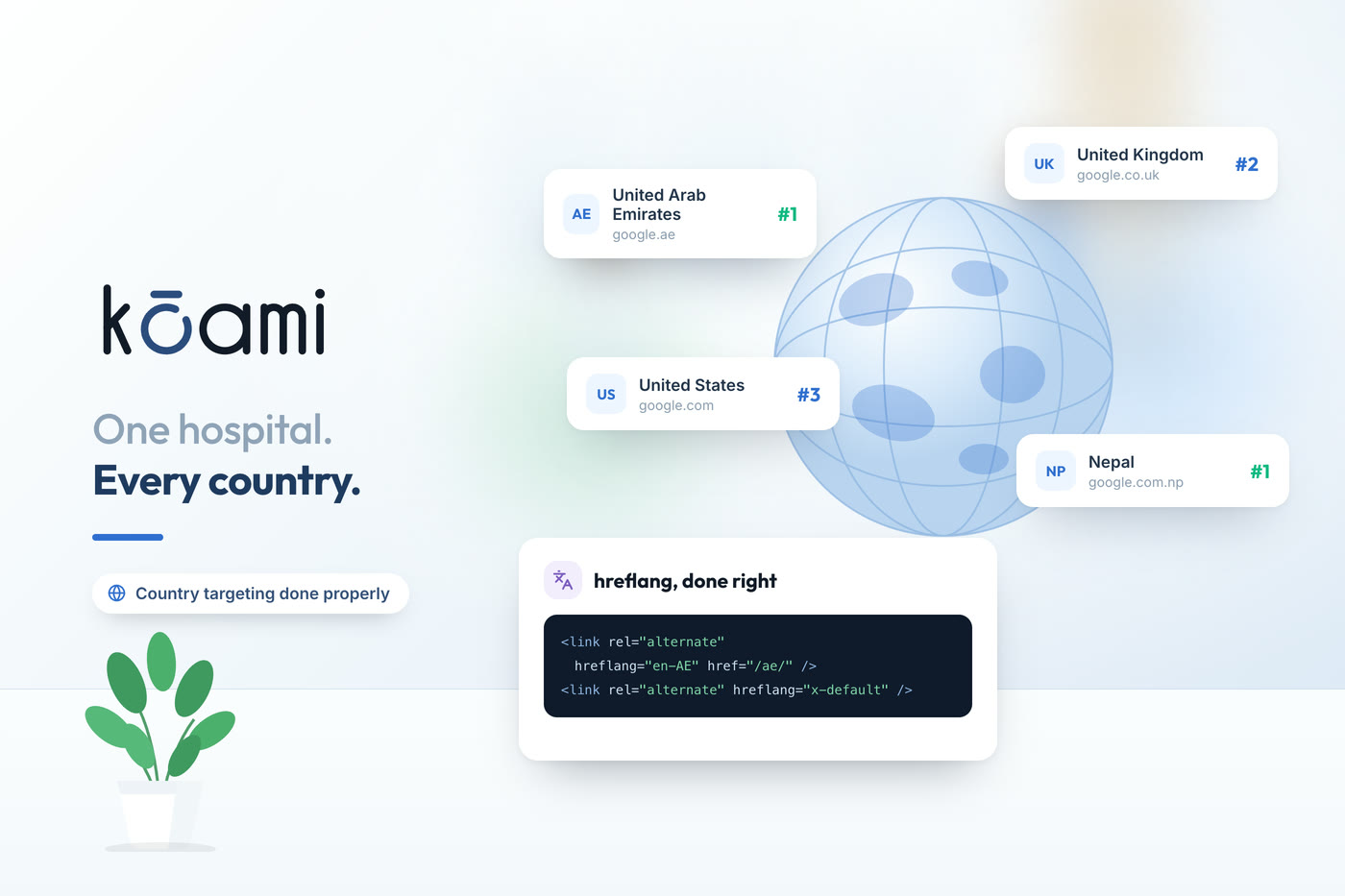
A hospital in Hyderabad wants enquiries from Muscat. A fertility centre in Delhi wants to be found in Kathmandu. A software company in Chennai wants to rank in the UK. The question is always the same — can we rank on Google in a country we are not in? — and the answer is yes, with a caveat that decides everything: Google ranks pages, not passports, but it ranks them for a country using signals you have to actually supply.
Nothing about this is exotic. International SEO is mostly URL structure, hreflang, localisation and links, executed carefully and then left alone long enough to work. What follows is the whole method, including the parts that agencies still sell which no longer exist.
Can you rank in a country where you have no office?
Yes. Nothing in Google's system requires a local address to rank in a country's results. What it requires is a page that is clearly relevant to people searching from that country, in their language, with content that matches what they are actually looking for, and enough signals of authority in that market to compete with local sites.
Where the lack of an office does bite is the map. Local listings need a real, staffed address in the country, and Google verifies it. So a hospital with no UAE premises can rank in google.ae's blue links for "hip replacement in India cost" — a query a patient in Dubai plausibly types — but cannot appear in a Dubai map pack for "orthopaedic hospital near me". Knowing which of those two you are actually competing for is the first strategic decision, and a surprising number of agency proposals never make it.
Should you use a country domain, a subdirectory or a subdomain?
For almost every hospital: subdirectories on your main domain, like example.com/ae/ and example.com/np/.
- Subdirectories inherit the authority of the main domain, which is the single hardest thing to build. One site to secure and maintain, one analytics property, and new markets cost a folder rather than a project.
- ccTLDs — example.ae, example.co.uk — send the strongest possible country signal and are the right answer when you have a genuine local entity, local staff, and budget to build authority from zero for each one. Each domain starts with no reputation at all, which is the cost nobody quotes.
- Subdomains — ae.example.com — sit awkwardly between the two, and are mostly justified by infrastructure constraints rather than SEO.
The failure mode we see most often is a hospital with four ccTLDs, three of them unmaintained since launch, splitting authority four ways and ranking with none of them.
What does hreflang actually do?
It tells Google which language and regional version of a page to show a given user — and that is all it does. It is not a ranking factor, it will not make a page rank in a new country by itself, and adding it to a site with one version of every page accomplishes nothing.
Where it earns its place is stopping the wrong version from being served and stopping your own versions from competing with each other. If you have an India page and a UAE page about the same procedure, both in English, hreflang is what keeps the right one in front of the right reader.
Three rules it is easy to get wrong:
- Return tags must match. If the India page points at the UAE page, the UAE page must point back, or Google ignores the pair.
- Use the right codes. Language, optionally with a region: `en`, `en-AE`, `en-GB`, `ne-NP`. The region alone is not valid.
- Include an x-default for everyone your specific versions do not cover.
How do you tell Google which country a page is for?
Through structure and content, because the setting people remember is gone: Google deprecated Search Console's International Targeting report — the site-wide country-targeting switch and hreflang error reporting — in August 2022, and removed it the following month, on the stated grounds that it had little value.
That leaves the signals that do work, and they are all things a serious agency should be doing anyway: a URL structure that separates the market, hreflang between versions, content written for that country, local currency and local phone formats, prices and packages in the local context, a physical address and local contact where one exists, and links and citations from sites in that market.
That last one is the real work. Ranking in the UAE is substantially a question of whether anything in the UAE links to you.
Does the content have to be in the local language?
It has to be in the language people search in, which is not always the local language. In the Gulf, medical-tourism enquiries are frequently searched in English; in Nepal, a mix of English and Nepali; in Francophone Africa, French, and an English page will simply not appear.
What does not work is machine translation published unreviewed. A page translated word-for-word from an Indian site keeps Indian idiom, Indian pricing conventions and Indian examples, and reads to a local as exactly what it is. Localisation means the currency, the units, the insurer names, the visa reality and the objections of that market — the questions a patient in Muscat has are about travel, escorts, follow-up and cost, not about whether your surgeon is good.
How do medical-tourism enquiries actually convert?
On response time and on the estimate. A patient considering treatment in another country is comparing three hospitals in two countries and the one that replies first with a specific, itemised estimate usually wins the conversation.
The funnel worth building, in order: an enquiry form that captures the report or scan, a named coordinator who replies the same day, a written estimate with what is and is not included, the visa invitation letter, travel and accommodation guidance, and a follow-up plan for after the patient flies home. Every one of those is a page that can rank in its own right, which is the pleasant accident of this work: the content that converts an international patient is also the content that ranks for them.
How long does it take, and what should it cost?
Slower than domestic and for the same reasons as any competitive market: you are building authority in a place where you currently have none. Structure and localisation can be delivered in weeks; visibility in a competitive Gulf or UK market is a six to twelve month programme, and anybody who promises a position by a date is selling something Google itself says cannot be sold — its guidance on hiring an SEO states plainly that no one can guarantee a number-one ranking.
Budget in three lines: the build (structure, hreflang, localised pages), the ongoing content and in-market link work, and paid search in the target country while the organic work matures. The third line is what makes the first two survivable, because it produces enquiries in month one.
Where Kōami fits
Kōami Studio does this work for hospitals, fertility centres and diagnostic chains that want patients from beyond their own city — India and Nepal, the Gulf, the UK, the US, South-East Asia and East Africa.
We will also tell you when a market is not worth it, which is the part that distinguishes a plan from a pitch: if a term is owned by three local hospital groups with a decade of authority, the honest recommendation is paid search plus a narrower organic target, not a twelve-month assault on a keyword nobody will hand over. If you want to know which countries are realistic for you, send us your site and your target markets and we will map what is actually winnable.
Keep reading
Affordable Hospital Management Software in India (2026): A Premium Suite Without the Enterprise Price
Nursing Home Management Software in India (2026): Features, Price and a Buyer’s Checklist