Affordable Hospital Management Software in India (2026): A Premium Suite Without the Enterprise Price
Every hospital owner who has shopped for software in India has seen both ends of the market in the same week. One vendor quotes ₹1,500 a month and promises everything. Another sends a proposal with a crore in it and a twelve-month implementation plan. Neither number tells you what you will actually spend, and neither tells you whether the system will still be carrying your billing in year five.
Affordable is the right thing to want. It is also the most misunderstood word in the category, because the price that decides affordability is not the one on the first page of the quotation. This guide sets out what cheap and premium hospital management software really cost, where the money leaks, and how a hospital of any size can buy a complete, premium suite without paying an enterprise premium for it.
What is the cheapest hospital management software in India?
On sticker price, the cheapest options are free and open-source systems, government software such as NIC's eHospital for eligible public facilities, and entry-level cloud subscriptions that start at a few thousand rupees a month. On total cost over five years, the cheapest system is usually a different one.
The gap between those two answers is the subject of this article. A free system still needs a server, someone to install and maintain it, and a developer the first time a scheme changes its claim format — which is why free and open-source hospital software so often turns out to be the most expensive option a small hospital tries. An entry-level subscription can be genuinely good value for a clinic, and a trap for a 40-bed hospital that outgrows its user limit in the first year.
The useful question is not which system is cheapest. It is which system has the lowest five-year cost while doing everything the hospital needs. That question has an answer.
What does hospital management software cost in India in 2026?
Indicative 2026 bands for software alone, before implementation: a single-doctor clinic pays roughly ₹1,500 to ₹5,000 a month, a polyclinic or small nursing home ₹5,000 to ₹15,000 a month, a 50 to 100 bed hospital on cloud around ₹1.5 to ₹6 lakh a year, and a 100 to 300 bed hospital ₹5 to ₹20 lakh a year.
Those bands come from our detailed hospital software cost guide, which also covers on-premise licences and multi-site groups. The spread inside each band is wide, and features do not explain it. Two hospitals of the same size routinely pay amounts that differ by a factor of three or four, and the difference is almost always in how the price is structured rather than in what the software does.
Why does cheap hospital software end up expensive?
Because the low number is a subscription, and the bill is everything around it. The hidden costs that turn a budget quote into an expensive system are consistent enough to list.
- Per-user fees. ₹200 to ₹2,000 a user a month looks small for five front-desk staff. A 60-bed hospital has doctors, nurses, pharmacists, technicians and billing staff — often eighty or more logins — and the fee scales with every one.
- Modules sold separately. Pharmacy, laboratory, TPA billing and the discharge summary priced as add-ons, so the base price describes a system nobody could run a hospital on.
- Per-transaction charges. A fee per appointment, per claim or per report delivered, which grows exactly as fast as the hospital does.
- Messaging billed on top. SMS and WhatsApp reminders metered separately, and rarely in the comparison sheet.
- Implementation and training. Commonly twenty to sixty percent of the first year's software cost, and the item most often quoted as a token figure.
- Renewal escalation. A ten to fifteen percent annual increase clause turns a cheap first year into an ordinary fourth one.
- Customisation charges. Every change to a form, report or bill format raised as a paid request.
- Data export fees. The cost of leaving, discovered on the day you try.
A budget quote that leaves out five of these is not cheaper. It is incomplete, and the missing lines arrive later as invoices.
What does a premium hospital suite include that budget software leaves out?
A premium suite is one where every module shares one patient record and the compliance work is already done. The difference shows up in daily work rather than in the feature list, because budget systems often list the same module names.
- One record across departments. Registration, OPD, IPD, pharmacy, laboratory, radiology and billing on one patient identity, so charges reach the bill without re-entry and a result reaches the consultant without a phone call.
- ABDM certification, not ABDM readiness. ABHA creation at the counter, care-context linking, and the M1, M2 and M3 milestones actually held.
- Claims that survive scrutiny. A tariff and package engine for TPA, corporate and PM-JAY work, pre-authorisation estimates, and structured records for NHCX.
- Audit trails and access control. Role-based access, multi-factor authentication and a log of who viewed a record, not only who edited it — which NABH and the DPDP Act both ask for.
- Bedside clinical documentation. Nursing charts, medication administration and early-warning scores recorded on the ward rather than transcribed later.
- Reports an owner reads. Revenue by department and doctor, occupancy, outstanding claims and turnaround times without an export to Excel.
- Room to grow. A second branch, a workforce or inventory module, or imaging added to the same platform rather than bought as another system and integrated at your expense.
Budget systems are not bad software. They are usually built for a smaller job, and they become expensive at the point where a hospital asks them to do the larger one — which is why switching hospital software is such a common second purchase.
Per bed, per user, per module or flat fee: which pricing model is cheapest?
For most hospitals with more than twenty beds, per-bed pricing with unlimited users is the cheapest model over five years, because a hospital's headcount grows faster than its bed count.
Each model rewards a different kind of facility:
- Per user suits a small clinic with a handful of logins and punishes a hospital, where every nurse, technician and resident needs one. It also quietly encourages shared logins, which destroys the audit trail.
- Per bed tracks the thing that drives inpatient revenue and stays predictable as staff numbers change. It is the fairest model for a hospital.
- Per module is good value when you genuinely need only part of a system, and expensive when the modules you skipped turn out to be the ones that connect everything else.
- Flat fee is the simplest to budget and usually carries a cap on users, beds or patients that is worth reading before signing.
Whatever the model, ask the vendor to price the hospital at twice its current size. The answer tells you what the software will cost at exactly the moment you can least afford to change it.
How do you compare two hospital software quotes fairly?
Add up five years of everything, in the same format, for both vendors. It is the only comparison that holds.
A worksheet for each quotation:
- Year-one subscription or licence at today's user and bed count
- Implementation, data migration and training, as a fixed figure rather than an estimate
- Modules you need that are priced separately, including pharmacy, laboratory, TPA billing and ABDM
- Interfaces for analysers, imaging modalities, biometric devices and payment gateways
- Messaging, per-transaction and support fees at your current volume
- Infrastructure: servers, backup and their replacement if on-premise; connectivity and redundancy either way
- Years two to five, with the escalation clause applied and your growth plan included
Then add the other side of the ledger. Hospitals with ten or more beds registered on the Health Facility Registry can earn under the Digital Health Incentive Scheme for ABHA-linked records, and a system that creates and counts those records well offsets part of its own cost. Very few comparison sheets include it.
Can a small hospital afford a premium hospital management suite?
Yes, if the suite is priced by what the hospital switches on rather than by the full catalogue. Modular pricing is what makes premium software affordable for a 20 or 50 bed hospital.
The practical route is to start with the core that pays for itself — registration, OPD, IPD, billing and pharmacy — on a cloud deployment that removes the server room from the budget entirely, and to add laboratory, imaging, workforce or inventory when the hospital is ready. That sequence gives a small hospital the same record, the same compliance and the same reporting as a large one, at a cost scaled to its size. Our guide to nursing home management software sets out what that first phase needs for a 10 to 50 bed facility, and digitising a 30-bed hospital shows what it looks like on the ground.
Which questions keep a hospital software quote honest?
Eight, asked in writing before the demo rather than after it.
- Is this price per bed, per user or per module, and are there any caps?
- Which modules on our list are not included in this figure?
- What does this cost at twice our current size?
- What is the annual escalation, and is it capped in the contract?
- Are implementation, migration and training fixed, and what happens if they overrun?
- Which ABDM milestones do you currently hold, for this product?
- Are SMS, WhatsApp and payment gateway charges included?
- What does it cost to export all our data, and in what format does it arrive?
A vendor who answers all eight clearly is usually a vendor whose price will still make sense in year four.
Where Kōami fits: a premium suite at an affordable price
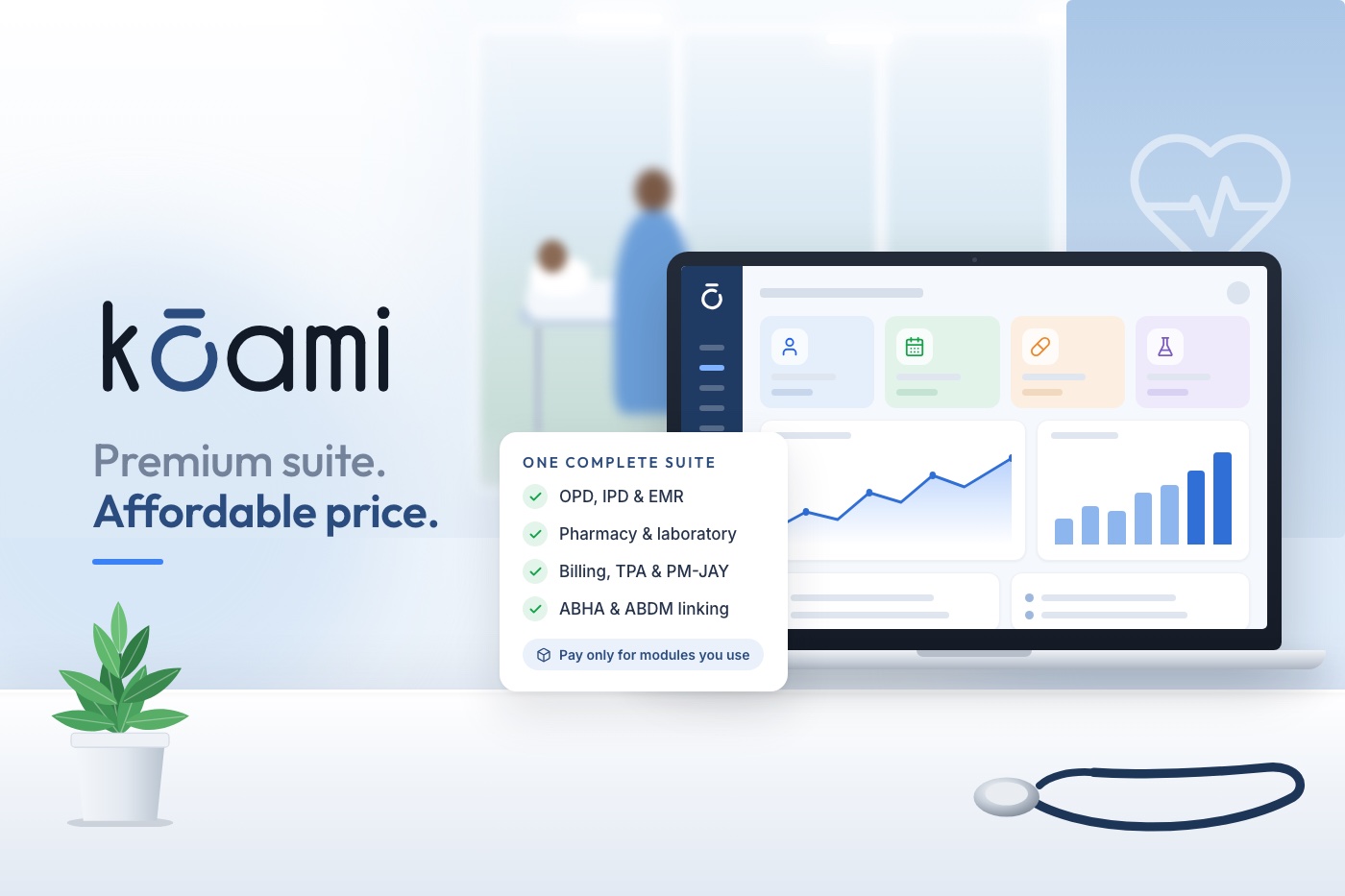
Kōami is built to give hospitals a complete, premium hospital suite at a price they can actually justify — every department on one connected platform, for less than the cost of several systems stitched together.
The affordability is structural rather than a discount. You pay only for the products and modules you switch on, and every Kōami product works on its own, so a hospital can start with Kōami Hospital and add Workforce, Inventory or PACS later without a second implementation. Hospital deployments are typically priced per bed, and the hospital plan includes unlimited users, so the nurse, the resident and the pharmacist each get their own login and the audit trail stays real. Secure cloud hosting is included in every plan, which takes servers and backups out of the five-year sum, and hospital plans include onboarding, data migration support and training rather than billing them as a separate project.
The premium part is what arrives in the same price: OPD and IPD, EMR, pharmacy, laboratory, radiology, operation theatre and billing on one patient record; a tariff and package engine for TPA, corporate and PM-JAY work; GST-compliant invoicing; role-based access, multi-factor authentication and audit logging built in; and native mobile apps for staff.
A single-doctor clinic with no plans to grow will pay less for a focused clinic product, and it is better to say so plainly. For a nursing home, a multi-specialty hospital or a growing group that wants premium software without an enterprise bill, see how Kōami pricing is structured, then book a demo and bring your current quotation. We will build the five-year comparison with you, line by line.