Best Hospital Management Software in Nepal: A Buyer’s Guide
Published
The best hospital management software in Nepal is not the product with the longest module list. It is the system that can run one real patient journey — registration, consultation, admission, orders, pharmacy, billing and discharge — without staff rebuilding the record at every counter.
Nepalese hospitals also have localisation questions that a generic international demo can conceal: Nepalese rupees, local invoices and fiscal periods, Health Insurance Board processes, routine HMIS reporting, connectivity outside the strongest urban networks, and support when a ward is working after normal office hours. A serious comparison puts those questions beside clinical depth and total cost.
What should an HMS in Nepal include?
At minimum, it should connect the patient-facing and back-office workflows on one identity.
- Registration, appointments, OPD token and consultation
- IPD admission, transfer, bed state, nursing and discharge
- Structured EMR, orders, laboratory and imaging results
- Pharmacy dispensing, batch and expiry, stores and procurement
- NPR tariffs, packages, receipts, refunds and payer splits
- Insurance worklists, document completeness and settlement tracking
- Management dashboards and exportable routine reports
The phrase “all-in-one” is not enough. Ask the vendor to enter a service once and show where it appears: in the clinical record, department worklist, stock ledger and bill. If four people still re-enter it, the modules are adjacent rather than integrated.
How should a Nepalese hospital compare vendors?
Score the same live scenarios across every vendor. Give each team your tariff sheet, one insurance case, one lab order, one return to pharmacy and one corrected bill. Do not accept screenshots for a workflow the hospital performs every day.
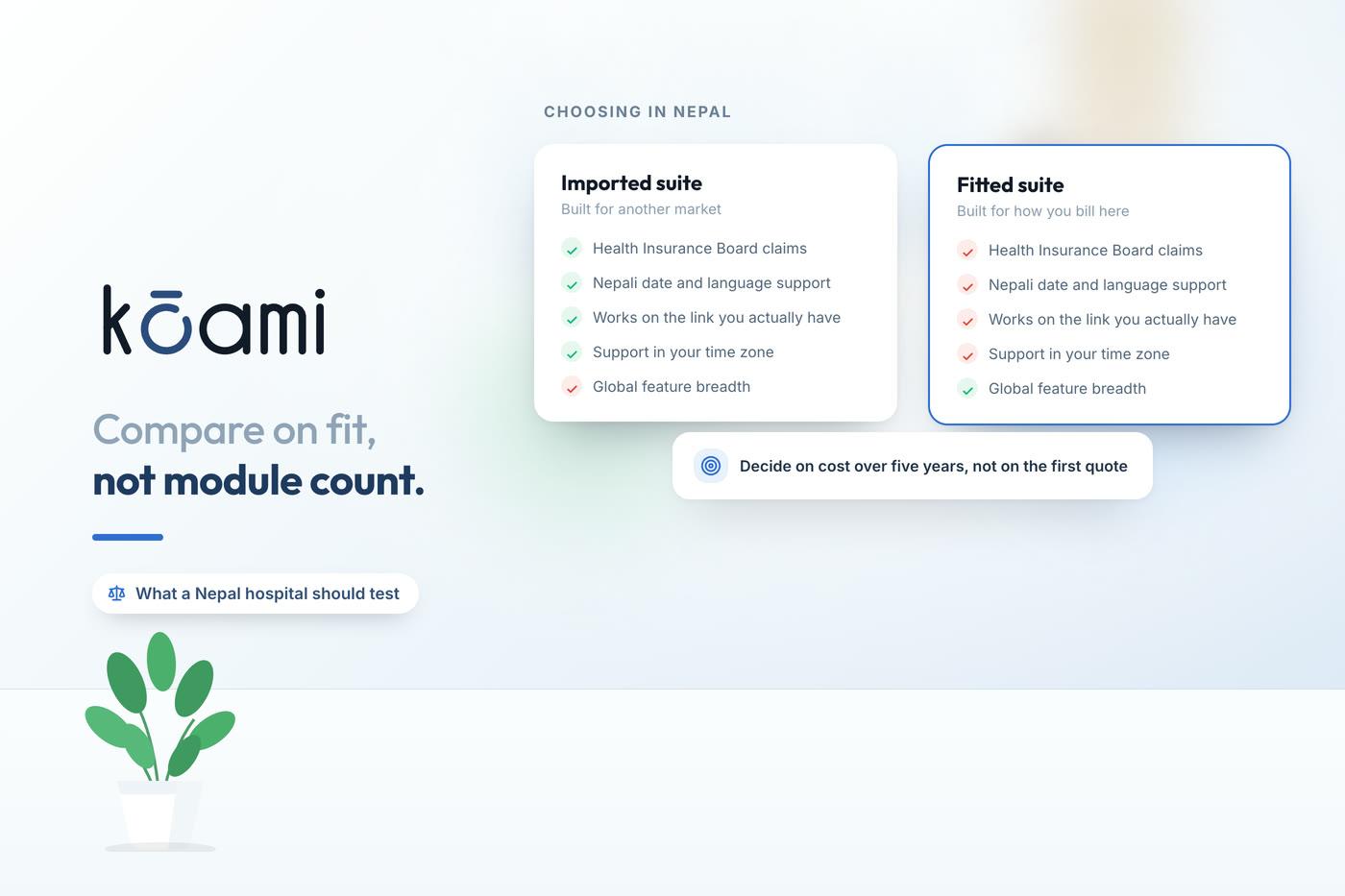
Evaluate six dimensions: workflow depth, Nepal localisation, interoperability, implementation capacity, support, and five-year cost. Give localisation its own acceptance criteria. “Configurable” should mean the vendor can demonstrate the configuration, identify who maintains it and commit to it in the statement of work.
Use the hospital software in Nepal checklist as a starting point, then add the cases that generate the most complaints in your own hospital.
What Nepal-specific requirements need proof?
Currency is the easy part. The harder part is matching the forms, calendars, payer rules and reports people actually use.
Ask for the exact NPR invoice and receipt formats finance has approved. Test the fiscal-year rollover and any Bikram Sambat date requirement in the actual output, not merely on screen. For Health Insurance Board work, trace eligibility or beneficiary details, services, supporting evidence, queries and settlement reconciliation. For routine reporting, ask the medical-records team to bring last month’s submission and identify which fields can come from transactional data.
The Ministry of Health and Population is actively developing digital-health and interoperability initiatives. A vendor should therefore show open APIs, structured exports and standards awareness, not claim that today’s interface will never change. Nepal’s Digital Health platform explicitly describes links among HMIS, EHR systems and the Health Facility Registry.
Is cloud or on-premise better in Nepal?
Neither is automatically better. The decision depends on measured connectivity and the hospital’s ability to maintain infrastructure.
Cloud removes server-room maintenance, simplifies multi-site access and makes geographic recovery easier. On-premise can be defensible where connectivity is genuinely unreliable and the hospital has people who patch, monitor, back up and test restores. The dangerous choice is cloud without a downtime process or on-premise without an IT operating discipline.
During the demo, disconnect the network. Ask what registration, pharmacy and billing staff do for the next two hours, how temporary records are reconciled and when the continuity process was last rehearsed. Read the detailed cloud versus on-premise guide for Nepal before deciding.
Where does Kōami fit?
Kōami connects hospital operations, workforce, inventory, PACS, fertility and biomedical equipment on one identity and data model. That makes it relevant to hospitals and groups trying to replace disconnected departmental systems.
The platform is India-first today, so Nepal-specific statutory, payer, payroll and reporting requirements should be scoped and accepted before go-live rather than assumed. That is a more useful starting point than a “fully localised” claim nobody has tested. Bring your forms and one complete patient journey to a Nepal discovery call; the outcome should be a written map of what is ready, what is configuration and what requires localisation.
Follow Kōami on LinkedIn
Get the next guide on hospital operations, software and compliance in your feed, as soon as it is published.