EMR Software in India (2026): How Doctors and Hospitals Should Choose One
Published
A consultant physician in a busy Indian OPD sees sixty patients before lunch. If the EMR takes ninety seconds longer per patient than a pen and a printed letterhead, that is ninety minutes a day, every day, and within a month the consultant is back on paper while a junior doctor types the notes in afterwards. The system has not failed technically. It has failed at the one job that decides everything else, which is being faster than the thing it replaced.
EMR software in India is now a crowded market — clinic apps, hospital systems, free tiers, open-source projects and AI scribes all claim the word. This guide is for doctors, medical directors and hospital owners choosing one in 2026: what an EMR is, what it must do in India specifically, what it costs, and the demo tests that separate a clinical record from a text box with a prescription printer attached.
What is EMR software?
EMR software is the electronic medical record a hospital or clinic keeps for its own patients: consultation notes, diagnoses, orders, results, prescriptions, procedures and discharge summaries, held as one record per patient across every visit.
It is easily confused with neighbouring terms. An EHR is the record designed to follow the patient across organisations, which in India is what ABDM is building; an HMS or HIS is the wider system that also runs registration, billing, pharmacy and the wards. Our explainer on HMS, HIS, EMR and EHR settles the acronyms. The practical point is that in a hospital the EMR should be a module of the HMS, sharing one patient identity, rather than a separate product joined by an interface.
What is the difference between a clinic EMR and a hospital EMR?
A clinic EMR is built around one doctor and one consultation: notes, prescription, follow-up, perhaps a lab order. A hospital EMR has to hold the whole stay — admission notes, daily progress notes, nursing charts, medication administration, operation notes, cross-consultations and a discharge summary assembled from all of it.
That difference decides the purchase. A clinic EMR stretched across a hospital fails at the ward: nursing is charted on paper, medication administration is not recorded against the prescription, and the discharge summary is retyped. A hospital EMR squeezed into a single-doctor clinic is usually too heavy. Buy for the setting you actually run, and for the one you will be running in three years.
What features should EMR software have in India?
Ten, and an EMR that misses any of them pushes the gap back onto the doctor or the nurse.
- Structured, coded diagnoses. ICD-coded rather than typed prose, which is what makes clinical audit, case-mix reports and scheme claims possible at all.
- Fast e-prescriptions. A drug database with brand and generic names, favourites per doctor, dose and frequency in one line, and a legible printout or digital copy for the patient.
- Specialty templates. Different starting points for medicine, surgery, obstetrics, paediatrics, ophthalmology and the rest, editable by the department rather than by the vendor.
- Orders from the chart. Laboratory, imaging and medication orders that reach the laboratory, the modality worklist and the pharmacy as structured requests, with results returning as values that can be trended.
- One longitudinal record. OPD, IPD, theatre and emergency on one patient identity, so the consultant sees the patient rather than the visit.
- Bedside nursing and medication administration for inpatients, including clinical scores such as early-warning and falls risk.
- ABHA and ABDM linking, so records can be linked to the patient's health account and shared with consent.
- Audit trails and access control. Role-based access and a log of who viewed a record as well as who edited it, which both NABH and the DPDP Act expect.
- Teleconsultation support that records the consultation, consent and prescription in the same record as an in-person visit.
- Data export in a usable format, because a clinical record has to outlive the software that created it.
Is EMR software mandatory for doctors and hospitals in India?
No law requires every private doctor or hospital in India to use an EMR. What has changed is that almost everything around the clinical record has become digital, and a paper record now costs a hospital money and time at every point where it meets an insurer, a scheme, an accreditor or a patient.
Insurers and TPAs want structured documents for pre-authorisation and claims, and NHCX moves those claims onto a digital exchange. PM-JAY files are audited against the clinical record. NABH assessors examine record completeness and the audit trail. The DPDP Act gives patients rights over their data that are far easier to honour from a system than from a file room. And the professional conduct rules doctors work under already require inpatient records to be kept and produced on request. An EMR is not compulsory; running a hospital without one has simply become the expensive option.
What does ABDM require of an EMR?
ABDM integration is certified in three milestones: M1 for creating and verifying ABHA numbers at registration, M2 for linking care contexts and sharing records as a health information provider, and M3 for fetching a patient's records from other providers, with consent, as a health information user.
Records move as FHIR documents using India's ABDM profiles, which is why a structured record matters: a diagnosis typed as prose cannot become a useful coded entry in a shared record. Ask vendors which milestones they hold for the exact product you are buying, not for a sister product. Our guides to ABDM certification milestones, HL7 FHIR in India and ABHA at the registration counter go deeper, and hospitals with ten or more beds should also read about the Digital Health Incentive Scheme, which pays for ABHA-linked records.
How fast should an EMR be in a busy Indian OPD?
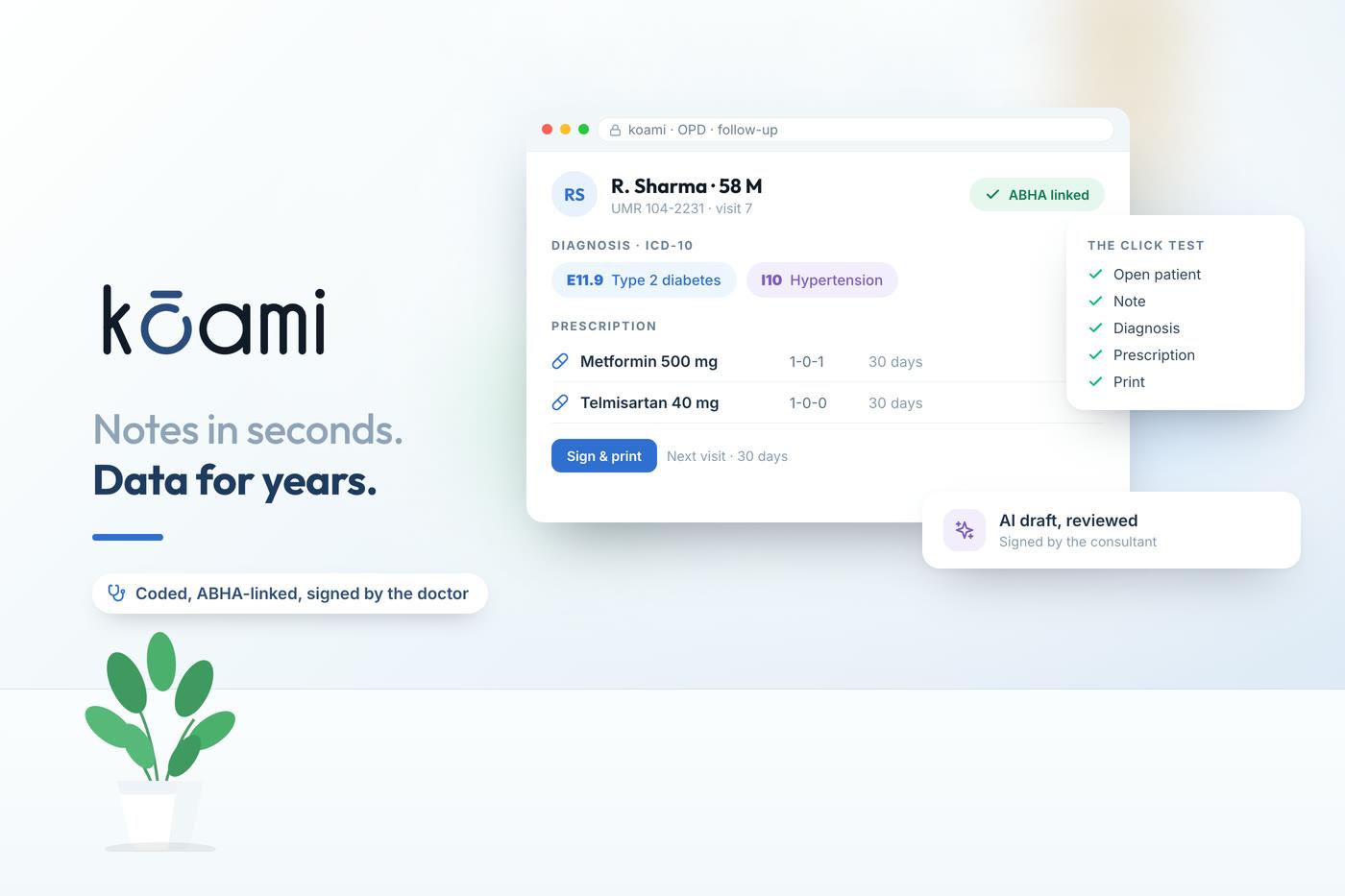
Fast enough that a routine follow-up — note, diagnosis, prescription, next visit — takes no longer than writing it by hand. In practice that means a handful of clicks or a short dictation, not a sequence of tabs.
Count it in the demo. Ask the vendor to complete a real follow-up visit for a patient with hypertension and diabetes, from opening the patient to printing the prescription, while you count every click and every screen. Then ask the doctor who will actually use it to do the same. The difference between those two numbers is the training and adoption effort, which our article on the consultant who would not type describes from the ward.
Can an AI scribe replace typing in the EMR?
For a growing number of consultations, largely yes — if the scribe writes into the EMR's structured fields and the doctor reviews the draft before it enters the record. An ambient scribe listens to the consultation, including the mix of English, Hindi and regional languages Indian OPDs actually use, and drafts the note, diagnoses, orders and prescription for the doctor to confirm.
The distinction that matters is where the draft lands. A standalone scribe that produces a block of text for copying into the EMR saves typing but not structure. One built into the EMR writes coded diagnoses and orders against the patient's existing record. Our guide to the AI medical scribe for Indian doctors covers accuracy, consent and a four-week pilot plan.
How much does EMR software cost in India?
For a single-doctor clinic, EMR software typically costs roughly ₹1,500 to ₹5,000 a month in 2026. In a hospital the EMR is usually priced as part of the hospital management system, and the bands in our hospital software cost guide apply.
The headline matters less than the structure. Per-user pricing looks cheap for a clinic and becomes expensive in a hospital where every resident, nurse and technician needs a login — and quietly encourages shared logins that make the audit trail meaningless. Check which features are add-ons: ABDM integration, teleconsultation, WhatsApp delivery of prescriptions, AI scribing and the laboratory interface are commonly priced separately.
What is the best free EMR software in India?
Free EMR software exists in two forms: free tiers of commercial clinic apps, which are usually limited by patients, features or users, and open-source systems such as OpenMRS and Bahmni, which cost nothing to license but need hosting, configuration and someone to maintain them.
For a single doctor testing digital prescriptions, a free tier can be a sensible start. For a hospital, "free" rarely survives contact with the first year: servers, implementation, ABDM certification work and the developer you need every time a form changes all have a price. Our article on free and open-source hospital software works through what it really costs.
What should you test in an EMR demo?
Eight tests, run on your own patients' scenarios rather than the vendor's script.
- Complete a routine follow-up visit and count the clicks to a printed prescription.
- Record a diagnosis, then list every patient with that diagnosis this quarter.
- Order a lab test from the chart and show the result returning as a value that can be trended.
- Create or verify an ABHA number and link the visit as a care context.
- Admit a patient, chart a medication dose at the bedside and produce the discharge summary without retyping.
- Show the audit trail for a record that was viewed but not edited.
- Run a teleconsultation and show its consent and prescription in the same record.
- Export one patient's complete record, and ask what format it arrives in.
A system that passes all eight on your scenarios is a clinical record. One that passes them only on the vendor's demo data is a presentation.
Where Kōami fits
The EMR in Kōami Hospital is a module of a premium, complete hospital suite rather than a separate app, so the consultation, the ward, the laboratory, the pharmacy and the bill all share one patient record. Diagnoses are ICD-coded, orders are structured, medication reconciliation compares what the patient was on with what was prescribed and given, cross-consultations land in the same chart, and nursing charting with early-warning and falls scores happens at the bedside. ABDM and ABHA linking is built into registration, and role-based access with an audit log of every view and edit applies to every note — including the drafts from Kōami's ambient documentation, which the doctor reviews and signs before anything enters the record.
It is also an affordable way to buy a premium EMR. You pay only for the modules you switch on, hospital deployments are typically priced per bed with unlimited users, secure cloud hosting is included in every plan, and hospital plans include onboarding, data migration support and training. A single doctor with no plans to grow will pay less for a focused clinic app, and it is better to say so. For a nursing home, a multi-specialty hospital or a growing group, see how Kōami pricing works, then book a demo and bring your busiest consultant. We will run the eight tests above on their patients, not ours.
Follow Kōami on LinkedIn
Get the next guide on hospital operations, software and compliance in your feed, as soon as it is published.