Free and Open-Source Hospital Management Software: What It Actually Costs
Published
Somewhere in the evaluation of every hospital system, usually late in the process and usually from the finance side, someone asks whether there is a free option. There is. Several, in fact, some of them serious pieces of engineering with hospitals running on them worldwide.
The question is worth taking seriously rather than dismissing, because the honest answer is not no. It is that free software has a cost structure rather than no cost, and that structure suits some hospitals very well and others not at all.
Is there genuinely free hospital management software?
Yes. There is mature open-source software in this category, used in real hospitals, and the licence genuinely costs nothing.
The established projects have been developed over years, often with support from global health organisations and deployments in resource-constrained settings. There are open-source electronic medical record platforms with substantial clinical depth, open-source laboratory systems, open-source imaging archives that are widely used even inside commercial deployments, and general-purpose ERP systems with healthcare modules.
None of this is vapourware, and dismissing it as unserious is a vendor reflex rather than an argument.
So what does free actually cost?
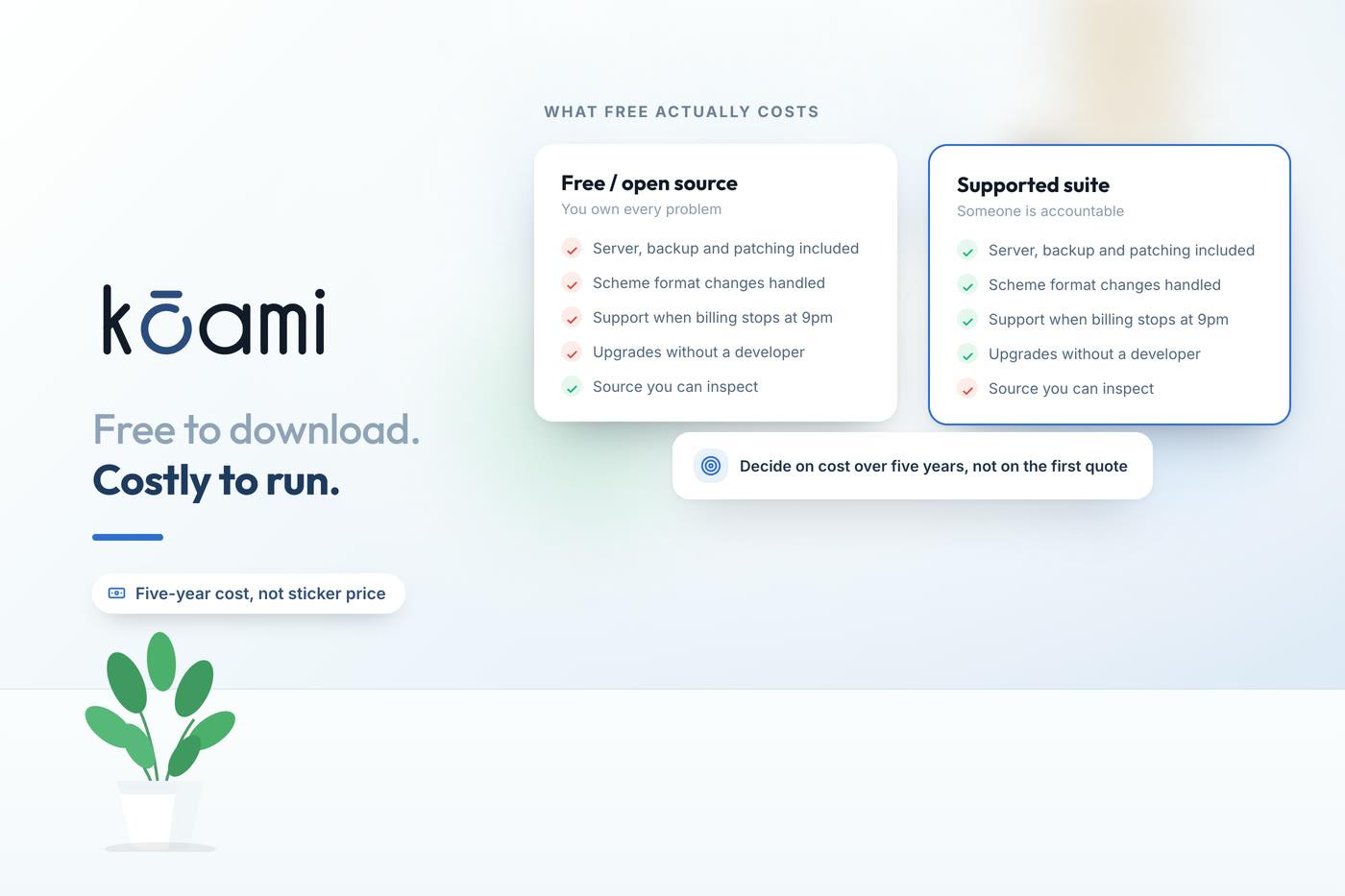
The licence is zero. The deployment is not, and the ongoing operation is where the real number lives.
- Hosting and infrastructure. Servers or cloud capacity, redundancy, backups, and someone monitoring them.
- Implementation. Configuration, master data, tariffs, forms, roles, and workflow design. Identical work whether the software was free or not.
- Localisation. Indian statutory registers, GST-compliant billing, PM-JAY and TPA claim formats, ABDM integration. Most international open-source projects do not include these, and building them is a development project, not a configuration exercise.
- Development capacity. Someone who can read the codebase, fix what breaks, and build what is missing. This is a salaried role or a retained agency, permanently.
- Upgrades. Community releases are not backwards-compatible with your customisations by default. Every upgrade is a merge exercise.
- Support at three in the morning. There is no number to ring. There is a forum.
Free software transfers cost from a licence line to a payroll line. For a hospital with the payroll line already in place, that is a good trade. For one without it, it is not a trade at all.
Which hospitals does open source genuinely suit?
Three kinds, and they have something in common.
Institutions with real internal IT capacity. Teaching hospitals, large trusts, government programmes and health networks with a development team already on staff. They can absorb the maintenance burden, and in exchange they get complete control and no per-bed fee across a large estate.
Organisations with unusual requirements. Research institutions, public health programmes, and anyone whose workflow is far enough from commercial assumptions that they would be paying for heavy customisation anyway.
Deployments where the licence cost is genuinely prohibitive. Low-resource settings and large-scale public deployments where a per-bed subscription across thousands of beds is simply not fundable.
What these share is that the marginal cost of maintaining the software is spread across a large deployment or an existing team. Where that is not true, the arithmetic reverses.
Which hospitals should not choose it?
A hospital with no IT department, or one person who also handles the printers.
This is the most common Indian case and it deserves plain speaking. A fifty-bed hospital where the systems are looked after by one capable generalist cannot run open-source HMS successfully. Not because the software is bad, but because the operating model assumes engineering capacity that the hospital does not have and would find expensive to acquire.
The failure mode is predictable and slow. The system goes in with enthusiasm and an implementation partner. The partner's engagement ends. Something breaks during an upgrade. The one person who understood the deployment takes another job. Two years later the hospital is running an unpatched version nobody dares touch, with a security exposure it cannot assess and a data set it cannot easily move.
That is a worse outcome than any subscription.
What about the middle path?
There are two, and both are more common than pure open source in Indian hospitals.
Commercially supported open source. A vendor takes an open-source core, localises it, hosts it and supports it, for a fee. You get the open licence and an escape route, plus somebody to ring. The fee is real and often comparable to commercial software, but the exit position is better because the core is not proprietary.
Open components inside a commercial system. This is quietly the most common arrangement in healthcare software of any kind. Open-source DICOM libraries, terminology services, database engines and interface tooling sit inside commercial products everywhere. It is a reason to ask about licences and dependencies, not a reason to worry.
What questions settle the decision?
Five, answered honestly rather than aspirationally.
- Who, by name, will maintain this in eighteen months? If the answer is a role that does not currently exist, the answer is nobody.
- What will it cost to build Indian statutory compliance, and who owns it when the regulations change?
- What is the upgrade path, and who does the merge?
- What happens at three in the morning during a go-live weekend?
- If this fails, what is the exit? Which is the one question where open source usually answers best, because the data model is documented and yours.
What does this mean for how you evaluate commercial vendors?
Use the open-source option as a measuring stick rather than as a threat.
The genuine advantages of open source, which are control, transparency and no lock-in, are things you can demand from a commercial vendor in contract form. Ask for a documented data model. Ask for standards-based APIs rather than a private integration. Ask what a complete data export looks like, in what format, at what cost, on what timeline. Ask what happens to your data if the vendor is acquired or ceases trading, and whether source escrow is available.
A commercial vendor who answers those well has given you most of what open source offers, with a support contract attached. One who deflects has told you exactly why the open-source question was worth asking.
Kōami is commercial software, and we would rather be chosen for the reasons above than because the alternative was dismissed. If your hospital has real engineering capacity and unusual requirements, open source may well be the better answer for you. If it does not, the honest comparison is not free against paid. It is paid against paid, with one of the payments hidden in a job description that has not been written yet.
Follow Kōami on LinkedIn
Get the next guide on hospital operations, software and compliance in your feed, as soon as it is published.