Biomedical Equipment Management Software: Choosing a Hospital CMMS in India
Published
Every hospital knows roughly what it spent on medical equipment. Very few can say what any single machine has cost them since it arrived, how much of the last year it spent out of service, or whether the annual maintenance contract renewed last month was worth its price. The information exists. It exists in service reports in a file, warranty documents in a drawer, and the biomedical engineer's memory.
A computerised maintenance management system, a CMMS, is the software that turns that into a record. For a hospital it also happens to be an accreditation requirement, which is usually what finally triggers the purchase.
What does biomedical equipment management software do?
It maintains an asset register, schedules preventive maintenance, manages breakdown calls, records every service event against the machine, and tracks calibration and contracts.
Put more usefully, it answers questions the hospital currently cannot answer:
- Which equipment is due for preventive maintenance this month, and which is overdue?
- How many hours has this ventilator been out of service this year?
- Which vendor consistently misses its response time commitment?
- Which machines are out of warranty and not under contract?
- Which calibrations expire before the next NABH audit?
- Is it now cheaper to replace this machine than to keep repairing it?
Why does NABH make this a purchase rather than a nice-to-have?
Because accreditation asks the hospital to demonstrate a documented equipment management programme, and demonstration means records.
The clauses concerned expect an inventory of equipment, planned preventive maintenance carried out to schedule with evidence, breakdown maintenance recorded, calibration of measuring equipment against traceable standards, and evidence that critical equipment availability is managed. An assessor asking for the last four preventive maintenance records for a specific ventilator is asking a question a filing cabinet answers slowly and a system answers immediately.
Hospitals that fail this section rarely fail because maintenance was not done. They fail because it cannot be shown.
A maintenance programme that cannot be produced on demand is, for accreditation purposes, a maintenance programme that did not happen.
What should a hospital CMMS include?
Eight things, and the ones hospitals underestimate are the last three.
- Asset register with real depth. Make, model, serial, location, department, purchase date and value, warranty expiry, contract status, criticality classification, and the responsible department.
- Preventive maintenance scheduling. Frequency by asset class or by manufacturer recommendation, checklists per equipment type, automatic work order generation, and escalation when a schedule slips.
- Breakdown and work order management. Fault logged from the ward, assigned to an engineer or a vendor, tracked to closure, with downtime measured from report to restoration rather than from when someone opened a ticket.
- Contract and warranty tracking. AMC and CMC coverage, what each covers, renewal dates with lead time, and whether a given breakdown falls inside coverage. This single feature usually pays for the system.
- Calibration management. Due dates, certificates stored against the asset, traceability to standards.
- Spares and consumables. What is held, what is consumed per repair, and reorder for critical spares.
- Vendor SLA performance. Response and resolution times measured against commitments, per vendor, over time. Without this, contract renewal is a negotiation with no evidence.
- Cost history per asset. Every rupee spent on a machine, so the replace-or-repair decision has a number behind it.
How is this different from general asset management software?
Three ways, and each one matters at audit.
General asset software is built for finance: what the hospital owns and what it is worth. A CMMS is built for uptime: what is working right now. Depreciation schedules and maintenance schedules are different data with different owners.
Medical equipment has regulatory obligations that generic tools do not model: calibration traceability, manufacturer-specified maintenance intervals, and in some categories, event reporting. A field labelled "next service date" is not the same as a calibration record with a certificate attached.
And medical equipment failure is clinically consequential. Criticality classification, so that a failed infusion pump in the ICU is routed differently from a failed printer, needs to be built into the workflow rather than added as a priority flag.
Should biomedical maintenance sit inside the hospital system?
It should at least share the hospital's location and department structure, and ideally its inventory and procurement.
The argument for integration is practical. Equipment lives in wards and theatres that already exist as entities in the hospital system. Spares are inventory. Purchase of a replacement is procurement. Downtime on a theatre machine affects the surgical list. When these are separate systems, the biomedical department maintains a parallel map of the hospital, and the two maps drift.
The argument for a standalone specialist CMMS is depth, particularly for large multi-site organisations with hundreds of engineers and complex contract portfolios. That is a real argument at scale. Below it, the integration cost usually outweighs the extra depth.
What should be in the demo?
Use your own equipment list, including the awkward items.
- Import our asset register and show me every item out of warranty and not under contract.
- Generate this month's preventive maintenance schedule and show the checklist for an anaesthesia workstation.
- Log a breakdown from a ward, on a phone, with a photograph.
- Assign it to an external vendor and show me the SLA clock.
- Close it, record the spare used, and show the cost added to that asset's history.
- Show me total downtime for the CT this year.
- Show me each vendor's average response time against its contracted commitment.
- Produce the last four PM records and the current calibration certificate for a named ventilator.
That final request is the accreditation question. If it takes more than a few seconds, the system has not solved the problem you are buying it for.
What does it cost?
CMMS is usually priced per asset under management or per engineer user, and it is one of the cheaper systems a hospital buys relative to what it protects.
The cost that matters is not the licence. It is building the asset register accurately in the first place: walking the hospital, tagging equipment, capturing serials and contract details, and classifying criticality. Budget for that as a project with a named owner, because a CMMS on top of an incomplete register produces confident reports about a fiction.
Ask whether the vendor helps with the initial asset capture, whether tagging hardware is included, and how the register is kept current when equipment moves between departments, which it does constantly.
Where Kōami Field Service fits
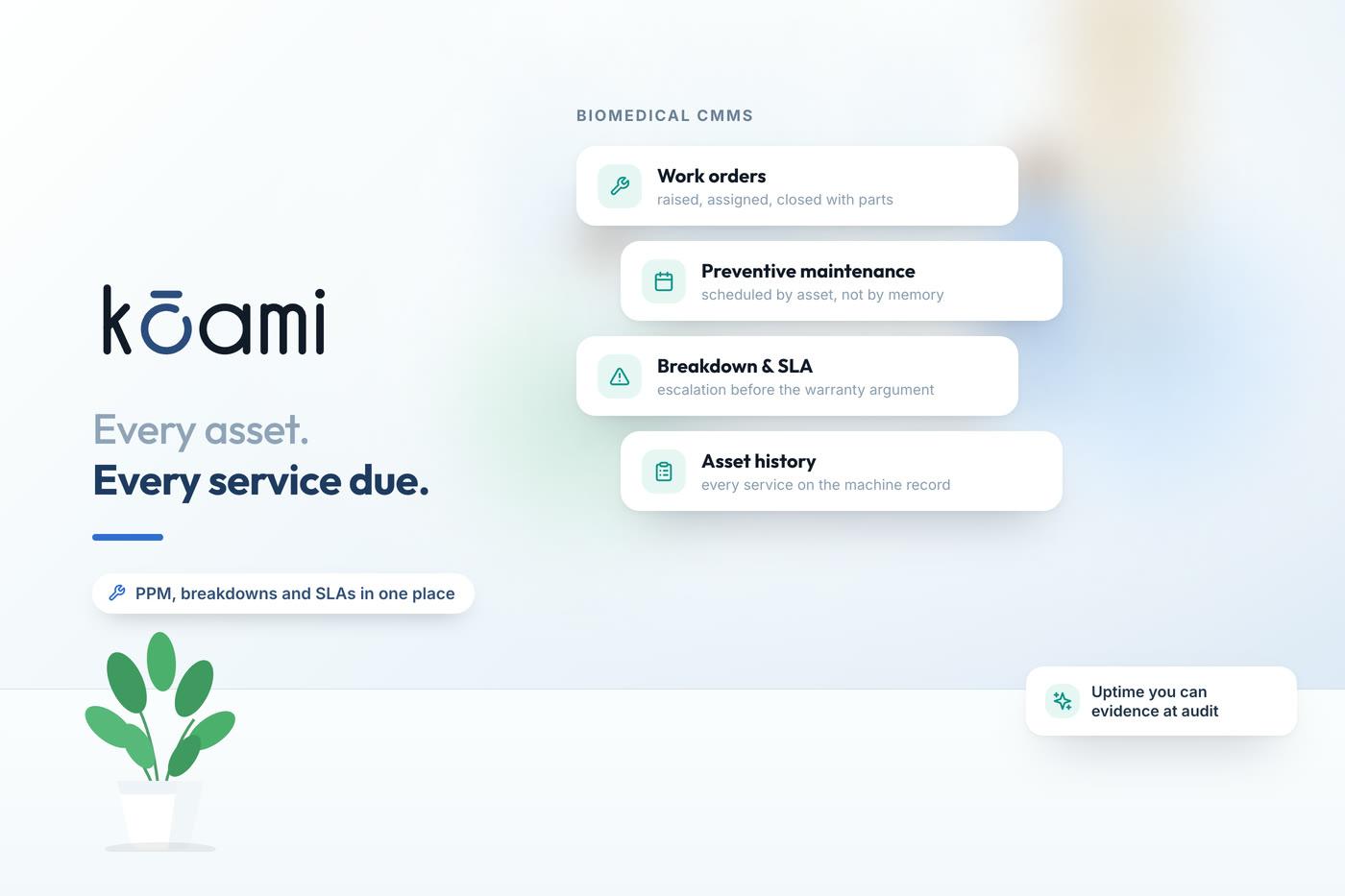
Kōami Field Service covers biomedical equipment upkeep as part of the wider platform: preventive maintenance scheduling, engineer dispatch, SLA tracking against vendors and internal teams, and full asset service history.
Because it shares the hospital's structure, a fault raised from a ward is raised against a real location, spares consumed come out of the same inventory the pharmacy and stores use, and a machine's cost history includes what was actually spent through procurement rather than what somebody typed into a maintenance note.
For a hospital group running a large in-house biomedical department across many sites, evaluate dedicated CMMS platforms too; they go deeper. For most hospitals, the reason equipment records are poor is not that the available software lacked features. It is that the system sat outside everything else, so nobody kept it current.
Follow Kōami on LinkedIn
Get the next guide on hospital operations, software and compliance in your feed, as soon as it is published.