Door-to-Doctor Time in Casualty, and How to Shorten It
Published
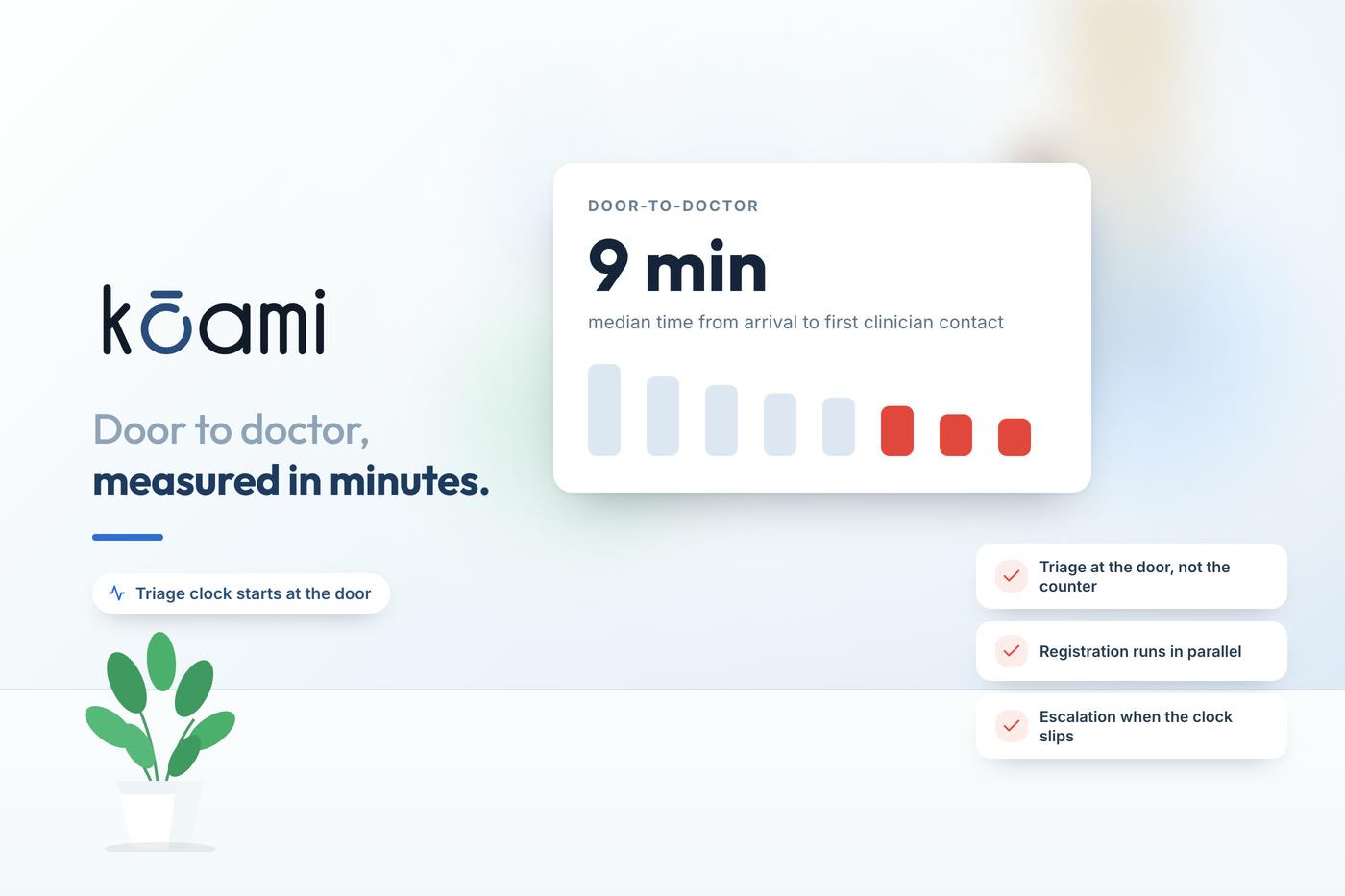
In an emergency department, the first number that matters is how long a patient waits between walking through the door and being seen by a clinician. Everything else — time to investigation, time to decision, time to admission or discharge — sits downstream of it. A department that fixes door-to-doctor time usually finds the rest improves without being attacked separately.
It is also the number most often measured badly, because the clock is started when somebody remembers to start it.
What is door-to-doctor time and why does it matter more than the others?
It is the interval between a patient's arrival and their first assessment by a doctor, and it matters because it is the only interval during which nobody is doing anything for the patient.
Every other emergency interval contains work. Time to CT includes the scan. Time to admission includes the decision. Door-to-doctor is pure waiting, and for a proportion of arrivals it is the interval in which a deteriorating patient is unattended.
It is also a leading indicator. When door-to-doctor lengthens, it is almost always because something downstream has blocked: no cubicle free because admitted patients are boarding, no doctor free because one is tied up in resuscitation, or registration has become a bottleneck.
Where do the minutes actually go in an Indian casualty?
Four places, and registration is usually the largest and the most fixable.
- Registration and payment before assessment. In many hospitals a patient cannot be seen until they are registered, and registration includes payment or payer verification. For a genuine emergency this is both a clinical risk and an operational bottleneck.
- Triage that is a queue rather than a sort. If arrivals are seen in order of arrival, the sickest patient waits behind six minor complaints.
- Cubicle availability. Space occupied by patients who have been decided upon but not moved.
- Doctor availability at the specific hour. Emergency arrivals are not uniform through the day, and rosters frequently are.
The first is the one to attack first, because it is entirely within the hospital's control and it costs nothing to change.
How should registration work in an emergency?
Assessment first, registration in parallel, with a provisional identity created in seconds.
The workable pattern is a rapid registration that captures the minimum needed to create a record — an approximate age, a sex, a presenting complaint and a system-generated temporary identifier — and lets the patient be seen immediately. Full demographics, payer details and payment follow while care is under way, and the temporary record merges into the permanent one once identity is established.
This matters for the unidentified patient too. A road traffic casualty brought in by a passer-by needs a record before anyone knows their name, and that record has to be capable of receiving orders, results and charges, then merging cleanly later without losing anything.
If your emergency department cannot create a working patient record for an unidentified, unaccompanied patient in under thirty seconds, registration is part of your clinical risk, not just your queue.
What does triage have to do to be worth the time it takes?
Sort by acuity in under two minutes, and make the sort visible to everyone who acts on it.
A triage that takes eight minutes has consumed a meaningful fraction of the interval it exists to protect. A triage whose output lives on a paper slip is invisible to the doctor scanning the department for who to see next.
What works is a short structured assessment producing a category, recorded once, and immediately visible on a live emergency board that everybody reads: who is waiting, in what category, for how long, and what has been ordered. When a category-one patient has been waiting four minutes, that fact should be on a screen, not in someone's memory.
The same principle applies to re-triage. A patient who has waited forty minutes is not the patient who arrived; their category should be revisited, and the system should prompt it.
How do you stop the department blocking from downstream?
Measure boarding time separately, and treat it as an inpatient problem rather than an emergency one.
Boarding — patients who have been admitted but remain in emergency because no ward bed is available — is the single largest cause of emergency overcrowding in most hospitals, and it is not caused by the emergency department. It is caused by discharge timing on the wards.
If your wards discharge in the late afternoon and your emergency admissions peak in the evening, the two curves guarantee boarding. Moving ward discharges earlier in the day is an emergency department intervention, even though nothing about it happens in the emergency department. This is one more reason the discharge process matters beyond its own metric, as set out in admission to discharge and why discharge takes so long.
What should an emergency department measure?
Six intervals, reported by hour of day rather than as daily averages, because the whole point is to find the hours that fail.
- Door to triage
- Door to doctor, at median and ninetieth percentile
- Door to first investigation ordered, and to result available
- Decision to admit, and decision to admission on a ward bed, which is boarding time
- Total time in department, split by admitted and discharged
- Left without being seen, counted rather than estimated
Reporting these as a daily average hides the problem. Reporting them by hour shows you that the department fails between six and ten in the evening, which is a rostering conversation rather than a process one.
How Kōami shortens door-to-doctor time
Kōami Hospital treats the emergency arrival as a record that can exist before identity, payment or payer are known, so nothing clinical waits on administration.
- Rapid registration creates a working UMR immediately, capable of carrying orders, results and charges, and merging into the permanent record once identity is confirmed without losing the history attached to it.
- Triage category is recorded once and drives a live view of the department, so the next patient to be seen is decided by acuity and waiting time rather than by whoever is loudest at the counter.
- Orders placed from the chart go straight to the lab and to the imaging modality worklist, and results and turnaround times post back automatically, so the clock on an investigation is visible rather than inferred.
- Live bed and ward occupancy means the decision to admit can be matched to an actual available bed, and boarding time becomes a number on a screen rather than an argument between two departments.
- Because Kōami Workforce holds the roster, staffing can be matched to arrival patterns by hour, and the credential rules that decide who can staff which area are enforced when the roster is built rather than discovered on the shift.
- Charges accrue as care happens, so an emergency patient who is admitted, discharged or transferred does not generate a separate billing reconciliation afterwards.
If your emergency department's numbers are collected on paper or not at all, that is the place to start, and it is worth doing before any software decision. If you already have the timestamps, bring a month of them to a demo.
Follow Kōami on LinkedIn
Get the next guide on hospital operations, software and compliance in your feed, as soon as it is published.