HMS, HIS, HIMS, EMR, EHR: The Acronyms, Settled
Published
Two vendors are sitting in front of a hospital's purchase committee. One says their product is a complete HIS. The other says theirs is an HMS with an integrated EMR. A board member asks whether the hospital needs an EHR as well. Nobody in the room is being dishonest, and nobody is quite sure whether the two products do the same thing.
They mostly do. The acronyms are a mixture of genuine distinctions and marketing habit, and the distinctions that are real are worth knowing before you sign anything.
What is an HMS, and is it different from an HIS or a HIMS?
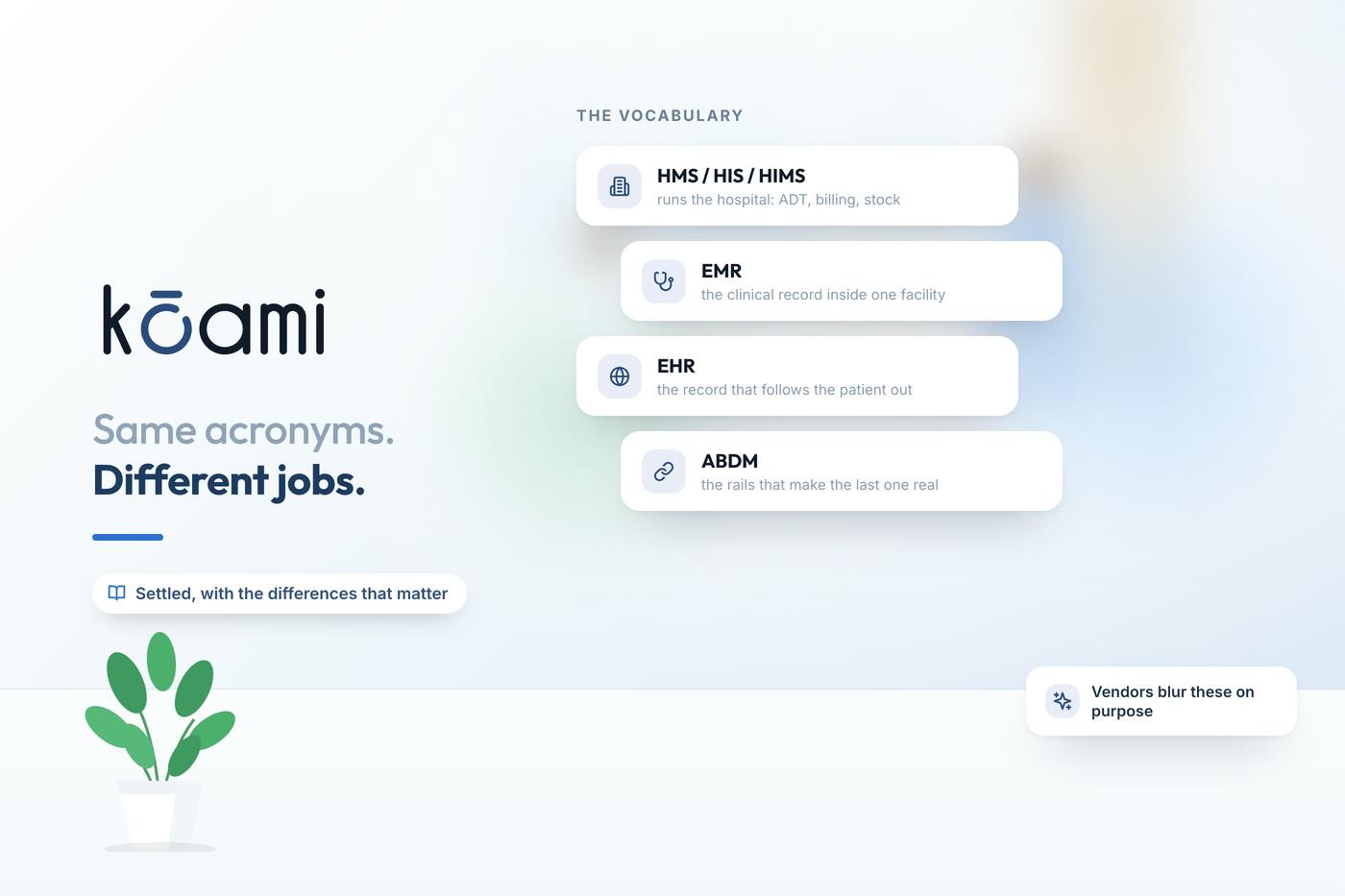
In practice, HMS, HIS and HIMS all describe the same category of software: the system that runs a hospital's day-to-day operations.
- HMS: Hospital Management System
- HIS: Hospital Information System
- HIMS: Hospital Information Management System
- Occasionally, hospital ERP
Buyers use them interchangeably, and so do most vendors. If a proposal uses one and a competing proposal uses another, that tells you nothing about scope. Ask for the module list instead.
If you want to be pedantic there is a shade of difference in the origins. HIS came from an information-systems tradition and leans clinical. HMS came from an administrative tradition and leans operational: registration, billing, pharmacy, stores. In India today the terms have converged so completely that the shade is not worth acting on.
What is an EMR, and how is it different from an EHR?
An EMR is the clinical record held by one organisation. An EHR is a record designed to follow the patient across organisations.
That is the one distinction in this whole list that carries real consequences.
An EMR holds what your hospital knows about a patient: consultations, diagnoses, orders, results, prescriptions, discharge summaries. It is complete within your walls and stops at them. If the patient goes to a different hospital, your EMR does not travel with them.
An EHR is the longitudinal record. The same patient, seen anywhere, with their history available to whoever is treating them now, subject to consent. In India this is what the Ayushman Bharat Digital Mission is building: an ABHA number as the identity, health records held by the facilities that created them, and a consent-driven exchange that lets a record move when the patient permits it.
The practical consequence for a buyer: every serious HMS contains an EMR. Almost none contains an EHR, because an EHR is not a product you buy, it is a network you join. What you should actually ask is whether the EMR can participate in that network.
So what should a hospital actually ask for?
Ask for the module list and the integration list, and ignore the acronym on the cover.
- Which modules are included at the quoted price, named individually
- Whether the clinical record is genuinely structured, or free text with a search box
- Whether it can create and verify ABHA numbers at registration
- Whether it can link care contexts, so records become discoverable to the patient
- Whether it exposes standards-based interfaces rather than a private export
A vendor who answers those five clearly is offering something specific. A vendor who answers by restating that they are a complete HIS is offering a word.
Where do LIS, RIS and PACS fit?
They are departmental systems, and the question is not whether you have them but whether they are separate.
- LIS, the Laboratory Information System, runs the lab: order to sample to result to approval, with analyser interfacing and turnaround tracking.
- RIS, the Radiology Information System, runs imaging orders, scheduling and reporting.
- PACS stores and displays the images themselves, in DICOM.
In an integrated suite these are modules that share the patient record, so a lab order placed in the chart appears on the lab worklist and the result posts back without anybody re-keying it. Bought separately, each needs an interface, and each interface is a small project with its own failure modes. Neither approach is wrong. The mistake is buying separately while assuming integration is free.
What about HRMS, ERP and the rest?
An HRMS manages people, not patients, and a hospital HRMS is not the same as an office one.
Hospitals run rotational shifts around the clock, with statutory staffing ratios, night and on-call differentials, and professional registrations that expire. Generic HR software models none of that. When a hospital says it needs an HRMS, it usually means rostering, attendance across wards, statutory payroll, and credential-expiry tracking.
ERP in a hospital context usually means the finance and supply chain layer: purchasing, stores, fixed assets, general ledger. Some HMS products include it. Some hospitals run a separate ERP and interface it. The decision hinges on whether your finance team already lives in something they will not leave.
The question the acronyms are hiding
Whether a product is called an HMS or an HIS tells you nothing. What separates products is narrower and easier to test.
- Does a patient have one identity across every department, or one per system?
- Is clinical data structured enough to be counted, or only readable?
- Do charges attach to care as it happens, or get assembled at discharge?
- Can the record leave the building when the patient consents, using a standard rather than a spreadsheet?
- When something goes wrong, is there an audit trail that shows who did what, including who merely looked?
A product that answers those five well is worth buying under any acronym. One that answers them badly is not worth buying under all of them.
A short glossary to keep in the room
- HMS / HIS / HIMS: the hospital operations and clinical system. Same thing.
- EMR: your organisation's clinical record for a patient.
- EHR: a record that follows the patient across organisations.
- ABHA: the health account number that identifies a patient in India's digital health network.
- ABDM: the national programme that defines how records are identified, linked and exchanged.
- HIP: a Health Information Provider, meaning a facility that creates records others may request.
- HIU: a Health Information User, meaning a facility that requests them.
- LIS / RIS / PACS: lab, radiology workflow, and imaging storage and display.
- HRMS: workforce, rostering, attendance and payroll.
- TPA: the third party that administers insurance claims between the hospital and the insurer.
Print it, put it on the table, and spend the meeting on the module list instead.
Follow Kōami on LinkedIn
Get the next guide on hospital operations, software and compliance in your feed, as soon as it is published.