Pathology Lab Software in India (2026): Features, NABL Readiness and Price
Published
A phlebotomist on a morning home-collection round draws blood from two members of the same family, labels both tubes by hand in the car, and gets them the wrong way round. The father's HbA1c goes onto the daughter's report and the daughter's onto his. Both results are analytically perfect. Both reports are wrong, and the laboratory finds out only when the family's doctor phones to ask why a healthy twenty-four-year-old has diabetes.
Most laboratory errors happen before the sample reaches an analyser or after the result leaves it, and that is exactly the ground pathology lab software is meant to cover. This guide is for owners, pathologists and laboratory managers of standalone labs, collection-centre networks and hospital laboratories choosing a system in 2026: what the software must do, what NABL now expects under ISO 15189:2022, how pricing works and what to test before you sign.
What is pathology lab software?
Pathology lab software, usually called a laboratory information system (LIS), runs the whole path of a diagnostic test: registration and billing, the test order, sample collection and barcoding, receipt in the laboratory, results from analysers or manual entry, validation and approval, and delivery of the signed report to the patient and the referring doctor.
It also holds the evidence a laboratory needs to prove its quality — internal quality control, calibration, reagent lots, staff competency and every amendment to a released report. A system that runs tests but cannot produce that evidence is a billing counter with a report printer, and NABL will notice the difference.
What features does pathology lab software need?
Twelve, and a laboratory should expect them to share one patient and one sample identity rather than be bolted together.
- Registration and billing with rate cards for walk-in patients, corporate clients, health camps and referring hospitals, applied automatically rather than calculated at the counter.
- A test master with methods, units, sample types, and reference ranges by age and sex, including paediatric ranges.
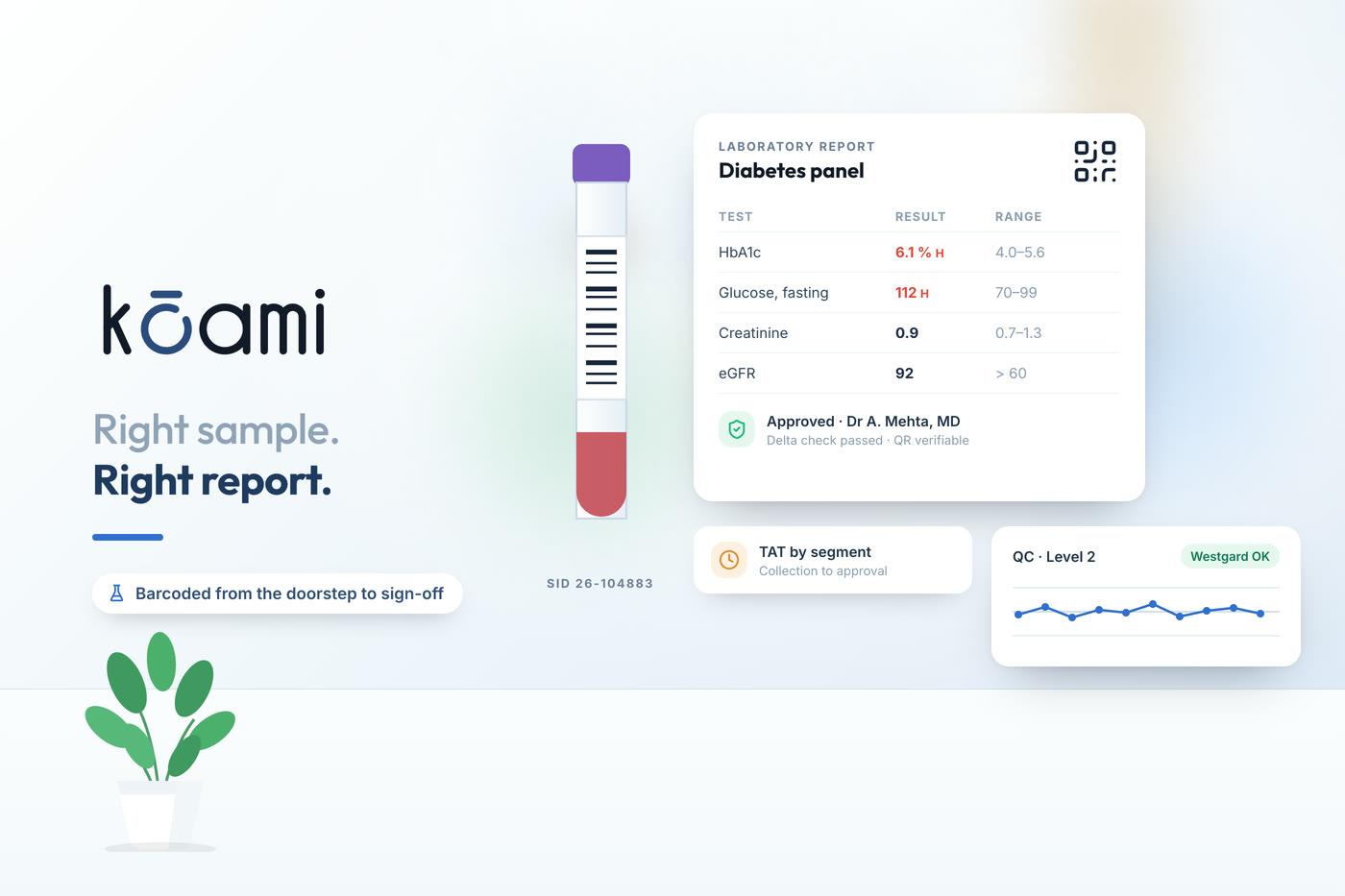
- Barcoding at the point of collection, including home collection and collection centres, so the label is printed for the patient in front of the phlebotomist.
- Sample tracking from collection to receipt, with rejection reasons recorded when a sample is haemolysed, clotted or insufficient.
- Analyser interfacing, ideally bidirectional, so the analyser receives the worklist and returns results without anyone typing them.
- Validation rules and delta checks that hold results for review when they are implausible or have changed sharply since the patient's last test.
- Quality control with Levey-Jennings charts and Westgard rules recorded at the time each run is performed.
- Critical value alerts with the call to the clinician documented — who was told, when and by whom — as our article on closing the loop on critical results describes.
- Report formats and digital signatures per department, with the approving pathologist recorded against each release.
- Report delivery by SMS, email, WhatsApp or a patient portal, with a verification code or QR on the report so a forged copy can be detected.
- TAT measured in segments — order to collection, collection to receipt, receipt to result, result to approval — so the failing step can be identified rather than averaged away.
- Reagent and consumable inventory with lot numbers and expiry, linked to the tests that consume them.
What does NABL require of laboratory software in 2026?
NABL accredits medical laboratories against ISO 15189:2022, and since the transition deadline of 31 December 2025 it accepts applications only under the 2022 edition. NABL 112A sets out the specific criteria for applying the 2022 standard in the Indian setting.
The 2022 edition reorganised the familiar clauses, put more weight on risk management and on the laboratory's information systems, and folded in point-of-care testing requirements that used to sit in a separate standard. For software, the practical demands are the ones assessors have always asked about, now asked more pointedly:
- Traceability. Every result traceable to the sample, the analyser, the reagent lot, the QC run and the person who released it.
- Controlled changes. An amended report shows that it was amended, what changed, who changed it and why.
- Access control. Each user sees and does only what their role allows, with a log to prove it.
- Record retention for the periods NABL 112A sets for each kind of record.
- Evidence as a by-product. QC, calibration and competency recorded when they happen, not reconstructed before the assessment.
Software does not accredit a laboratory. It decides whether that evidence exists every day or only in the six weeks before an assessment — the subject of our article on what the software has to prove for NABL.
What is the difference between an LIS and a LIMS?
In Indian pathology the terms are used almost interchangeably. Strictly, an LIS is built around patients and clinical reports, while a LIMS is built around samples and batch workflows, as in research, food or pharmaceutical testing.
A diagnostic laboratory needs the patient-centred features of an LIS — the patient record, reference ranges, the referring doctor, report delivery — and some of the sample discipline of a LIMS. Ask vendors to demonstrate your workflow rather than arguing about the label.
Should a hospital laboratory and a standalone lab use the same software?
They need the same laboratory core, but different things around it. A hospital laboratory lives inside the hospital record: tests are ordered from the consultation or the ward, results must reach the treating doctor's chart, and every test raises its charge on the patient's bill. A standalone lab lives on its counter, its collection network and its referring doctors.
That is why a hospital is usually better served by a laboratory module inside its hospital management system than by a standalone LIS joined by an interface — the order, the result and the charge never have to cross a boundary. A standalone lab or diagnostic centre needs strong counter billing, rate cards, home collection and report delivery, and, if it also does imaging, one patient across both departments, which our page on diagnostic centre software covers.
How do you connect lab analysers to the software?
Through an interface for each analyser, usually over the ASTM or HL7 protocols, either directly or through a middleware box. A bidirectional interface sends the worklist to the analyser by barcode and receives the results back; a unidirectional one only receives results.
Each interface is a small project: the analyser's protocol, its test codes mapped to the laboratory's test master, units and flags, and validation on real samples before going live. Ask vendors which of your exact analyser models they have already interfaced at other labs, and what each new interface costs. Our article on wiring analysers into the LIS covers the practicalities.
How much does pathology lab software cost in India?
Pricing is almost always a subscription — per month or year — and varies with the number of locations, users or monthly test volume. A single-location lab can find entry plans in the low thousands of rupees a month; a multi-branch network or a hospital laboratory costs more, and the real differences sit in what is included.
The lines to check: analyser interfaces, often priced per instrument; SMS and WhatsApp report delivery, metered per message; collection-centre and home-collection apps; patient portal and report verification; data migration of historical reports; and support hours that match a laboratory that opens at six in the morning.
What is the cheapest pathology lab software in India?
On sticker price, the cheapest options are entry-level cloud subscriptions and free tiers limited by tests or users. For a small lab doing a few dozen tests a day they can be enough. The cheapest software to run is the one that removes manual result entry, keeps QC and NABL evidence without extra staff time, and does not need a second system as the lab adds collection centres or imaging.
Transcription is the hidden cost. A lab that types results from analyser printouts pays for it in staff hours, in delay and in errors, and a single wrong report can cost more than a year's subscription. Compare systems on five-year cost with every interface and message included, and on how much manual work each one removes.
What should you test in a pathology lab software demo?
Run your own scenarios, with your own analysers' test codes, and ask for each of these.
- Register a walk-in patient and a corporate client for the same test panel, and show both prices applied automatically.
- Book a home collection, print the barcode at the patient's door, and track the sample to receipt.
- Reject a haemolysed sample and show the recollection request and the reason recorded.
- Pull a result from one of your analysers without typing it.
- Trigger a delta check and a critical value, and show who was alerted and how the call was recorded.
- Run a QC series and show the Levey-Jennings chart with a Westgard violation flagged.
- Amend a released report and show what the audit trail records.
- Report TAT by segment at median and ninetieth percentile.
- Deliver a report on WhatsApp and verify it from its QR code.
Where Kōami fits
Kōami Hospital includes a full laboratory module that runs order to sample to result to approval on the same record as the consultation that ordered the test: barcoded sample collection, analyser interfacing, result entry with validation and named approval, amendments with an honest trail, and TAT reported in segments. In a hospital that means a test ordered on the ward reaches the laboratory without re-entry, the approved result returns to the chart, and the charge lands on the bill automatically. For standalone diagnostic centres, the same platform handles walk-in, corporate, camp and referrer rate cards and puts pathology and imaging — through Kōami PACS — on one patient, with approved reports delivered to patients and referring doctors.
It is a premium laboratory system priced to be affordable: you pay only for the modules you switch on, secure cloud hosting is included in every plan, and onboarding, migration support and training are included in hospital plans. A large reference laboratory running hundreds of franchise collection points should test that specific workflow in the demo, and we would rather you did. See our laboratory information system page for the full checklist, then book a demo and bring your test master and one week of reports.
Follow Kōami on LinkedIn
Get the next guide on hospital operations, software and compliance in your feed, as soon as it is published.