Connecting Hospital Records to Nepal’s HMIS Reporting
Published
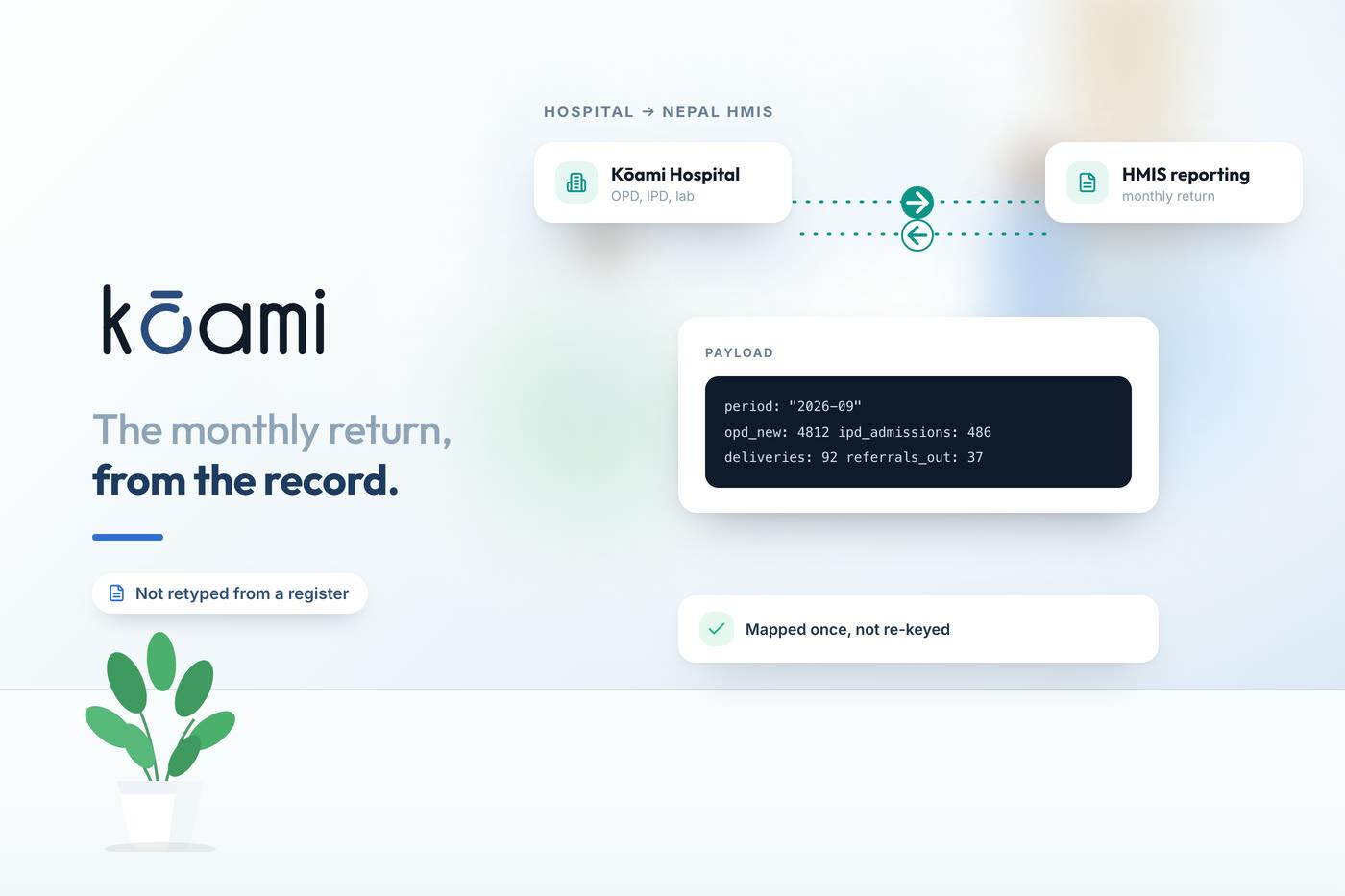
A hospital information system and Nepal’s national HMIS do different jobs. The hospital system records individual patients, orders, services, stock and bills so care can be delivered. National HMIS reporting aggregates selected activity so health services can be monitored and planned.
Confusing the two creates duplicate entry. Staff run the hospital in one system, then rebuild monthly totals in another because the local fields and national indicators were never mapped. The better design treats reporting as an output of care data, with human validation where definitions require judgement.
What is the difference between hospital HMIS and national HMIS?
In procurement, HMIS often means the application that runs a hospital. In government reporting, HMIS means the routine reporting framework and platform used by health authorities.
The operational system is patient-level and transactional. National reporting is generally indicator-level and aggregate. One evolves with hospital workflows; the other evolves with policy and programme definitions. A vendor saying “we support HMIS” should specify which meaning, which forms or interfaces, and for which reporting period.
Which data can be generated automatically?
Counts built from consistently recorded events are the best candidates.
Visits, admissions, discharges, diagnoses, procedures, tests, births, deaths and service utilisation can often be derived if source fields are structured and definitions are mapped. Free-text notes are a weak source because two clinicians can describe the same event differently. A dropdown with the wrong code is not better, so the mapping requires medical-records and clinical review.
Every indicator should have a small specification: numerator, denominator where relevant, source event, inclusion and exclusion rules, reporting period, facility and responsible reviewer. Keep versions. If a definition changes, the hospital must still explain why the same query produced a different number this year.
How should data quality be checked?
Validate close to the source and before submission.
Create exception worklists for missing age or sex, invalid dates, discharge without outcome, diagnosis without code, procedure without department and totals that differ from a related register. Give the department that creates the data ownership of the correction. A medical-records officer should not be expected to guess what happened in theatre.
Then reconcile aggregate reports to operational controls: visits to registration, admissions to ADT, lab tests to the LIS and pharmacy issues to stock movement. Preserve the submitted version, reviewer, timestamp and any correction. An audit trail turns a monthly spreadsheet into a defensible reporting process.
What integration design will survive change?
Use open interfaces and a mapping layer rather than hard-coding a report into clinical screens.
The Ministry’s current digital-health direction emphasizes standards and interoperability. Its digital platform plan envisages links among HMIS, EHR systems and the Health Facility Registry, while SIL-Nepal supports standards-based design and testing.
That makes five capabilities important: stable patient and facility identifiers, coded clinical data, APIs, versioned indicator mappings and export in usable structured formats. The exact exchange mechanism may change; clean source data and an open integration boundary remain valuable.
What should a hospital ask an HMS vendor to demonstrate?
Bring one report the facility submitted last month.
Ask the vendor to trace five totals back to the underlying patients, show missing-data exceptions, apply a correction, regenerate the report and preserve both versions. Ask who updates mappings when government definitions change, how fast changes are tested, and whether the facility can export the source data independently.
Do not accept a static PDF template as integration. The value is the lineage from a reported figure to the events that produced it.
How does Kōami approach Nepal reporting?
Kōami captures registration, encounters, ADT, diagnoses, orders, results, pharmacy, billing and other operational events on one record. That creates a strong source for routine indicators and management reporting.
Nepal-specific HMIS forms, indicator mappings and live exchange requirements still need discovery and acceptance with the facility’s medical-records team. They should be treated as maintained interfaces, not as a one-time checkbox. A Nepal HMS discovery call should begin with the actual forms and submission workflow, and end with a written integration scope.
Follow Kōami on LinkedIn
Get the next guide on hospital operations, software and compliance in your feed, as soon as it is published.