A Practical HMIS Implementation Plan for Hospitals in Nepal
Published
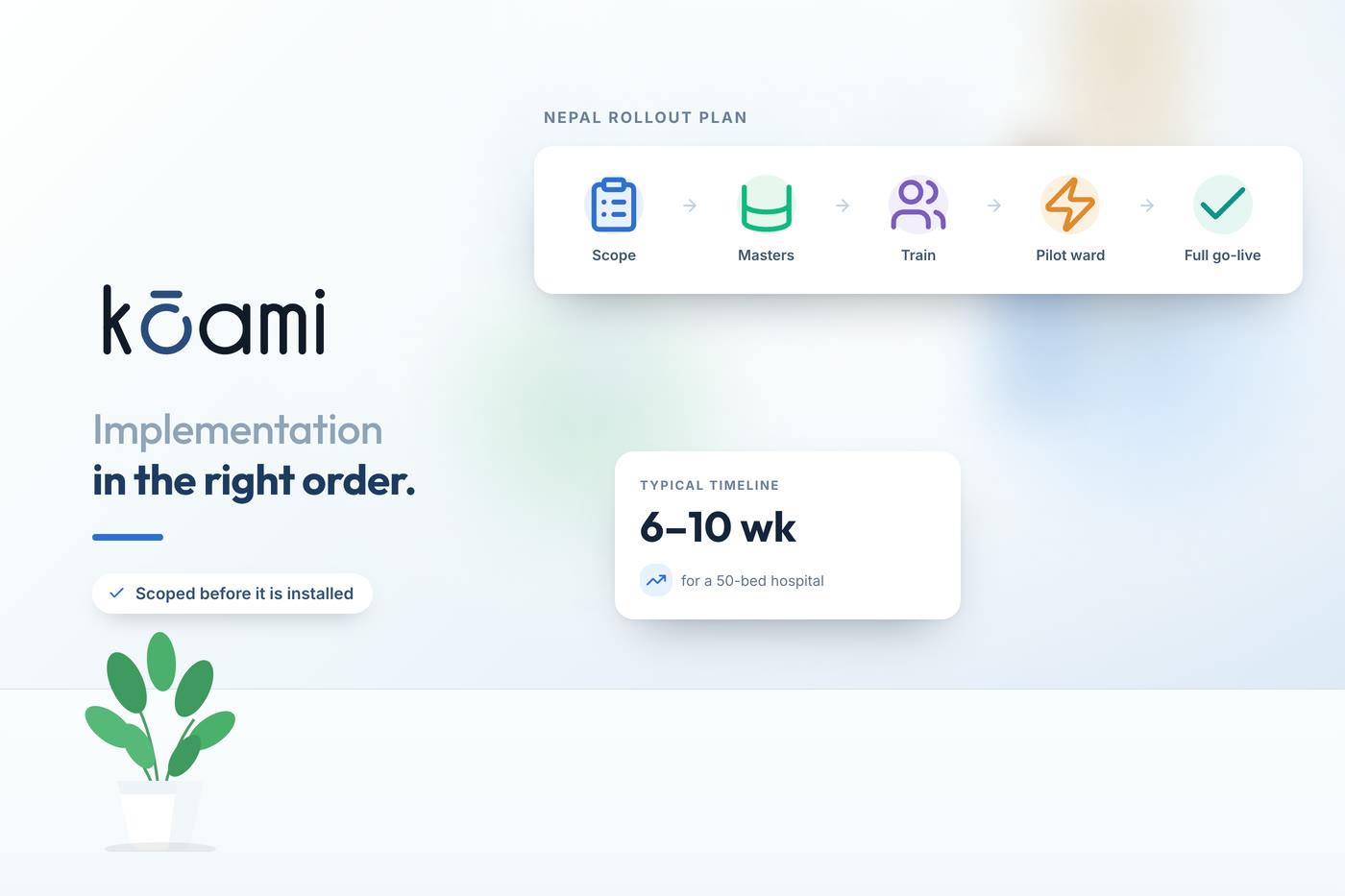
An HMIS implementation fails long before go-live if the project is treated as a software installation. The difficult work is agreeing how the hospital will register patients, name services, move stock, document care, close bills and produce reports when every department currently has its own answer.
For hospitals in Nepal, the implementation also has to test local finance, insurance, government reporting and connectivity requirements. Those belong in the first design workshops, not in a localisation sprint after the system is otherwise complete.
What should happen before configuration begins?
Map the current patient and data journeys, then name the future owner of each decision.
Follow five real cases from entry to closure: cash OPD, insured OPD, cash admission, insured admission and an emergency case. Record every register, form, spreadsheet, approval, label and handoff. Then list the master data underneath them — services, tariffs, packages, doctors, beds, stores, medicines, tests and users.
The output is not a long requirements document. It is a decision register: what will remain, what will change, who approves it and by when. Unresolved decisions should be visible to the steering group every week.
Which modules should go live first?
Choose a sequence that creates one complete flow.
For most hospitals, registration, appointments, OPD, billing and pharmacy form the first useful release. IPD, nursing, discharge and insurance follow once identity, tariffs and stock are stable. Laboratory and imaging interfaces should be prepared early because external vendors and device testing make their timelines less predictable.
Do not launch fifteen half-trained modules on one date. A phased go-live is not less ambitious; it creates a reliable base before more clinical risk is placed on it.
- Phase 1: patient master, OPD, cash billing and pharmacy
- Phase 2: IPD, beds, nursing, discharge and payer workflows
- Phase 3: laboratory, imaging, theatre and deeper clinical documentation
- Phase 4: procurement, management analytics and advanced integrations
How should legacy data be migrated?
Profile it before promising to move it.
Count duplicate patients, missing identifiers, inactive items, negative stock, unclosed admissions and balances that do not reconcile. Decide what must be transactional in the new system and what can remain in a searchable archive. Most hospitals need active patients, allergies, current medications, open balances, stock and recent reports more urgently than every old click.
Run at least three trial migrations. Each one needs a signed reconciliation: patient counts, opening receivables, pharmacy quantity and value, deposits, open admissions and key clinical histories. Migration is complete when these balances are understood, not when an import command finishes.
How should staff training work?
Train by role on real shifts and real exceptions.
A front-desk user needs twenty repetitions of registration, correction, refund and duplicate handling. A nurse needs admission, medication, transfer and downtime practice. A doctor needs the shortest safe path through notes, orders and discharge. Department super-users should train early, help test, and own local reinforcement after the vendor leaves.
Measure competence with scenarios rather than attendance sheets. Keep the sandbox available, schedule refresher sessions after two weeks, and put floor support where demand peaks — often registration, pharmacy, wards and billing.
What proves the implementation is stable?
Agree the measures before go-live.
Track unresolved critical defects, transaction response time, duplicate registrations, bills requiring manual correction, stock reconciliation variance, unposted services, help requests by department and downtime events. Compare core operating measures with the baseline: registration time, discharge billing time, insurance query rate and report preparation hours.
The project can close only when owners have accepted the workflows, reconciliations balance, support routes work and the hospital has exercised downtime and restore procedures. The system should also be ready for evolving national interoperability: Nepal’s Standards and Interoperability Lab exists specifically to advance testing and interoperable digital-health systems.
Kōami Hospital supplies the connected clinical and operational backbone. Nepal-specific gaps should appear openly in the implementation backlog with an owner and acceptance test. Bring the project team, not only the procurement team, to the discovery call.
Follow Kōami on LinkedIn
Get the next guide on hospital operations, software and compliance in your feed, as soon as it is published.