Hospital Management Software Cost in Nepal: A Five-Year View
Published
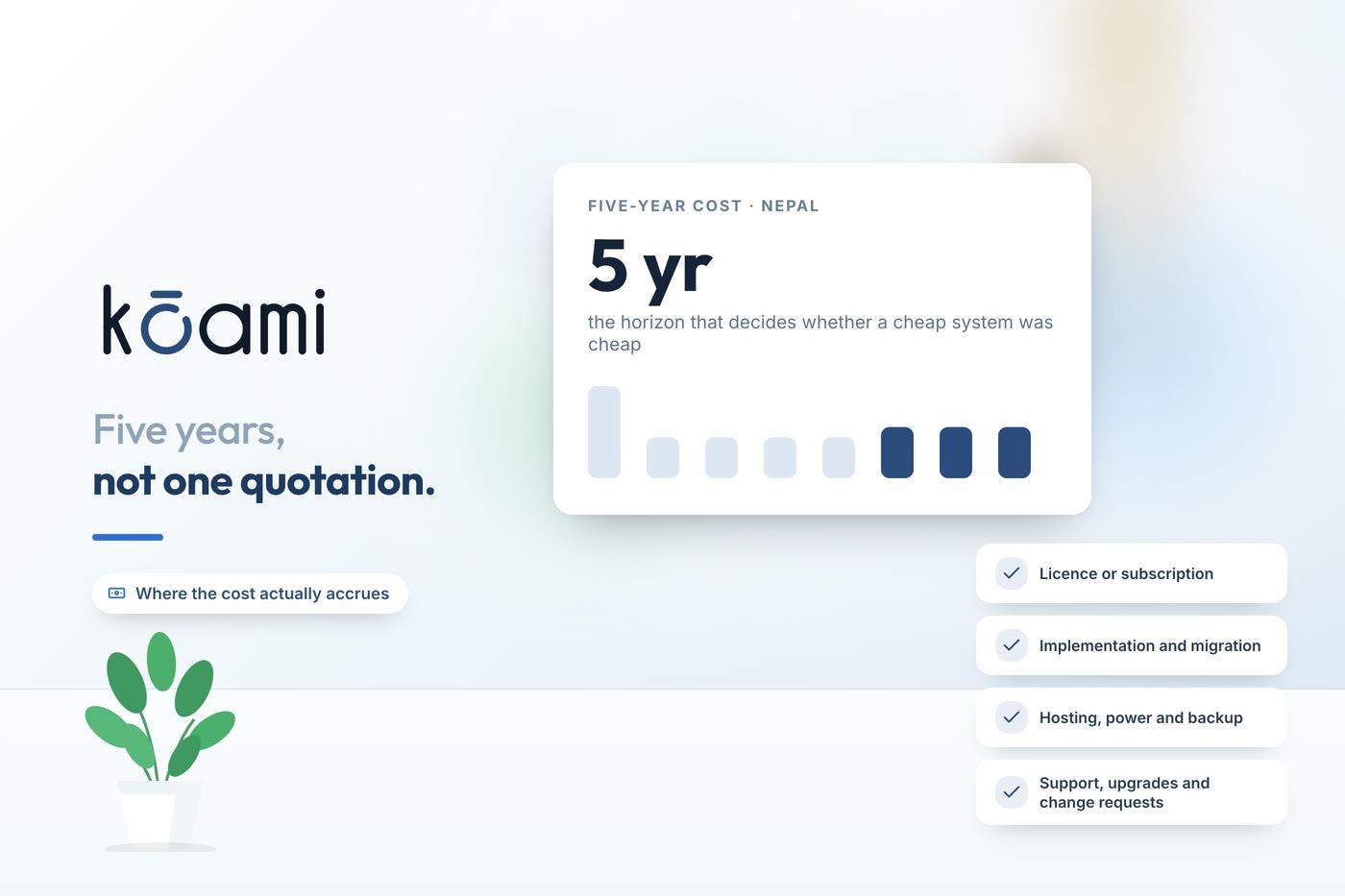
A quotation for hospital management software in Nepal is rarely the cost of the system. It is the visible first line of a five-year operating commitment that also includes implementation, migration, interfaces, training, infrastructure, support and change requests.
Comparing only licence prices rewards the proposal that moved the most work out of the licence line. A fair comparison converts every bid into the same five-year model and attaches deliverables to every amount.
What determines HMS cost in Nepal?
Scope determines cost more than bed count alone.
A 40-bed surgical hospital with an operating theatre, implants, package billing and insurance can require more configuration than a larger hospital with simpler flows. The main cost drivers are sites, simultaneous users, modules, data volume, interfaces, payer complexity, local reporting, custom documents and the support window.
Ask vendors to state what their metric means. “Per bed” may mean sanctioned, operational or occupied beds. “Per user” may mean named or concurrent users. “Unlimited” may exclude mobile apps, storage, reports or future branches. Put the definition in the commercial schedule.
Which costs are usually missing from the quote?
The missing work is usually the work that decides whether the project succeeds.
- Data profiling, cleanup, mapping and repeated trial migrations
- Lab analyser, PACS, payment, SMS and other interfaces
- Nepal-specific invoices, fiscal calendars, reports and payer workflows
- Devices, printers, barcode scanners, labels, networking and backup links
- Staff time for process decisions, master-data approval and training
- Go-live floor support, after-hours coverage and later refresher training
- Report changes and integrations requested after users see the live system
- Data export, archive access and transition support at contract exit
A proposal that says “migration included” should name the source systems, historical period, objects, trial cycles and reconciliation reports. Otherwise it is a promise without a boundary.
How should hospitals compare cloud and on-premise cost?
Use total cost, not subscription against server purchase.
For cloud, include subscription escalation, storage growth, interfaces, backup connectivity and premium support. For on-premise, include servers, database licences, power, cooling, monitoring, backup media, off-site recovery, hardware refresh and the staff who maintain all of it. Add the cost of planned downtime and the cost of an unplanned outage to both models.
Cloud usually makes costs more predictable and removes the refresh cliff. On-premise may use recent hardware the hospital already owns. The correct answer can change by facility, which is why the assumptions belong next to the total.
What payment milestones protect the hospital?
Tie payment to evidence the hospital can accept.
A practical sequence is a mobilisation payment, configuration sign-off, first trial migration, interface testing, user-acceptance completion, go-live and a stability holdback released after agreed measures are met. Define those measures: reconciliation balances, critical scenarios passed, response times, open severity-one defects and user coverage.
Avoid paying most of the project before the first real data appears. Configuration screens are easy to demonstrate; a reconciled pharmacy stock ledger, patient balance and opening receivable are the work.
How is return on investment measured?
Measure the few operational changes the system can actually influence.
Establish baselines before implementation: registration time, discharge-to-final-bill time, rejected insurance claims, pharmacy expiry loss, stock-outs, duplicate registrations, manual report hours and days to close the month. Give each measure an owner and compare it at 30, 90 and 180 days after go-live.
Software does not create the return by being installed. It creates the conditions for a new process, and management creates the return by enforcing that process. A phased implementation plan should therefore sit beside the financial model.
For Kōami, pricing is quotation-based because scope, localisation and integration drive the work. A useful demo should end with assumptions written down clearly enough that another vendor can price the same scope. That makes the comparison better even if Kōami is not selected.
Follow Kōami on LinkedIn
Get the next guide on hospital operations, software and compliance in your feed, as soon as it is published.