Clinic and Polyclinic Management Software in India: What a Small Practice Actually Needs
Published
A ten-doctor polyclinic and a two-hundred-bed hospital are often sold the same software, and the mismatch runs in both directions. Some clinics buy a full hospital system and use eight percent of it, paying for the rest and navigating around it. Others buy an appointment app, discover at the first tax filing or insurance query that it holds nothing they need, and start again.
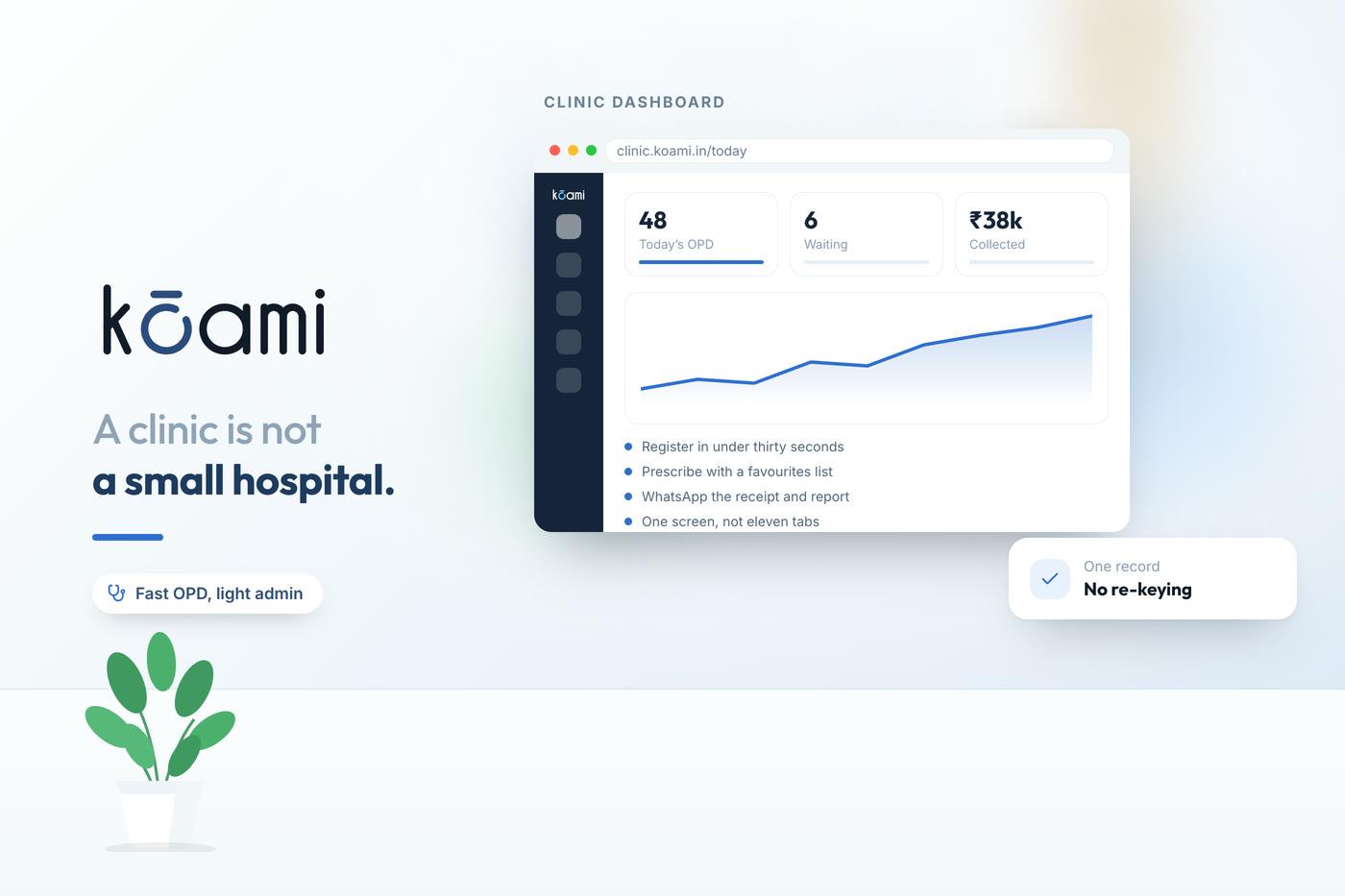
Clinics are not small hospitals. The differences are structural, and knowing them makes the purchase straightforward.
How is clinic software different from a hospital system?
A clinic's work is a sequence of visits. A hospital's work is a stay. Almost everything follows from that.
A hospital system is organised around admission, bed, length of stay and a bill assembled over days. It needs ward management, nursing charting, theatre scheduling, inpatient pharmacy and an interim billing model. A clinic needs none of these, and carrying them costs money and clutters every screen.
What a clinic needs instead, and needs to be genuinely good, is the outpatient flow: getting patients booked, seen on time, recorded quickly, billed correctly and brought back. The hospital equivalent of that flow is one module among thirty. In a clinic it is the entire business.
What should clinic management software actually include?
Eight things, and only eight for most practices.
- Appointments and scheduling. Multi-doctor calendars, online booking, reminders by SMS or WhatsApp, walk-in handling, and a queue display that keeps the waiting area calm.
- Patient records. One identity per patient, demographics, history, allergies, and previous visits accessible in seconds rather than searched for.
- Consultation and prescription. Fast note capture with speciality templates, a drug database with interaction and allergy checks, and a printed or digital prescription that meets the requirements for a valid prescription.
- Billing and receipts. Consultation and procedure charges, packages, discounts with a control on who can give them, GST where applicable, and daily collection reconciliation.
- Pharmacy, if you dispense. Stock with batch and expiry, dispensing against the prescription, and the charge on the same bill.
- Diagnostics, if you have a lab or imaging on site. Orders, results attached to the visit, and results shared with the patient.
- Reports that a practice owner reads. Daily collection, doctor-wise revenue, new against repeat patients, no-show rate, and outstanding.
- Compliance basics. Consent records, an audit trail of who saw what, ABHA creation and linkage, and teleconsultation records if you consult remotely.
If a clinic system cannot register a walk-in, get them to the right doctor, record the consultation and print the bill in under three minutes total, nothing else about it matters.
What do clinics buy that they do not need?
Four things, consistently.
Inpatient modules. Wards, beds, nursing charting and theatre, licensed because they came in the bundle. Maintenance is paid on all of them.
Deep insurance and TPA workflows, in a practice that is ninety-five percent cash. Useful if you take insurance; expensive complexity if you do not.
Elaborate role hierarchies designed for a hospital's departmental structure, imposed on a team of twelve people who all know each other.
Full financial accounting inside the clinic system. A clean export to whichever accounting package your chartered accountant already uses is almost always the better arrangement.
What do clinics under-buy?
Three things, and each one costs more than the modules they overbought.
Patient recall and follow-up. A clinic's economics depend on repeat visits, and most systems treat recall as an afterthought. The ability to define a follow-up interval at the consultation and have it turn into a reminder automatically is worth more than any clinical feature on the list.
Online presence and booking. Patients increasingly find a clinic through search and expect to book without ringing. A booking link that is a form which emails somebody is not online booking.
A real data export. Small practices change software more often than hospitals do, and the ones that get stuck are the ones whose records live in a system with no export. Ask on day one, not in year four.
What about polyclinics, day-care centres and chains?
They sit between the two, and the questions that matter are multi-site identity, multi-doctor economics and revenue sharing.
A polyclinic with visiting consultants has a payout problem before it has a clinical software problem. Each consultant may work on a different arrangement: revenue share on consultations, a different share on procedures, a fixed session fee, or a combination. If the system cannot calculate this from recorded activity, someone does it monthly in a spreadsheet, and consultants query it.
A small chain adds the requirement that a patient registered at one branch is recognised at another, that stock can move between sites, and that the owner sees consolidated numbers without three exports. These are not hospital features; they are the specific things that break when a single-site clinic system is used across four locations.
Day-care and short-stay centres need a limited version of admission: a patient occupying a chair or bed for hours, with charges accruing, discharged the same day. Confirm the system models this, because clinic software often does not and hospital software often makes it heavy.
What does clinic software cost in India?
Considerably less than hospital software, and the market spans from a few thousand rupees a month to a few tens of thousands for a multi-site practice.
Pricing is usually per doctor or per user per month, sometimes with a cap. The variables are the number of doctors, the number of locations, whether pharmacy and diagnostics are included, and whether patient communication by SMS or WhatsApp is bundled or metered. Messaging costs are the item most often left out of the comparison and the one most likely to grow.
At this end of the market, the questions that protect you are simple: what is the price at twice our current size, what does data export cost, and is there a contractual minimum term.
What should a clinic ask in a demo?
Time the routine things rather than admiring the unusual ones.
- Register a walk-in patient and get them into the right doctor's queue.
- Record a consultation using our speciality's template and print the prescription.
- Bill it, apply a discount, and print the receipt.
- Show me the same patient's previous three visits.
- Set a follow-up for six weeks and show me the reminder it will send.
- Show me today's collection, split by doctor and payment mode.
- Dispense a medicine from our stock against this prescription.
- Book an appointment as a patient would, from a phone.
- Export all our patient data.
If any of the first three takes longer than a minute in the vendor's own hands, it will take longer in yours.
Where Kōami fits, honestly
Kōami is built for hospitals and multi-site healthcare groups, and it is used by clinics that expect to become one of those.
That is a real distinction and worth stating plainly. A single-site practice with four doctors, no pharmacy and no plans to expand will be well served by a focused clinic product and will pay less for it. Where Kōami earns its place is the practice that is adding locations, running a pharmacy and diagnostics on site, managing consultant payouts against recorded activity, or moving toward day-care and short-stay work, because those are the points at which clinic software runs out and stitching a second system alongside it begins.
Buy for the size you are, with one honest look at the size you intend to be in three years. Those two answers, more than any feature comparison, decide which end of this market you should be shopping in.
Follow Kōami on LinkedIn
Get the next guide on hospital operations, software and compliance in your feed, as soon as it is published.