Closing the Loop on Critical Results
Published
A radiologist spots a large pulmonary embolism at 2 in the afternoon. The report is dictated, signed, and sitting in the system within twenty minutes. Good. Now the only question that matters: did the person who can act on it actually find out, and can you prove when? Critical results are not a reporting problem. They are a communication problem wearing a reporting costume, and the gap between "the report exists" and "the right clinician acknowledged it" is where patients get hurt.
The report is not the message
Signing a report puts a finding into the record. It does not put it in front of a human. The referring clinician might be in theatre, off shift, or simply not looking at that patient's chart in the next hour. For a routine finding, that latency is fine. For a critical one - a tension pneumothorax, an acute bleed, a misplaced line, a new mass with impending airway compromise - an hour of silence is a clinical event in its own right.
This is why critical results need a channel of their own, separate from the ordinary flow of signed reports. The finding has to be pushed, not waited for, and the push has to land on a specific responsible person, not a shared inbox that everyone assumes someone else is watching.
- A named recipient, not a role or a distribution list nobody owns
- A defined severity, so a critical finding is visibly different from an urgent-but-not-emergent one
- A time expectation attached to that severity - minutes for the emergent, hours for the urgent
- A fallback path for when the first recipient does not respond
Acknowledgment is the whole point
A critical result that has been sent but not acknowledged is not closed. It is in flight. The loop closes only when the responsible clinician confirms they have seen it and understood what it means. That confirmation - the critical results acknowledgment - is the single most important artifact in the whole workflow, because it is the moment responsibility for the finding transfers from radiology to the treating team.
A finding you communicated but cannot prove you communicated is, in an incident review, a finding you did not communicate.
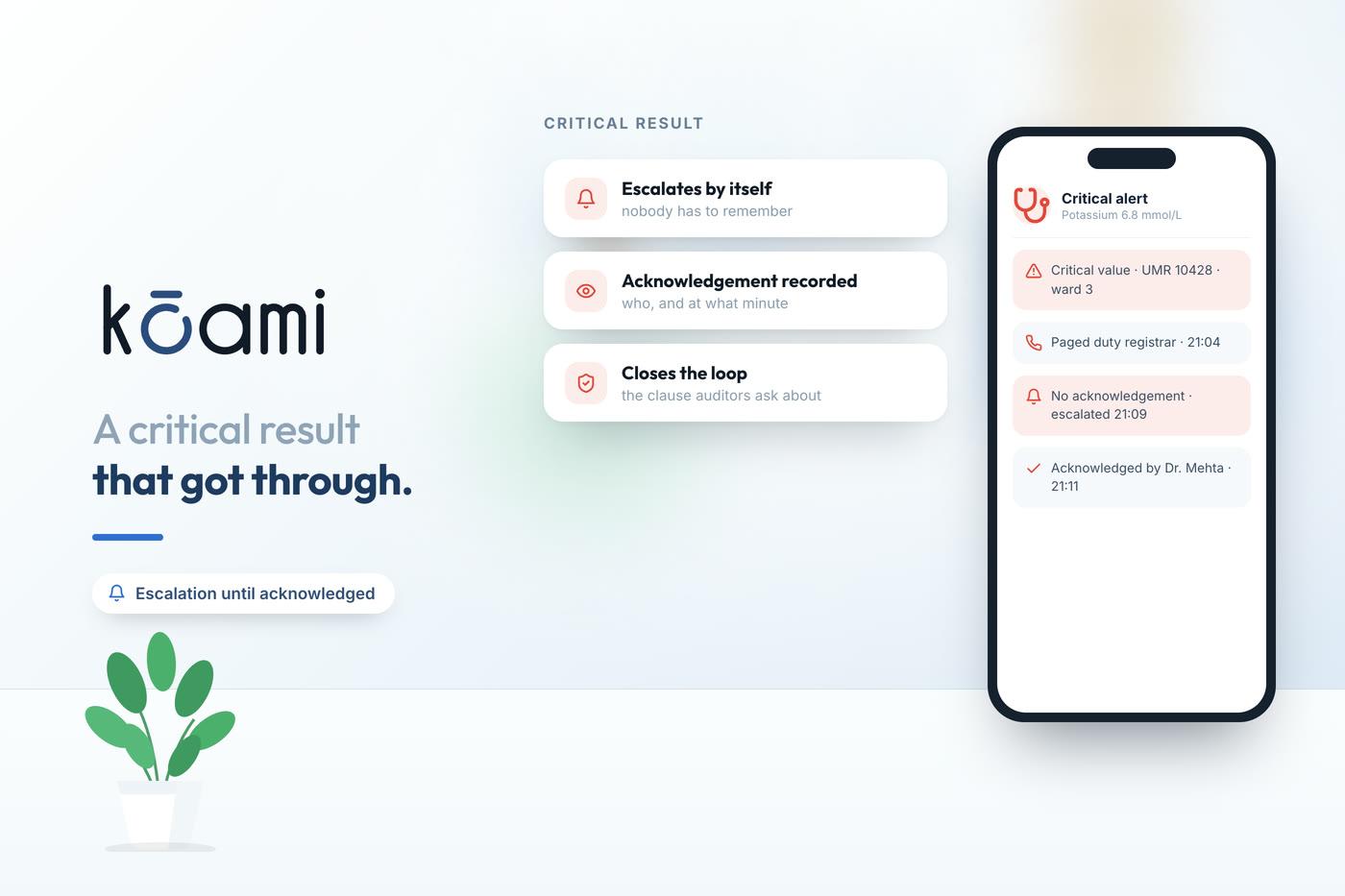
Acknowledgment has to be an explicit, recorded action. Not "the report was available." Not "the phone rang." A person, a timestamp, and a confirmation that this specific finding was received. Kōami records the acknowledgment as a discrete event tied to the study, the finding, and the clinician who cleared it, so the loop has a defined and auditable close.
Escalation is what makes it safe
People miss messages. That is not a failure to design around by hoping harder; it is a certainty to build for. The strength of a critical results workflow is entirely in what happens when the first attempt does not land.
An unacknowledged critical result must escalate on a clock. If the primary clinician has not acknowledged within the window their severity demands, the alert moves - to a covering colleague, to the on-call, to a supervisor, up a defined ladder until someone takes it. Silence can never be the resting state. The system should treat an unacknowledged emergent finding as an active problem that keeps demanding attention until a human resolves it.
- Start a timer the moment the result is raised, scaled to its severity
- Escalate automatically when the timer expires without acknowledgment
- Follow a documented chain so the next recipient is never ambiguous
- Keep escalating rather than giving up, because an unread emergent finding is not a state you can safely leave alone
The reassuring version of this is boring by design: most critical results get acknowledged quickly and never escalate at all. The escalation ladder exists for the few that would otherwise fall through, which are precisely the ones that end up in a coroner's report.
The trail you will be glad you kept
Every critical result carries a second life as evidence. When something goes wrong and the case is reviewed, the questions are always the same. When was the finding made? When was it communicated? To whom? When did they acknowledge it? What happened in between? A workflow that captures each of those as it happens turns a frightening reconstruction into a simple read of the record.
Kōami keeps the full timeline as a byproduct of doing the work: finding raised, notification sent, escalations fired, acknowledgment recorded, each with its actor and its timestamp. Nobody has to assemble it after the fact, because it was never scattered in the first place. The same data that keeps a live result from being forgotten is the data that answers the review board six months later.
It is worth being honest about what should count as a critical result in the first place, because a workflow that fires on too much is a workflow people learn to ignore. If every mildly abnormal finding triggers the same urgent channel, the genuinely emergent ones drown in the noise, and acknowledgment becomes a reflex click rather than a considered one. The severity tiers exist precisely so that the emergent finding looks and behaves differently from the merely notable one. A department that defines its critical findings carefully, and reserves the escalating channel for them, keeps that channel meaningful. Alert fatigue is not a side issue here; it is the failure mode that quietly undoes the whole system.
Closing the loop on critical results is unglamorous work. It is timers, recipients, and confirmation clicks, not clever imaging. But it is the part of radiology where the discipline of the process is directly the safety of the patient. Make the message its own channel, make acknowledgment explicit, make silence escalate, and keep the trail without anyone having to think about it. Do that, and the finding you caught in twenty minutes actually reaches the person who can act on it - which was the entire point of catching it.
Follow Kōami on LinkedIn
Get the next guide on hospital operations, software and compliance in your feed, as soon as it is published.