Why the Browser Is Enough for Reading Studies
Published
For most of the history of medical imaging, reading a study meant sitting at a specific machine. The radiology workstation was a heavy box under a desk, loaded with proprietary software, tied to a licence, and physically located in the reading room. If you wanted to read a study, you went to the workstation. The idea that a radiologist might open a full diagnostic study in an ordinary web browser, on whatever screen happened to be in front of them, would once have sounded like a compromise. It is not a compromise anymore. It is, for a great deal of clinical work, simply the better way, and it is worth being precise about why.
What the Browser Can Now Actually Do
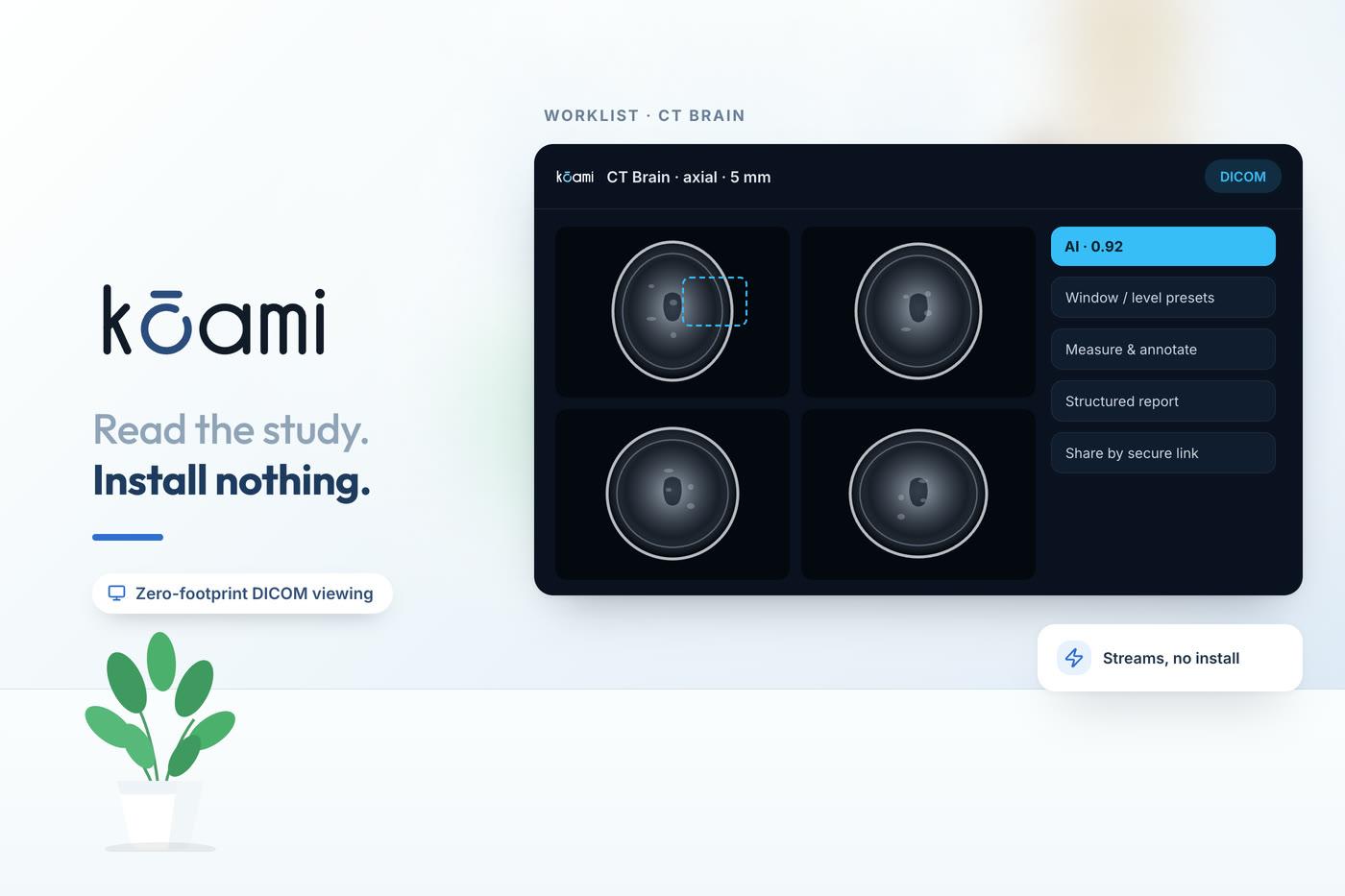
The old objection was capability. A browser, the reasoning went, cannot handle the pixel density, the window-level manipulation, the measurement tools, the multi-planar reconstruction that real reading demands. That objection has quietly expired. Modern browsers expose the graphics and compute primitives that image rendering needs, and open toolkits like Cornerstone have been built specifically to drive diagnostic-grade viewing inside them.
A browser-based viewer today handles the operations a reading actually requires:
- Window and level adjustment in real time, so a chest study can be swung from lung window to mediastinal window without a round trip to a server.
- Measurement, annotation, and comparison, including linked scrolling between a current study and a prior for the same patient.
- Multi-planar reconstruction and stack scrolling through hundreds of slices, driven by the client where the hardware allows.
Kōami's PACS viewer is built on this foundation, using the browser as a genuine imaging surface rather than a thin window onto a screen-scraped session somewhere else.
The question stopped being whether a browser can render a study to diagnostic standard. It can. The question is why you would still tether a radiologist to one particular desk.
Zero Install Changes Who Can Read, and Where
The deepest advantage of a browser-first approach is not technical elegance. It is that it removes the workstation as a chokepoint. When reading requires no installation, no licence transfer, and no specific hardware, the pool of people who can read a study and the places they can read it from both expand dramatically.
- A radiologist can open a study from home for an after-hours call without driving to the hospital, because the reading environment is a URL and a login, not a building.
- A referring clinician on the ward can pull up the images alongside the report, so the conversation about a patient happens with the actual pictures in front of both people.
- A second opinion from a specialist elsewhere becomes a link, not a burned disc couriered across a city.
This is the quiet revolution. The technology of browser-based viewing is interesting; the consequence - that expertise is no longer trapped at a physical console - is what actually changes how a hospital or a network operates. Kōami is designed around this reach, treating the viewer as something you send to a person rather than a place you send a person to.
The Server Does the Heavy Lifting
A browser-first architecture does not mean a browser doing everything. The intelligence of the design is in the division of labour: the client renders and interacts, and the server handles the data, the storage, and the streaming so that the client is never asked to swallow a whole study at once. A modern imaging back end speaks DICOMweb, and its streaming member WADO-RS in particular, so that the viewer requests exactly the pixels it needs, when it needs them, rather than downloading a gigabyte before the first image appears.
- The archive stays authoritative and central, so there is one source of truth for every study rather than copies scattered across workstations.
- Pre-fetching and progressive loading mean the first image is on screen in seconds even for a large study, because the viewer streams rather than transfers.
- Compute-heavy reconstruction can be done server-side where the client hardware is modest, so a reading on a laptop is not limited to what the laptop alone could render.
Kōami pairs its browser viewer with a DICOMweb back end precisely so that the lightness of the client does not come at the cost of performance. The browser is enough on the front end because the server is doing the right work behind it.
Being Honest About the Boundaries
A responsible case for browser-first reading has to name its limits, because overselling it helps no one. The display still matters: a diagnostic read of fine detail depends on a calibrated, high-resolution monitor, and the browser does not change the physics of the screen it runs on. Colour and grayscale calibration remain the reading site's responsibility. And where AI assists the read - flagging a region, prioritising a worklist - it is decision-support that helps a clinician look in the right place, not an autonomous device that renders a diagnosis. The radiologist reads; the software assists.
- A calibrated diagnostic display is still required for primary reading of subtle findings, regardless of the viewer's capability.
- Any AI assistance in the viewer is there to support the clinician's judgement, not to replace it, and the reporting clinician remains responsible for the read.
Kōami's viewer is built to serve that reality: powerful and portable, while leaving the diagnosis firmly with the person qualified to make it.
The browser is enough to read studies not because someone lowered the standard, but because the tools rose to meet it. The rendering is genuine, the streaming keeps it fast, and the archive keeps it safe. What you gain in return is freedom from the physical workstation, and with it a reach that the old model could never offer - the radiologist at home, the clinician at the bedside, the specialist across the country, all looking at the same images through nothing more exotic than the browser already open in front of them. That is not a compromise. It is progress that happens to be convenient.
Follow Kōami on LinkedIn
Get the next guide on hospital operations, software and compliance in your feed, as soon as it is published.