Best PACS Software in India (2026): Cloud, On-Premise and What to Ask Every Vendor
Published
A radiologist's opinion of a PACS forms in the first ten minutes and rarely changes. Either the study opens fast and the tools land where the hands expect them, or it does not, and no amount of feature depth recovers from that. Buyers, meanwhile, are comparing storage tiers and licence counts. The two conversations barely touch, which is why so many imaging deployments are technically successful and clinically resented.
The Indian PACS market now spans everything from a free viewer on a workstation to enterprise imaging suites, with home-grown vendors, global platforms and cloud-first newcomers in between. Comparing them properly means separating three things buyers routinely conflate: the archive, the viewer and the workflow.
What is the difference between PACS, RIS and a DICOM viewer?
They are three separate things, and most confusion in an imaging purchase comes from treating them as one.
- A DICOM viewer displays images. It is a client. It can be free, it can be excellent, and on its own it stores nothing and schedules nothing.
- PACS is the archive and distribution layer. It receives studies from modalities, stores them, and serves them to viewers. It is where retention, redundancy and access control live.
- RIS is the workflow: orders, scheduling, the worklist, the report, and the billing hooks. It is what turns an image into a completed clinical event.
Some products cover all three, some cover two, and many proposals are ambiguous about which they cover. Ask explicitly. A hospital that buys PACS believing it includes RIS discovers on go-live that nobody knows which studies are unreported.
Should an Indian hospital choose cloud or on-premise PACS?
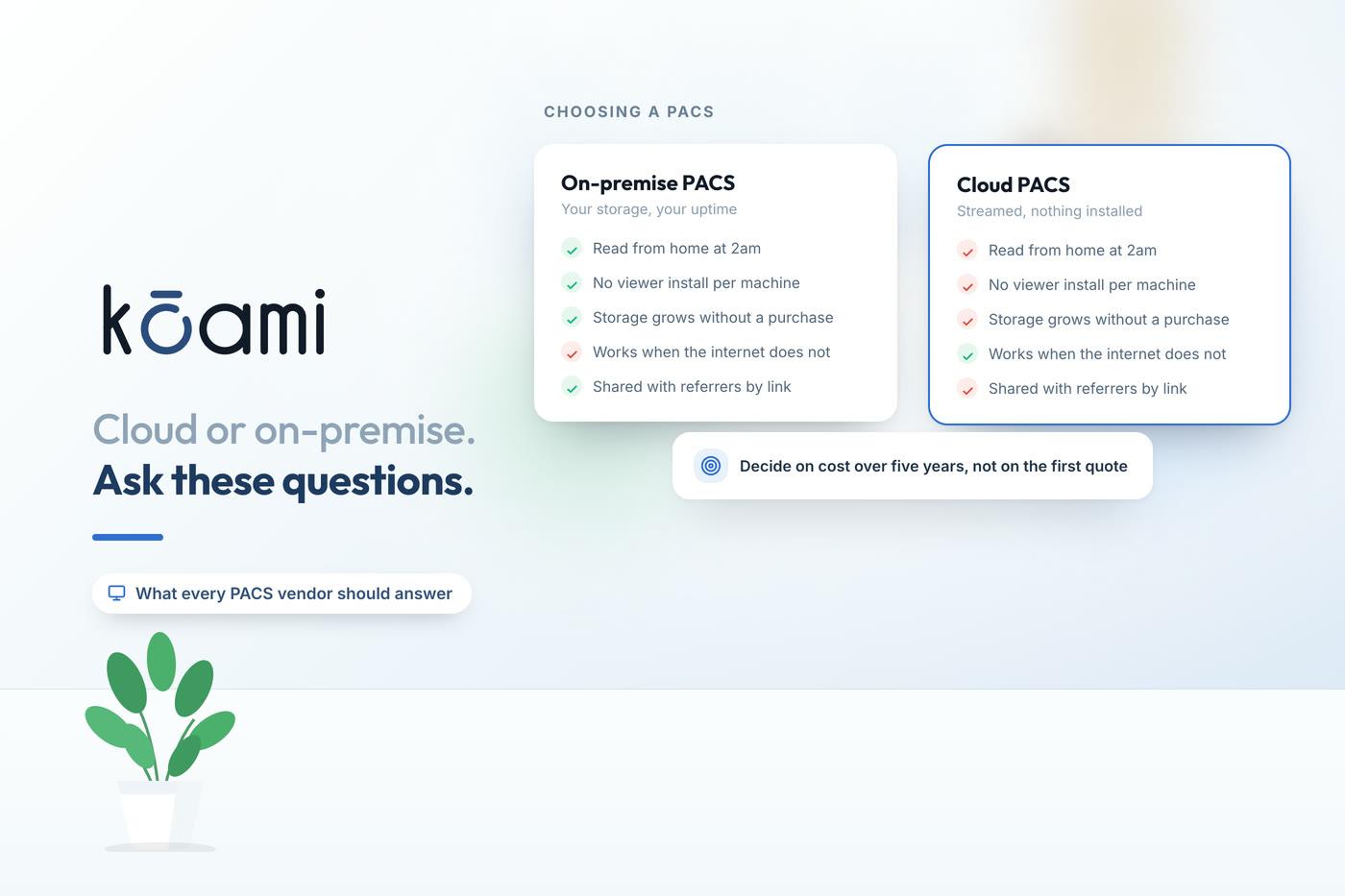
Cloud for most hospitals now, on-premise where imaging volume is very high or connectivity is genuinely unreliable.
The calculation has shifted. Imaging is the largest data set a hospital produces, and on-premise means buying storage for peak growth, running redundancy, managing backups, and refreshing hardware every few years. Cloud converts that into a recurring cost and removes a class of failure most hospitals were never staffed to handle.
What still argues for on-premise, or for hybrid, is throughput and bandwidth. A high-volume centre pushing large studies, particularly thin-slice CT and MR, needs to move a lot of data before a radiologist can read. If the site's upstream link cannot sustain that, the cloud archive will be correct and slow, which in practice means unused.
The pragmatic middle is common and worth asking about: a local cache or gateway holding recent studies for fast reading, with the cloud as the archive of record. Ask any cloud vendor how they handle a site with a weak link, because the answer tells you whether they have deployed in Indian conditions.
Radiologists do not evaluate a PACS on storage architecture. They evaluate it on how long a 900-slice CT takes to become readable, and whether the window presets are where they left them.
What separates a good viewer from a bad one?
Speed to first image, and whether the tools match how the reader actually works.
The technical mechanism that matters most is progressive, server-side rendering. A viewer that downloads an entire study before displaying anything will feel slow no matter how fast the network is. A viewer that streams slices on demand, rendering server-side and sending only what the reader is looking at, feels instant even on modest bandwidth. When comparing, ask specifically whether the viewer downloads studies or streams them.
After that, the things readers care about:
- Zero-footprint browser operation, with no installed client and no browser plug-in, so a study can be read from any machine including at home.
- Window and level presets per modality and body part, remembered per user.
- Hanging protocols that lay out prior and current studies the way that reader wants them.
- Measurement, MPR and basic 3D where the speciality needs it.
- Prior study retrieval that is automatic rather than a search.
- Mobile viewing that is honest about its limits, for reference rather than primary diagnosis.
What should the reporting side do?
It should produce structured reports and close the loop on critical findings.
Dictation into free text is still the default in much of the market, and it is the reason radiology data is nearly impossible to analyse afterwards. Structured reporting with templates by modality and indication takes discipline to adopt, but it makes reports consistent, faster to produce for routine studies, and actually queryable.
The second thing to insist on is critical results handling. When a radiologist finds something urgent, the system should record the notification, who received it, when, and the acknowledgement. NABH will ask, and more importantly a missed critical finding is the most serious failure mode radiology has.
What integration and compliance questions should be on the list?
Six, and they are the ones most likely to be answered vaguely.
- Modality integration. DICOM worklist to every modality, including the older ones. Ask specifically about your oldest machine, by model.
- HIS and RIS integration. Orders in, reports out, status visible in the hospital system, and billing triggered by study completion rather than by a person remembering.
- Standards. DICOMweb interfaces, HL7 or FHIR for orders and results. A private API instead of a standard is a lock-in signal.
- ABDM. Whether imaging reports can be linked as a care context so the record is discoverable to the patient, and whether the vendor holds current milestone certification.
- Data residency and DPDP. Where the archive physically sits, who can access it, and how access is logged. Imaging data is health data.
- Retention and exit. How long studies are kept, at what cost, and what it costs to get the whole archive back in standard DICOM if you leave. Imaging is the hardest data to migrate; the exit clause is not theoretical.
What does PACS cost in India?
The honest answer is that the licence is usually the smaller part of the number.
Vendors price by study volume, by concurrent user, by modality connection, by storage tier, or by some combination. The costs buyers forget are modality integration work charged per machine, migration of the existing archive, the local gateway hardware if one is needed, the network upgrade the deployment exposes, and archive egress at the end of the contract.
Ask for a five-year total against your actual annual study volume with a stated growth rate, including storage growth. A quote that does not model storage growth is not a quote for an imaging system.
What should you ask in a PACS demo?
Use your own studies. A vendor's demo data set is chosen because it opens quickly.
- Open a large multi-slice CT from our archive on this connection, and time it.
- Show the same study in a browser with nothing installed.
- Bring up the prior study automatically alongside it.
- Apply my window preset and show me that it persists next session.
- Report it using a structured template, then show me the report in the hospital system.
- Flag a critical finding and show the notification and acknowledgement trail.
- Show me the audit log for a study that was viewed but not reported.
- Export the last thirty days of studies as standard DICOM.
Where Kōami PACS fits
Kōami PACS is a browser-first, streaming-based imaging platform, built on the view that the viewer is the product and everything else is plumbing that should be invisible.
It does zero-footprint DICOM viewing with server-side rendering rather than whole-study download, window and level presets that follow the reader, structured reporting, critical results workflow, and secure external sharing. Because it sits on the same platform as the hospital system, an order placed in OPD reaches the modality worklist and the finished report reaches the patient record without an interface engine in between.
If you are a standalone imaging centre with no hospital system, a dedicated RIS-PACS vendor is a perfectly sensible choice and you should evaluate several. If you are a hospital tired of imaging being an island with its own patient identity, that is the problem Kōami PACS was built to remove.
Follow Kōami on LinkedIn
Get the next guide on hospital operations, software and compliance in your feed, as soon as it is published.