From Dictation to Structured Reports
Published
Every radiologist has a dictation style. Some read head to toe, some lead with the finding that matters and bury the rest, some circle back three times to the same lung nodule. Free-text dictation lets all of that happen, which is exactly the problem. The referring clinician on the other end does not want your narrative arc. They want to know whether the mass is there, how big it is, and what to do next. Structured reporting is the shift from telling a story to filling in a form that already knows what the reading physician needs.
What structured reporting actually changes
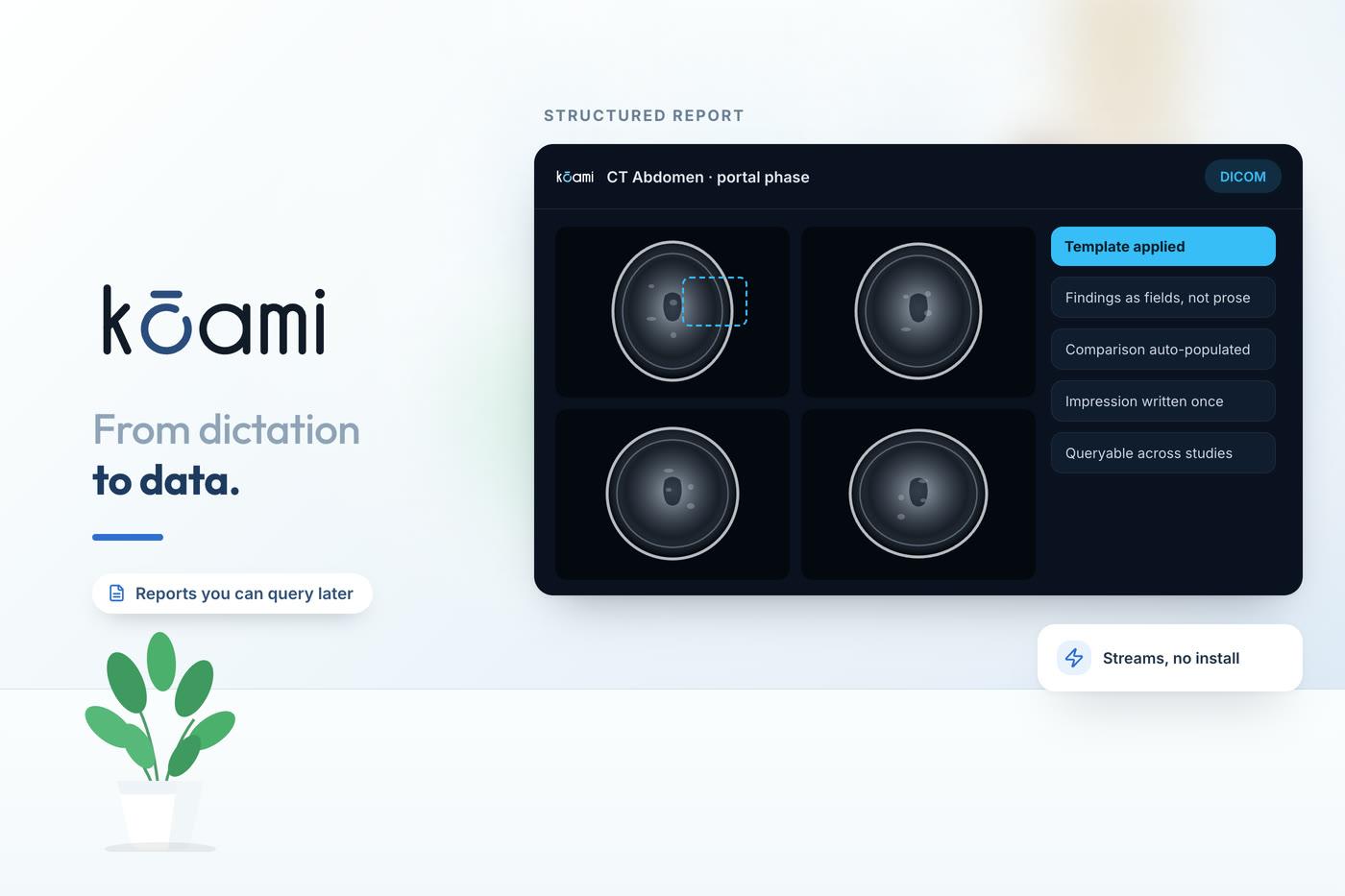
The honest version: structured reporting swaps a blank text box for a template with named fields. Instead of dictating a paragraph, you populate discrete elements - technique, comparison, findings by organ system, impression - each of which lives in its own slot. The output still reads like prose to the clinician, but underneath it is data.
That distinction matters more than it sounds. When a lesion size lives in a labelled field rather than mid-sentence, it can be tracked across studies, pulled into a tumour board list, or flagged when it crosses a threshold. When a free-text line says "stable 8 mm nodule, previously 6 mm" the software sees a sentence. When a structured field says diameter equals 8, the software sees a number it can compare.
- Fewer missing elements, because the template asks for laterality, size, and comparison every time
- Consistent language across a department, so "probably benign" means the same thing from every reader
- Findings that map cleanly to standardised systems like BI-RADS, LI-RADS, or Lung-RADS
- Report data that can flow downstream instead of being re-keyed by hand
DICOM SR and why the plumbing matters
Underneath the readable report sits a machine-readable one. DICOM SR (Structured Reporting) is the standard that lets a report carry coded content - measurements, findings, and their relationships - as structured objects rather than a flat blob of text. A CT measurement made on the workstation can travel as an SR object and land in the report already populated, with the units and the anatomical site attached.
RadReport-style templates give you the clinical scaffolding: a library of report layouts, organ by organ and study by study, that a department can adopt and adapt. Pair that library with SR as the transport, and the measurement you drew on the axial slice does not need to be dictated at all. It is captured where it was made and carried into the field where it belongs.
A number you typed twice is a number you will eventually type wrong.
Kōami treats the report as structured data from the first click, so a diameter measured on the image and the diameter printed in the impression are the same value, not two copies that drift apart.
Where speed comes from, and where it goes
Radiologists resist structured reporting for one honest reason: naively done, it is slower. Clicking through twelve fields to say "unremarkable chest" is a worse experience than dictating one sentence. If a template forces the same clicks for a normal study and a complex oncology follow-up, it has failed.
The fix is normal defaults and smart branching. A well-built template loads a fully normal report on open, so a clean study is a quick read and sign. You only touch the fields that deviate. Positive findings expand the relevant section; negative ones stay collapsed and pre-populated. The reader spends keystrokes where the pathology is, not where it is not.
- Start every study from a normal baseline, not a blank page
- Expand detail only for the organ systems with findings
- Let voice still drive the workflow for readers who prefer to talk, mapping speech into the structured fields
- Keep an escape hatch: a free-text zone for the genuinely unusual case that no template anticipated
Done this way, the routine study gets faster and the complex study gets more complete. That is the trade you want.
The impression is still yours
Structure is for the findings. It should never flatten the impression. The impression is where a radiologist earns their keep - synthesis, judgement, the recommendation that ties three findings into one actionable sentence. A good structured system leaves that section as expressive as you need it while still letting you tag the critical result, the follow-up interval, or the recommended next study as discrete, trackable items.
The goal is not to turn radiologists into data-entry clerks. It is to stop asking them to be the transport layer for information that software could carry perfectly well on its own. When the measurement, the laterality, and the follow-up date are all structured, the report becomes something the rest of the hospital can act on without a human re-reading and re-typing it.
There is a quieter benefit that shows up over months rather than minutes. A department reporting into consistent structured fields accumulates data it can actually look at: how many studies carried a given finding, how often a recommendation was for a specific follow-up, where reporting language drifts between readers. None of that is available when every report is a unique paragraph. Structure is what turns a pile of reports into something a department can learn from without a research project.
Structured reporting is not about constraining how you think. It is about capturing what you concluded in a form that survives the trip to the next clinician intact. Get the templates right, keep the impression free, and let the plumbing carry the numbers. The reading gets no harder, and everything downstream gets a great deal easier.
Follow Kōami on LinkedIn
Get the next guide on hospital operations, software and compliance in your feed, as soon as it is published.