Radiology Report Turnaround: From Scan to Signed Report
Published
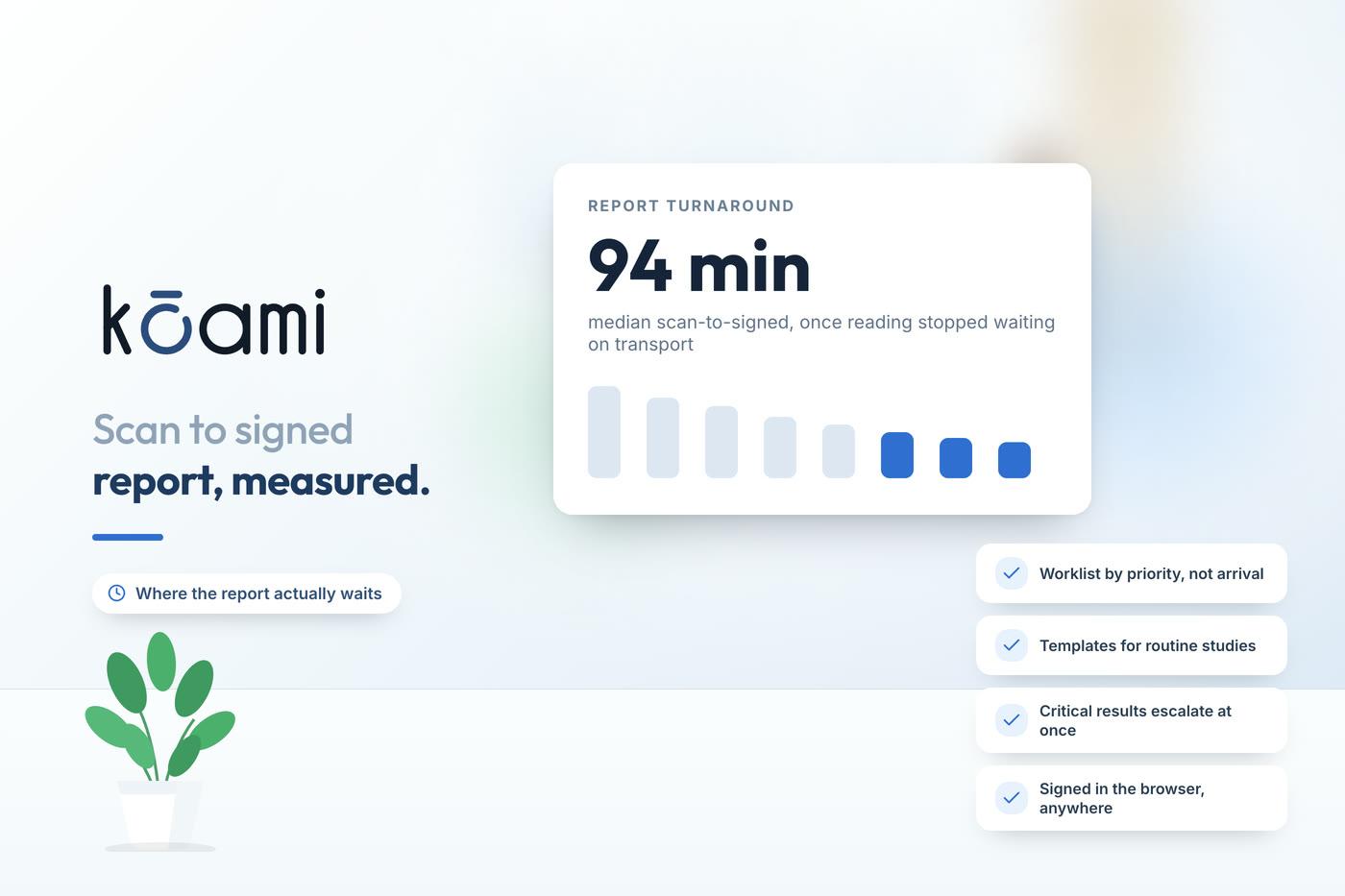
Ask a hospital why its radiology reports are slow and you will usually be told there are not enough radiologists. Sometimes that is true. More often, the radiologist is reading steadily all day while the report sits unsigned for reasons that have nothing to do with reading speed: the study did not appear on the worklist, the prior study could not be found, the report was dictated and is waiting to be typed, or it was signed hours ago and nobody told the ward.
Turnaround is an end-to-end interval. Reading is one segment of it, and rarely the longest.
What should radiology turnaround time actually measure?
The interval from the study being acquired to the report being available to the person who ordered it, not from when the radiologist opened it.
This definition matters because the shorter definitions are the ones that let a department report good numbers while clinicians experience bad ones. If the clock starts when the study reaches the worklist, every delay in getting it there is invisible. If it stops at signature rather than at availability, the last hop is invisible too.
Measure it in segments, because the segments have different owners:
- Order placed to scan performed
- Scan performed to study available on the worklist
- Study available to radiologist opening it
- Opened to report drafted
- Drafted to signed
- Signed to visible in the patient record and to the ordering clinician
Where do the hours usually go?
Between the scan completing and the report reaching the person who has to act on it — the two ends, not the middle.
At the front end, studies that do not reach the worklist promptly, or reach it unmatched because the accession number or patient identity was entered differently at the modality than at the order. An unmatched study waits for a person to notice it.
At the back end, the reporting chain. Dictation transcribed by a typist, returned for correction, corrected, returned, signed. Each hop is a queue. And then the last hop, which in many hospitals is a printout carried to a ward, or a report visible only in the radiology system that the treating team does not open.
In the middle, the delays are usually about context rather than speed: a prior study that has to be requested, a clinical history that is not attached, a protocol question that requires a phone call.
A report signed at eleven that reaches the ward at four has a turnaround time of five hours, whatever the radiology system says.
Why does the missing prior study cost so much?
Because comparison is often the whole diagnostic question, and a radiologist who cannot find the prior either waits or reports without it.
For oncology follow-up, chest imaging and anything being monitored over time, the prior is not a nice-to-have. If retrieving it means a request to another department, a CD, or a phone call to another hospital, the study stops. If the prior appears automatically alongside the current study, that delay disappears entirely.
This is one of the strongest arguments for a single archive across sites in a multi-branch group. A patient scanned at the satellite unit in March and at the main hospital in September should present as one imaging history, not two.
How much does structured reporting actually help?
It shortens routine reports substantially and makes them consistent, at the cost of discipline in setting up templates.
The gain is largest where volume is highest and variation is lowest: screening studies, routine radiographs, standard follow-ups. A templated report for a normal chest radiograph is a matter of confirming a structure rather than composing prose. The radiologist's time is then concentrated on the studies that need thought.
The secondary gain is that structured reports are queryable, which is what makes departmental analytics and any downstream automation possible at all. A decade of free-text reports is a decade of data you cannot count. The trade-offs are set out in from dictation to structured reports.
What about the last hop, which nobody measures?
Automate it, and measure separately whether a critical finding was acknowledged rather than merely sent.
A signed report should appear in the patient's record immediately and be visible to the ordering clinician without anyone carrying anything. For routine findings that is sufficient. For critical findings it is not: the requirement is a closed loop, where the notification is recorded, the recipient is identified, and the acknowledgement is captured. NABH will ask for this, and it is the failure mode with the most serious consequences. Closing the loop on critical results covers it.
Turnaround also has a length-of-stay consequence. A report that lands after the morning ward round costs an inpatient a day, not an hour, which is why radiology turnaround belongs in the operations conversation and not only the radiology one. See admission to discharge.
How Kōami shortens scan-to-report time
Kōami PACS is browser-first and streams rather than downloads, which removes the delay that most often makes a radiologist wait before reading.
- Studies land in the archive and appear on the worklist automatically, de-duplicated by SOP UID, so unmatched studies do not sit waiting for someone to notice them.
- The worklist is triaged rather than chronological, with red, amber and green badges, modality and status filters and an "assigned to me" view, so the urgent study is read first by design.
- The zero-footprint DICOM viewer opens in the browser with no install, streaming slices over WADO-RS rather than downloading the study, with window and level presets, measurement, multi-viewport, MPR and cine. A radiologist can read from any machine, including at home on call.
- Priors are part of the same archive, so comparison does not begin with a search.
- Structured reporting with RadReport templates, AI-assisted drafting and dictation runs inside the study, with a clean draft, final and addendum sign-off producing both DICOM SR and a branded PDF.
- AI findings are presented as ranked cards with heatmap overlays and the ability to navigate to a finding, positioned as assistance to the radiologist rather than a replacement, in line with AI findings as a second reader.
- Because imaging sits inside Kōami Hospital, the order reaches the modality worklist and the signed report reaches the patient record and the ordering clinician without an interface engine in between, and a critical-results queue tracks acknowledgement rather than assuming it.
- Imaging analytics report study volume, turnaround, modality mix and radiologist productivity, so the segments above are numbers rather than impressions.
If your department reports good turnaround numbers and your clinicians disagree, the definition is almost certainly the problem. Measure the six segments above for a fortnight and bring them to a demo.
Follow Kōami on LinkedIn
Get the next guide on hospital operations, software and compliance in your feed, as soon as it is published.