AI Findings as a Second Reader, Not a Replacement
Published
There is a version of clinical AI that promises to read the scan for you. It is the version that makes radiologists nervous, and they are right to be. A more honest and more useful framing has been sitting in radiology practice for decades: the second reader. A second pair of eyes on the same study, catching the thing the first reader's attention slid past at the end of a long list. AI is very good at being that second reader, and it is a poor and dangerous substitute for the first.
What a second reader actually does
Double reading is not a new idea. Screening programmes have long used two independent readers precisely because a single human, however skilled, misses things. Fatigue, satisfaction of search, the subtle nodule at the edge of the lung field on the two hundredth chest study of the day. A second reader does not have to be smarter than the first. It only has to be tired at a different time and biased in a different direction.
That is the role AI fits naturally. It never gets bored on the night shift. It looks at every part of every image with the same consistency. It has no memory of the last case colouring its read of this one. Those are exactly the failure modes that catch human readers, which is why pairing the two covers more ground than either alone.
- The human brings context, clinical history, and judgement about what matters for this patient
- The model brings consistency, tirelessness, and pixel-level attention across the whole image
- Together they catch both the subtle finding and the finding that only makes sense in context
Second reader, not replacement, and the difference is not semantic
The distinction sounds like marketing caution, but it reflects how the workflow is actually built. In a replacement model, the AI reads and the human rubber-stamps, and the human's attention quietly decays because they assume the machine has already done the work. That is the worst of both worlds: automation bias on top of a model that will, sometimes, be confidently wrong.
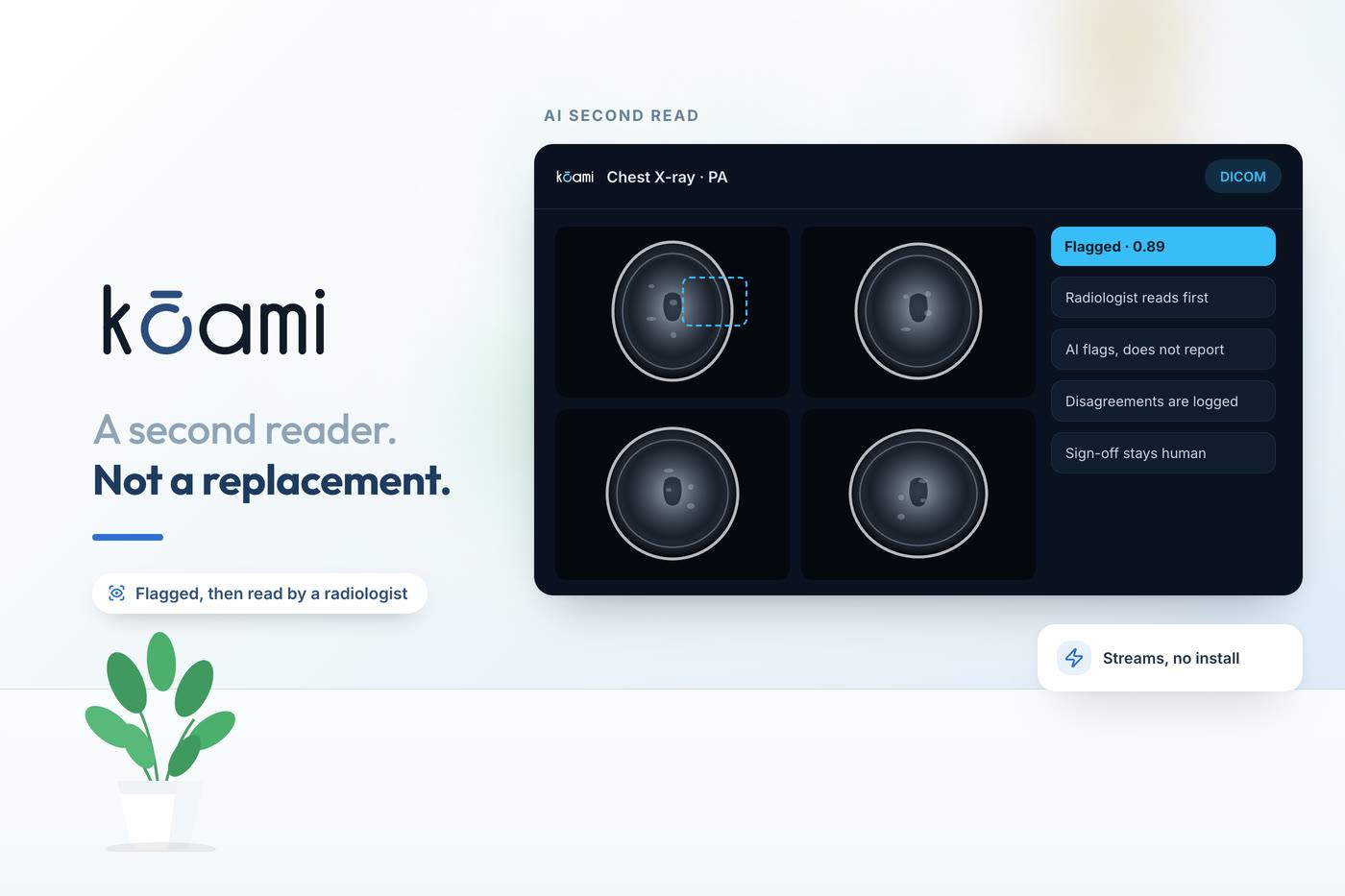
In a second-reader model, the human reads first and forms their own impression before seeing the AI's findings. The order matters. The clinician commits to a read, then the model's marks appear as prompts to reconsider, not as answers to accept. A flagged region asks a question: did you look here, and are you sure? The radiologist can dismiss it, and dismissing it is a normal part of the workflow, not an override that fights the system.
The AI is allowed to be wrong, because a named clinician still owns the report.
Where the extra pair of eyes pays off
The findings AI second reading helps with most are the ones humans miss for predictable reasons.
- Small pulmonary nodules that hide against vessels or at the lung apices
- Subtle fractures on trauma films read quickly under pressure
- Findings incidental to the clinical question, which attention naturally skips over
- The second abnormality, once the eye has locked onto the obvious first one
- Interval change on follow-up imaging, where side-by-side comparison is tedious and easy to shortcut
Notice what is not on that list. The model is not there to make the primary diagnosis on a complex case, weigh competing possibilities, or decide what a finding means for this particular patient. It is there to make sure nothing was skipped. The radiologist still reads through DICOM on PACS the way they always have; the second-reader marks simply overlay on the same study, sourced through WADO, so there is no separate tool to open and no images to shuffle between systems.
Designing so it helps instead of nagging
A second reader that flags everything trains people to ignore it. The failure mode is alert fatigue, and it kills these tools. So the design has to respect the radiologist's time and attention as the scarce resource it is. Flags should be specific, few, and confident enough to be worth a second look. The interface should let a reader accept or dismiss a mark in one motion, and it should never block sign-off waiting for the human to acknowledge every suggestion.
Just as important, every interaction leaves a trail. When a radiologist dismisses a flag, that decision is recorded, not to police the clinician but to let the department study the model's behaviour over time. Which flags get dismissed constantly? Those thresholds need tuning. Which dismissed flags later turned out to matter? That is the review that makes the system safer. In Kōami's imaging workflow the marks, the confidence, and the reader's response all sit in the audit log, so accountability and quality review draw on the same record.
Keeping the line of accountability clean
The single most important property of a second-reader system is that it never blurs who is responsible. The report carries a radiologist's name. The AI's marks are inputs to that person's judgement, exactly like a prior study or a clinical note, and they carry no authority of their own. If the model misses something, the human is still reading. If the model flags something wrong, the human dismisses it. At no point does the machine get to be the reason a mistake reached the patient unchallenged.
That clarity is what makes the second-reader model both safe and adoptable. Radiologists do not have to trust the AI to be right, because they are not relying on it to be right. They only have to accept that a tireless, consistent extra look, offered after they have formed their own view, catches things worth catching. Framed that way, AI stops being a threat to the profession and becomes what a good colleague has always been: someone who says, before you sign off, did you see this?
Follow Kōami on LinkedIn
Get the next guide on hospital operations, software and compliance in your feed, as soon as it is published.