The Consultant Who Would Not Type
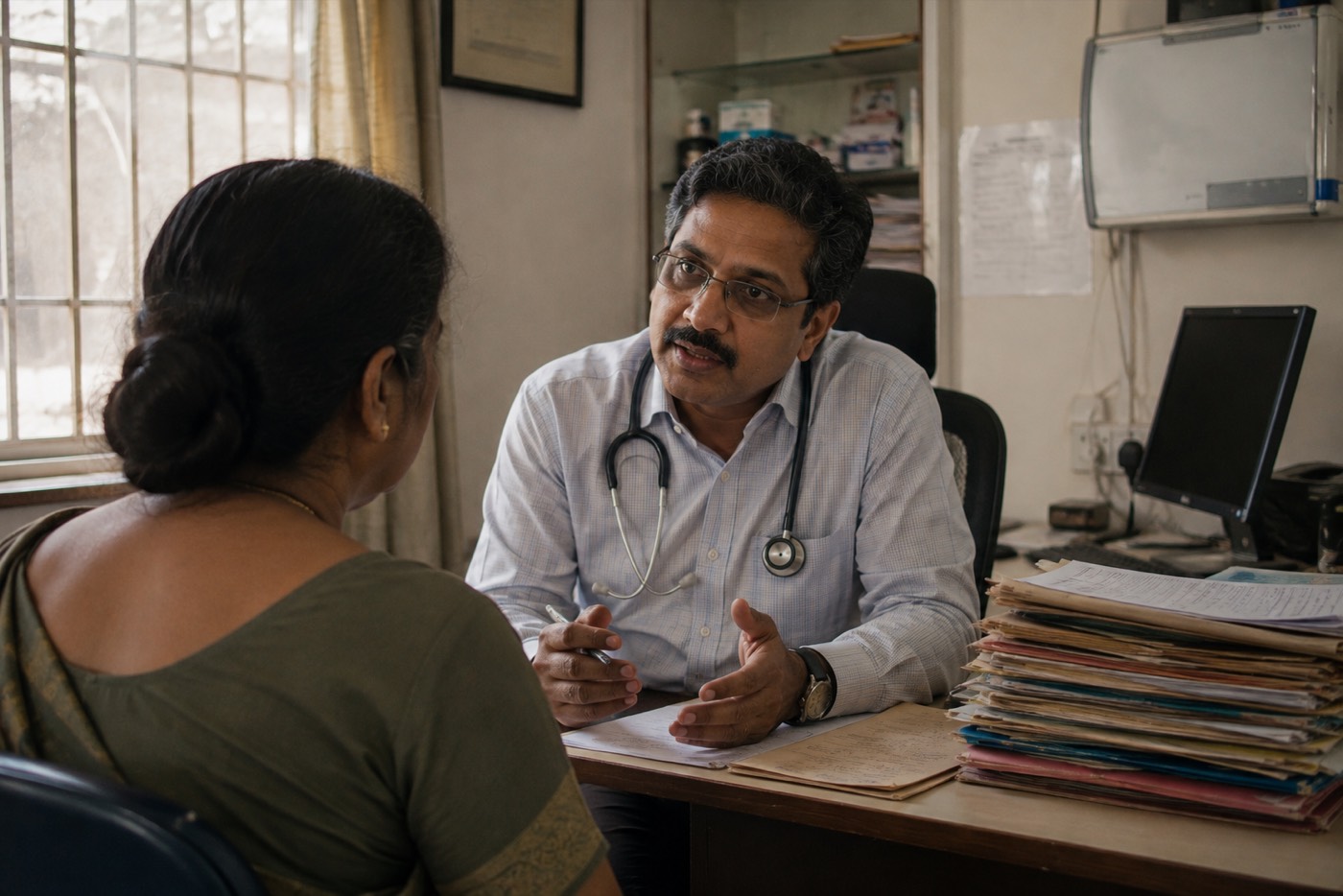
The consultant finishes his ward round at nine, walks into OPD, and by one o'clock has seen sixty patients. He writes on a prescription pad, in handwriting his junior has learned to read. Behind him a data entry operator is typing last Thursday's notes into the EMR, four days behind and falling further behind. The IT report that month puts physician adoption at forty per cent, and in that meeting a man who has practised for twenty-two years is called resistant to change.
He is not resistant to change. He is doing arithmetic.
The arithmetic of a four-hour OPD
A consultant seeing sixty patients in a four-hour clinic has roughly four minutes each, and those four minutes include the greeting, the history, the examination, the explanation to an anxious relative, and the decision. Ninety seconds of form-filling per patient is not ninety seconds. Across sixty patients it is an hour and a half, an entire second clinic that does not exist in the day. That time comes out of the examination, or the explanation, or the queue in the corridor.
This is why the adoption argument rarely moves. Management talks about NABH documentation and claim rejections. The consultant is thinking about the fifty-eighth patient, who travelled three hours and will be told to come back next week. Both are reasonable. Only one is being asked to absorb the cost.
Clicks are the currency here, and most systems are careless with them. Count them honestly one morning: log in, search the MRN, wait, open the encounter, pick a template, dismiss a popup, type, switch to the orders tab, search a drug by generic name because the brand the patient actually takes is not mapped, set dose, frequency and duration in three dropdowns, save, confirm, return to the worklist. Twenty-two clicks for a fixed-dose antihypertensive this consultant prescribes forty times a week, and nobody has been asked to justify them. They accumulated, the way clutter does.
Design the screen around the consultation, not the database
Most EMR screens are a database schema wearing a user interface. Demographics sit in one tab because they sit in one table. Vitals in another, labs in a third, pending investigations in a fourth, previous prescriptions in a fifth. The doctor reassembles the patient out of five tabs, sixty times a morning.
The clinical question is almost always the same shape: what has changed since I last saw this person? A follow-up diabetic needs the last three HbA1c values, the current drug list, the weight trend, renal function and any admission since the last visit — one screen, in the order a clinician thinks, no navigation. Put that up in two seconds when the MRN opens and the consultant will use it, because it beats the paper file the patient may not have brought.
The moment the screen is quicker than the memory of the last visit, the resistance quietly disappears.
Templates and order sets have to be written by clinicians
Every hospital has a folder of templates nobody uses. They were built by an implementation consultant, approved by a committee, and designed for the general case. General cases do not exist in clinics. An orthopaedic OPD is post-op reviews, knee pain, back pain and trauma follow-ups, and that is most of the morning. If those four are one tap each, opening pre-populated with the usual examination structure, investigations and advice — editable, never locked — the consultant writes a better note in less time than the pad took him.
The rule is unglamorous. Templates and order sets get built by specialty, with the consultants who will use them, and revised after the first month once everybody has found what was wrong with them.
- A paediatric clinic needs weight-based dosing that calculates, not a free-text box that invites a decimal error.
- A cardiology follow-up needs the previous echo report on the same screen as the new prescription.
- Casualty needs the shortest possible path to a note that is still defensible at 3am with one junior on duty.
A template that gets ignored is not evidence of a stubborn doctor. It is evidence that nobody sat in that clinic for a morning before building it.
More than one way into the record
The keyboard is one door into the record, and for a consultant who never learned to touch type it is the narrowest one available. Dictation and ambient capture have become genuinely usable — good enough to speak the note while examining and then review a draft rather than compose one. Reviewing text is a different task from producing it, and far quicker.
Delegation matters as much as the technology. Much of what sits in an EMR is not clinical judgement at all. Vitals, allergies, medication reconciliation, past history, the address correction, the TPA details: that work belongs to the nursing station, the ward sister, the junior resident. The consultant's irreducible contribution is the assessment, the plan and the signature. A system like Kōami earns its place here for a dull reason — several people write into the same encounter under their own roles and audit trail, the consultant countersigns, and a fuller record costs less consultant time.
What cannot be delegated is the thinking, and nobody should pretend that a clerk transcribing last week's pad amounts to an electronic medical record. That is a typed archive of paper. Interaction checks, an IPD discharge summary that assembles itself, ABDM linkage: all of it depends on the note existing at the time of the encounter.
Adoption is not a login count
A dashboard reporting that eighty-two per cent of consultants logged in this month tells you nothing. Logins measure attendance. The question worth asking is whether the notes are useful to the next clinician.
- Can the doctor on night duty, who has never met this patient, understand the plan from the note alone?
- Does the discharge summary build itself from the record, or does somebody retype it?
- Do the orders in the system match what was actually given on the ward?
- When the patient returns in six months, does the previous encounter answer the question, or merely prove that a visit happened?
A hospital can hit perfect login compliance and still hold a record no clinician would rely on. It can equally have a consultant signing in twice a day and writes four sentences worth more than anybody else's four paragraphs.
What the next clinician sees
The consultant who would not type was never arguing about technology. He was defending the one thing he cannot make more of, which is the minute spent looking at the patient instead of the screen. Every hospital that got this right did the same dull thing. Somebody sat in the clinic for a morning, counted the clicks, and then went and removed them. Not trained the doctors harder. Removed the clicks.
The proof turns up quietly, months later, when a junior in casualty at 2am opens a record from an OPD visit eleven weeks earlier and finds precisely what she needed. That never appears in an adoption report. It was the only thing that mattered.