Reading Attrition Before the Resignation Letter
Published
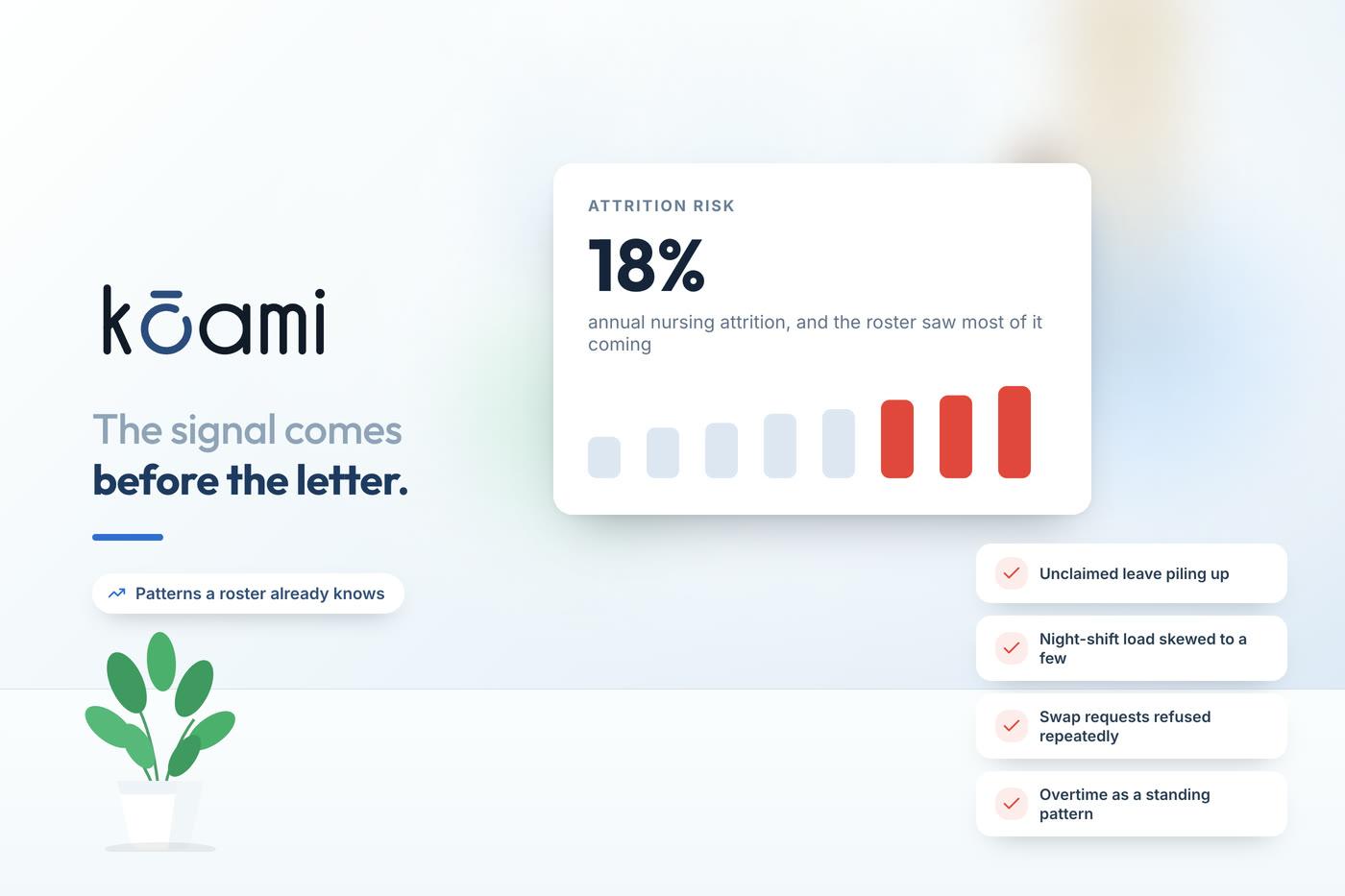
By the time a resignation letter lands on a manager's desk, the decision is usually weeks or months old. The nurse mentally left a while ago; the letter is just the paperwork catching up. This is the uncomfortable truth about attrition in hospitals: the moment you learn about it is the moment it is already too late to do much. Yet the departure was rarely silent. The signals were there in the roster, the attendance record and the overtime ledger, scattered across systems that were never asked to notice them. Reading attrition early is not about predicting individuals with spooky precision. It is about paying attention to patterns you already have the data to see.
Why hospital attrition hurts more
Losing a nurse is not like losing a generic employee. The cost compounds in ways that are specific to clinical work:
- Recruitment and onboarding for a specialised role - ICU, dialysis, OT - takes months, not weeks.
- The remaining team absorbs the gap, which raises their workload and their own attrition risk.
- Institutional knowledge walks out: the nurse who knew the ward's rhythms, the difficult families, the quirks of the equipment.
- Agency and overtime spend rises to plug the hole, so the departure costs money long before the replacement arrives.
Because the cost is so high and the replacement so slow, even a few weeks of early warning is worth a great deal. It is the difference between a managed transition and a scramble.
The signals are already in your systems
The data that predicts disengagement is not exotic. It is the operational exhaust a hospital already generates every day, sitting in the HRMS and the roster. The problem is that no single screen puts it together. Some of the more reliable signals:
- A sustained rise in unplanned leave or late check-ins from someone previously reliable.
- Overtime that has been climbing for months, a sign of a person being quietly overloaded.
- A drop in shift-swap participation, or a pattern of always offloading shifts and never picking any up.
- Repeatedly being rostered into the unpopular slots that others avoid.
- Leave balances hoarded and untaken, then a sudden burst of usage.
Attrition rarely announces itself. It leaks, one changed habit at a time, through data you are already collecting.
None of these is proof on its own. A nurse taking more leave might simply have a sick parent. But a cluster of these shifts, moving together over a quarter, is a pattern worth a conversation.
Patterns, not verdicts
It is worth being clear about what this kind of analysis should and should not do. The aim is not to hand a manager a ranked list of "flight risks" and invite them to treat people as suspects. That is both ethically corrosive and operationally counterproductive; staff who sense they are being scored will disengage faster, not slower. The aim is to surface changes in pattern that prompt a human check-in.
In the Kōami HRMS, the useful framing is a shift in a person's own baseline rather than a comparison against colleagues. Someone whose overtime has doubled and whose swap participation has fallen is not a data point to be flagged and filed. They are a colleague who may be quietly burning out, and the right response is a manager asking how they are doing - not a spreadsheet deciding their fate. The technology's job is to make sure that conversation happens before the letter, not after.
Framing the signal as a change in someone's own pattern also protects against the unfairness of comparing very different people. A nurse who has always worked a lot of overtime is not the story; a nurse whose overtime has suddenly climbed is. Watching each person against their own history keeps the focus on what changed rather than on who happens to look busy, and that distinction is what makes the resulting conversation feel supportive instead of accusatory.
Fix the causes the data reveals
Early signals are only useful if they lead somewhere. Often the same data that flags an individual also reveals a structural problem worth fixing:
- If overtime is concentrated on a few names, the roster is leaning on your best people until they break.
- If certain units generate most of the unpopular-shift complaints, the differential or the rota design needs attention.
- If leave is chronically unusable because cover never exists, the staffing model is the problem, not the person.
- If swap participation is collapsing across a team, morale is sliding for reasons no individual conversation will fix.
Treating attrition signals purely as an individual matter misses the point. Frequently the data is telling you something about how the ward is run, and the highest-leverage response is to change the system rather than to counsel one nurse.
Turn the signal into a habit
For this to work it cannot be a heroic quarterly analysis that one motivated manager runs and then abandons. It has to become routine: a regular look at the trends, a low-key check-in when a baseline shifts, and a willingness to act on what the aggregate patterns say about the roster itself. The hospitals that retain nurses are not the ones with the cleverest prediction model. They are the ones that notice a good nurse being quietly ground down and do something while there is still time.
Retention is won in the weeks before the resignation, not in the counter-offer after it. The data to see it coming is already flowing through your rosters and attendance logs. The only question is whether anyone is reading it in time - and whether, when the pattern shows up, the response is a genuine conversation and a fairer roster rather than a flag in a file.
Follow Kōami on LinkedIn
Get the next guide on hospital operations, software and compliance in your feed, as soon as it is published.