Cloud or On-Premise HMS in Nepal: A Hospital Decision Guide
Published
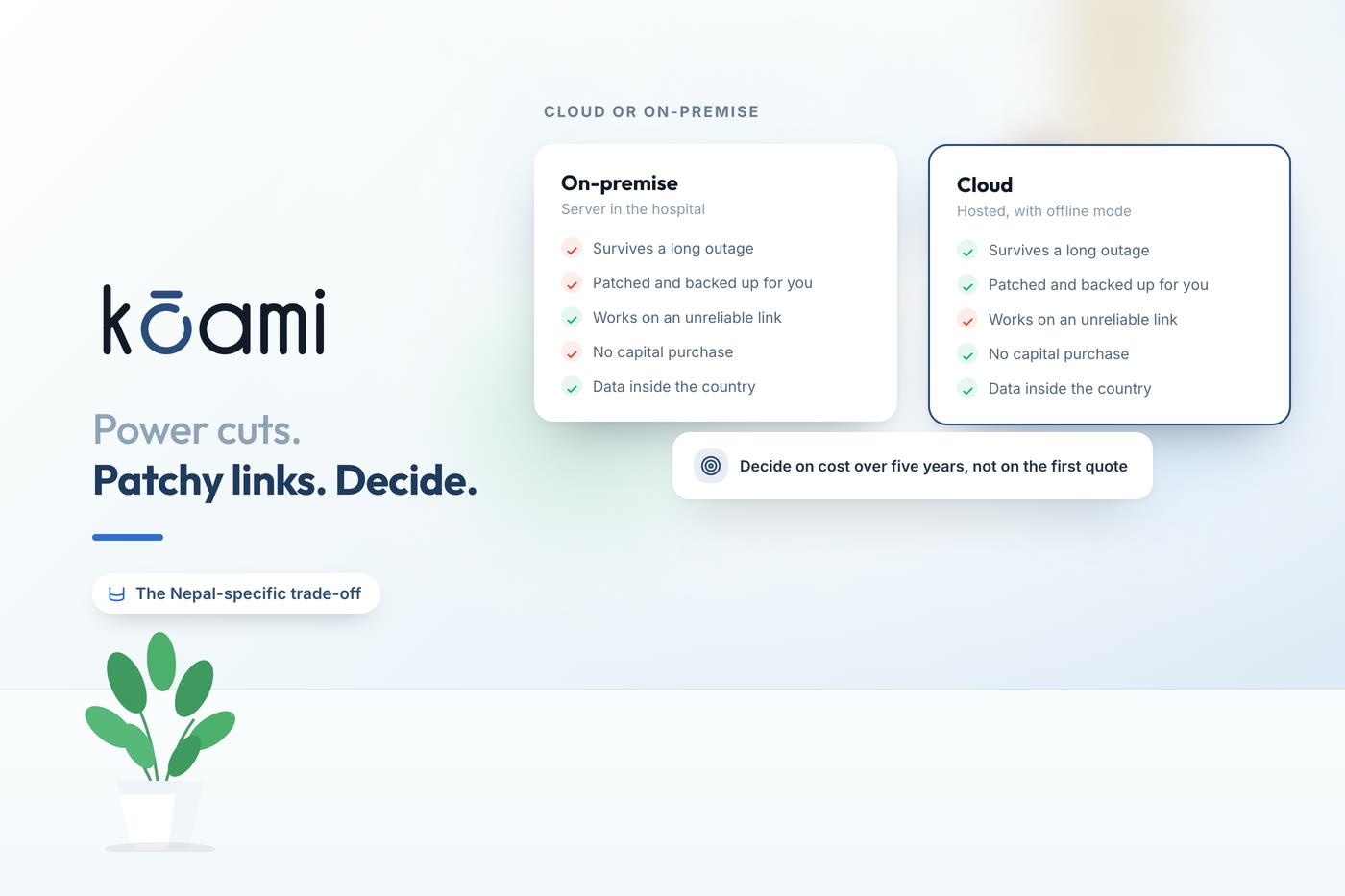
The cloud-versus-on-premise decision for a Nepal hospital is not modern against old. It is a choice about who operates the infrastructure, how the hospital works through a network failure, how quickly it can recover from a serious incident and what the full five-year commitment costs.
Both models can be secure and reliable. Both can fail badly. The useful comparison replaces slogans with dates, measurements and named owners.
When does cloud HMS make sense in Nepal?
Cloud is compelling when the hospital wants predictable access without running a server room.
The provider handles infrastructure patching, redundancy and platform backups; upgrades reach all sites together; a hospital group can use one patient and stock identity across Kathmandu and satellite locations; recovery does not depend on equipment in the same building as the incident.
Cloud still requires the hospital to manage user accounts, roles, endpoint devices, local networks and downtime. It also requires diverse connectivity. Two internet contracts are not true redundancy if both use the same last-mile path, power source or upstream dependency.
When is on-premise defensible?
When connectivity is genuinely limiting and the hospital has the capacity to operate infrastructure as a clinical service.
That means named staff, monitoring, patch schedules, secure remote support, off-site backups, tested restores, spare parts, power and cooling. Recent hardware already owned by the facility can change the economics. Local analyser and device connections may also be simpler.
Physical possession is not security by itself. An unpatched server with shared administrator credentials and an untested backup is less controlled than a well-run cloud service, even if it sits behind a locked door.
What should happen when connectivity fails?
The hospital should follow a rehearsed continuity procedure with safe reconciliation.
Identify the clinical minimum for registration, emergency care, medication, orders, results and billing. Define temporary identifiers, paper or local fallback forms, who declares downtime, how duplicates are prevented, how urgent results are communicated and who enters and checks the backlog later.
Test the procedure on a normal shift before an outage tests it at 2 a.m. Measure recovery point and recovery time: how much data could be lost, and how long until safe service is restored? “Offline capable” needs a precise scope; ask which screens, data and devices work, and how conflicts resolve.
How should security and recovery be compared?
Ask each option for evidence against the same controls.
- Individual accounts, MFA for privileged access and role review
- Encryption in transit and at rest
- Logging, monitoring, alerting and incident response
- Patch and vulnerability management
- Backup frequency, immutability and geographic separation
- Restore test date, result and measured recovery time
- Sub-processors, remote-access controls and breach notification
- Data export, retention and secure deletion at exit
The restore test is decisive. A backup nobody has restored is a belief, not a recovery capability.
How should five-year cost be calculated?
Include every resource required to keep the service safe and available.
Cloud cost includes subscription, storage, interfaces, support, connectivity and escalation. On-premise includes hardware, database and operating licences, power, cooling, monitoring, backup, off-site recovery, staff and refresh. Both include devices, training, migration, downtime planning and exit.
Use the same patient volume, sites, storage growth, support hours and interfaces in both cases. The detailed Nepal HMS cost guide provides the wider model.
What is a sensible hybrid approach?
Hybrid can mean cloud application with resilient local networks and documented manual continuity, or selected local services for devices and caching while the authoritative record remains cloud-hosted.
It should not mean two uncontrolled databases that staff reconcile by hand. Define the source of truth, synchronization boundary, conflict rules and security owner. Complexity is justified only when it solves a measured failure mode.
Kōami is cloud-native, so a Nepal proposal should include a connectivity assessment, continuity design and recovery commitments rather than assuming urban connectivity everywhere. Bring network history, site locations and the last outage report to a discovery call; those facts are more useful than a preference stated in the boardroom.
Follow Kōami on LinkedIn
Get the next guide on hospital operations, software and compliance in your feed, as soon as it is published.